Journal of International Oncology ›› 2026, Vol. 53 ›› Issue (11): 671-680.doi: 10.3760/cma.j.cn371439-20260120-00105
• Original Article • Previous Articles Next Articles
Correlation of CDX2 with CD133, CD44 and its role in colorectal cancer
Wang Yunshuai, Wang Huangjian, Wu Huibin, Zhang Hengyang, Xia Tianming( )
Department of General Surgery ,Luoyang Central Hospital (Luoyang Central Hospital Affiliated to Zhengzhou University) Luoyang 471000, China
-
Received:2026-01-20Online:2026-11-08Published:2026-11-05 -
Supported by:Henan Province Science and Technology Key Research and Development Program(232102310131);General Medical and Health Project in Luoyang(2401157B)

Cite this article
Wang Yunshuai, Wang Huangjian, Wu Huibin, Zhang Hengyang, Xia Tianming. Correlation of CDX2 with CD133, CD44 and its role in colorectal cancer[J]. Journal of International Oncology, 2026, 53(11): 671-680.
share this article
"

"
| 临床病理特征 | CDX2高表达 (n=35) | CDX2低表达 (n=37) | χ2值 | P值 | CD133、CD44 双高表达(n=23) | 非CD133、CD44 双高表达(n=49) | χ2值 | P值 | |
|---|---|---|---|---|---|---|---|---|---|
| 性别 | |||||||||
| 男 | 19(54.29) | 21(56.76) | 0.04 | 0.833 | 11(47.83) | 29(59.18) | 0.82 | 0.366 | |
| 女 | 16(45.71) | 16(43.24) | 12(52.17) | 20(40.82) | |||||
| 年龄(岁) | |||||||||
| ≤60 | 21(60.00) | 23(62.16) | 0.04 | 0.851 | 17(73.91) | 27(55.10) | 2.33 | 0.127 | |
| >60 | 14(40.00) | 14(37.84) | 6(26.09) | 22(44.90) | |||||
| 肿瘤部位 | |||||||||
| 结肠 | 19(54.29) | 20(54.05) | <0.01 | 0.984 | 11(47.83) | 28(57.14) | 0.55 | 0.459 | |
| 直肠 | 16(45.71) | 17(45.95) | 12(52.17) | 21(42.86) | |||||
| T分期 | |||||||||
| T1-2 | 15(42.86) | 6(16.22) | 6.18 | 0.013 | 3(13.04) | 18(36.73) | 4.25 | 0.039 | |
| T3-4 | 20(57.14) | 31(83.78) | 20(86.96) | 31(63.27) | |||||
| N分期 | |||||||||
| N0 | 25(71.43) | 15(40.54) | 6.95 | 0.008 | 8(34.78) | 32(65.31) | 5.91 | 0.015 | |
| N1-2 | 10(28.57) | 22(59.46) | 15(65.22) | 17(34.69) | |||||
| M分期 | |||||||||
| M0 | 34(97.14) | 33(89.19) | 0.75 | 0.388 | 19(83.61) | 48(97.96) | 3.58 | 0.059 | |
| M1 | 1(2.86) | 4(10.81) | 4(17.39) | 1(2.04) | |||||
| TNM分期 | |||||||||
| Ⅰ~Ⅱ | 25(71.43) | 17(45.95) | 4.81 | 0.028 | 9(39.13) | 33(67.35) | 5.13 | 0.024 | |
| Ⅲ~Ⅳ | 10(28.57) | 20(54.05) | 14(60.87) | 16(32.65) | |||||
| 肿瘤大小(cm) | |||||||||
| <3 | 22(62.86) | 15(40.54) | 3.59 | 0.058 | 12(52.17) | 25(51.02) | 0.01 | 0.927 | |
| ≥3 | 13(37.14) | 22(59.46) | 11(47.83) | 24(48.98) | |||||
| 分化程度 | |||||||||
| 高-中分化 | 32(91.43) | 32(86.49) | 0.09 | 0.770 | 22(95.65) | 42(85.71) | 0.72 | 0.396 | |
| 低-未分化 | 3(8.57) | 5(13.51) | 1(4.35) | 7(14.29) |
"
| 变量 | 单因素分析 | 多因素分析 | |||
|---|---|---|---|---|---|
| HR值(95%CI) | P值 | HR值(95%CI) | P值 | ||
| 性别(男/女) | 1.45(0.76~2.77) | 0.265 | |||
| 年龄(≤60岁/>60岁) | 0.68(0.35~1.32) | 0.228 | |||
| T分期(T1-2/T3-4) | 0.35(0.18~0.69) | 0.013 | 0.68(0.24~1.99) | 0.485 | |
| N分期(N0/N1-2) | 0.40(0.20~0.79) | 0.004 | 0.64(0.13~3.25) | 0.587 | |
| TNM分期(Ⅰ~Ⅱ/Ⅲ~Ⅳ) | 0.45(0.23~0.88) | 0.011 | 0.85(0.16~4.60) | 0.850 | |
| 肿瘤部位(结肠/直肠) | 1.40(0.73~2.66) | 0.309 | |||
| 肿瘤大小(<3 cm/≥3 cm) | 0.54(0.28~1.04) | 0.055 | |||
| 分化程度(高-中分化/低-未分化) | 0.12(0.03~0.49) | 0.003 | 0.23(0.08~0.63) | 0.004 | |
| CDX2(低表达/高表达) | 4.07(2.09~7.95) | <0.001 | 2.61(1.18~5.77) | 0.018 | |
| CD133(低表达/高表达) | 0.49(0.26~0.94) | 0.042 | 0.49(0.21~1.12) | 0.091 | |
| CD44(低表达/高表达) | 0.42(0.22~0.80) | 0.012 | 0.45(0.20~1.01) | 0.053 | |
"
| 变量 | 单因素分析 | 多因素分析 | |||
|---|---|---|---|---|---|
| HR值(95%CI) | P值 | HR值(95%CI) | P值 | ||
| 年龄(≤60岁/>60岁) | 0.72(0.38~1.36) | 0.288 | |||
| 性别(男/女) | 1.35(0.73~2.49) | 0.342 | |||
| 肿瘤部位(结肠/直肠) | 1.15(0.62~2.13) | 0.648 | |||
| 肿瘤大小(<3 cm/≥3 cm) | 0.63(0.34~1.16) | 0.125 | |||
| 分化程度(高-中分化/低-未分化) | 0.19(0.05~0.72) | 0.014 | 0.32(0.12~0.87) | 0.025 | |
| T分期(T1-2/T3-4) | 0.39(0.20~0.73) | 0.015 | 0.53(0.17~1.65) | 0.273 | |
| N分期(N0/N1-2) | 0.33(0.18~0.64) | <0.001 | 0.25(0.05~1.19) | 0.082 | |
| TNM分期(Ⅰ~Ⅱ/Ⅲ~Ⅳ) | 0.45(0.23~0.85) | 0.007 | 0.47(0.09~2.39) | 0.364 | |
| CDX2(低表达/高表达) | 4.48(2.38~8.41) | <0.001 | 2.69(1.23~5.89) | 0.014 | |
| CD133(低表达/高表达) | 0.44(0.24~0.82) | 0.016 | 0.55(0.25~1.22) | 0.142 | |
| CD44(低表达/高表达) | 0.50(0.27~0.93) | 0.037 | 0.60(0.29~1.24) | 0.165 | |
"
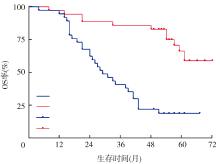
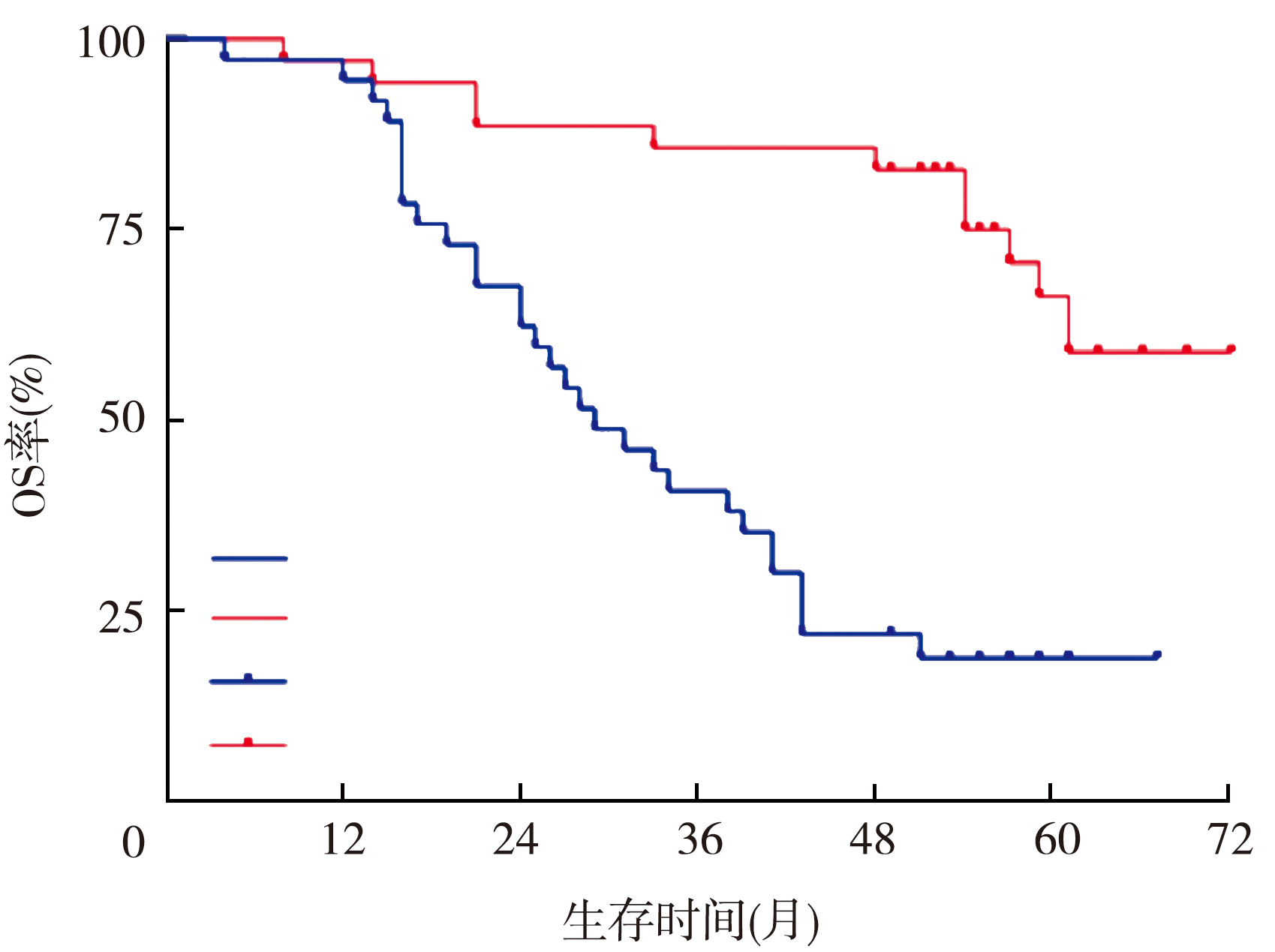
"
"
| 指标 | CDX2 | φ值 | χ2值 | P值 | |
|---|---|---|---|---|---|
| 低表达 | 高表达 | ||||
| CD133 | |||||
| 低表达 | 9 | 20 | -0.33 | 8.05 | 0.005 |
| 高表达 | 28 | 15 | |||
| CD44 | |||||
| 低表达 | 10 | 20 | -0.31 | 6.71 | 0.010 |
| 高表达 | 27 | 15 | |||
| CD133联合CD44 | |||||
| 非双高表达 | 17 | 32 | -0.49 | 17.12 | <0.001 |
| 双高表达 | 20 | 3 | |||
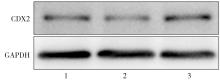
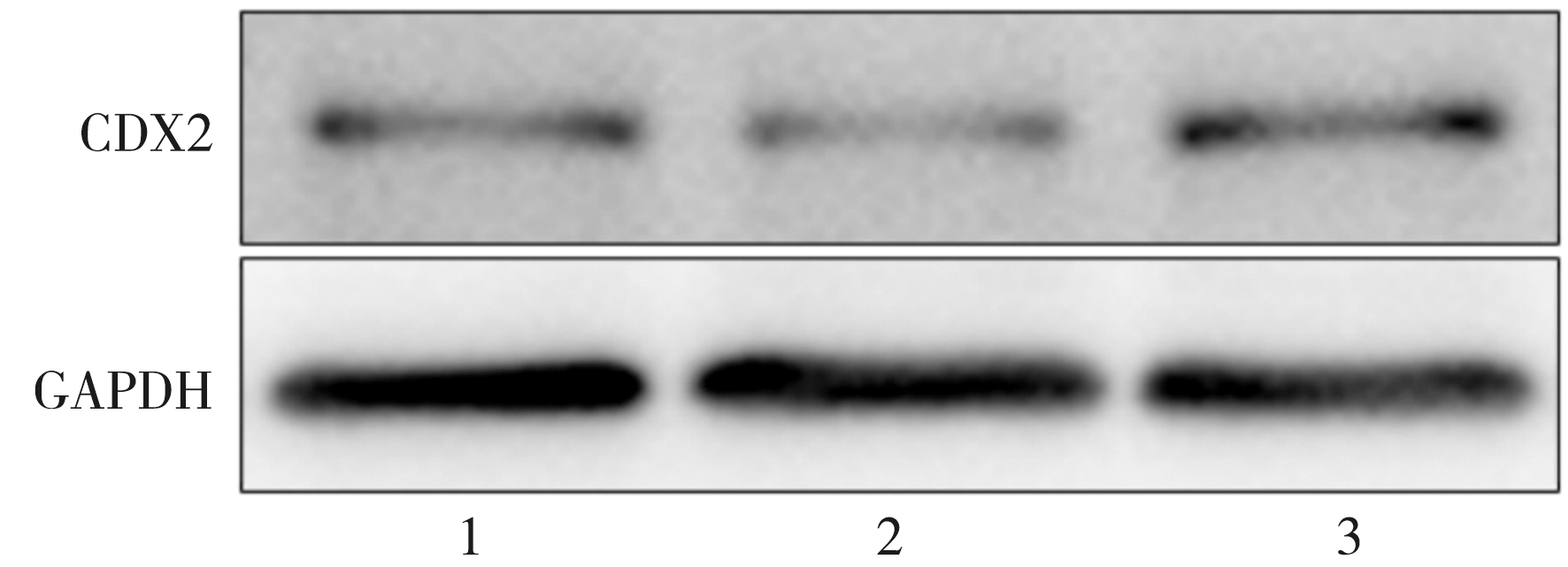
"
"
| 组别 | CD133 | CD44 |
|---|---|---|
| 空载对照组 | 0.60±0.05 | 0.50±0.03 |
| CDX2沉默组 | 0.93±0.05a | 0.77±0.08a |
| CDX2过表达组 | 0.42±0.06ab | 0.35±0.03ab |
| F值 | 63.88 | 52.90 |
| P值 | <0.001 | <0.001 |
"
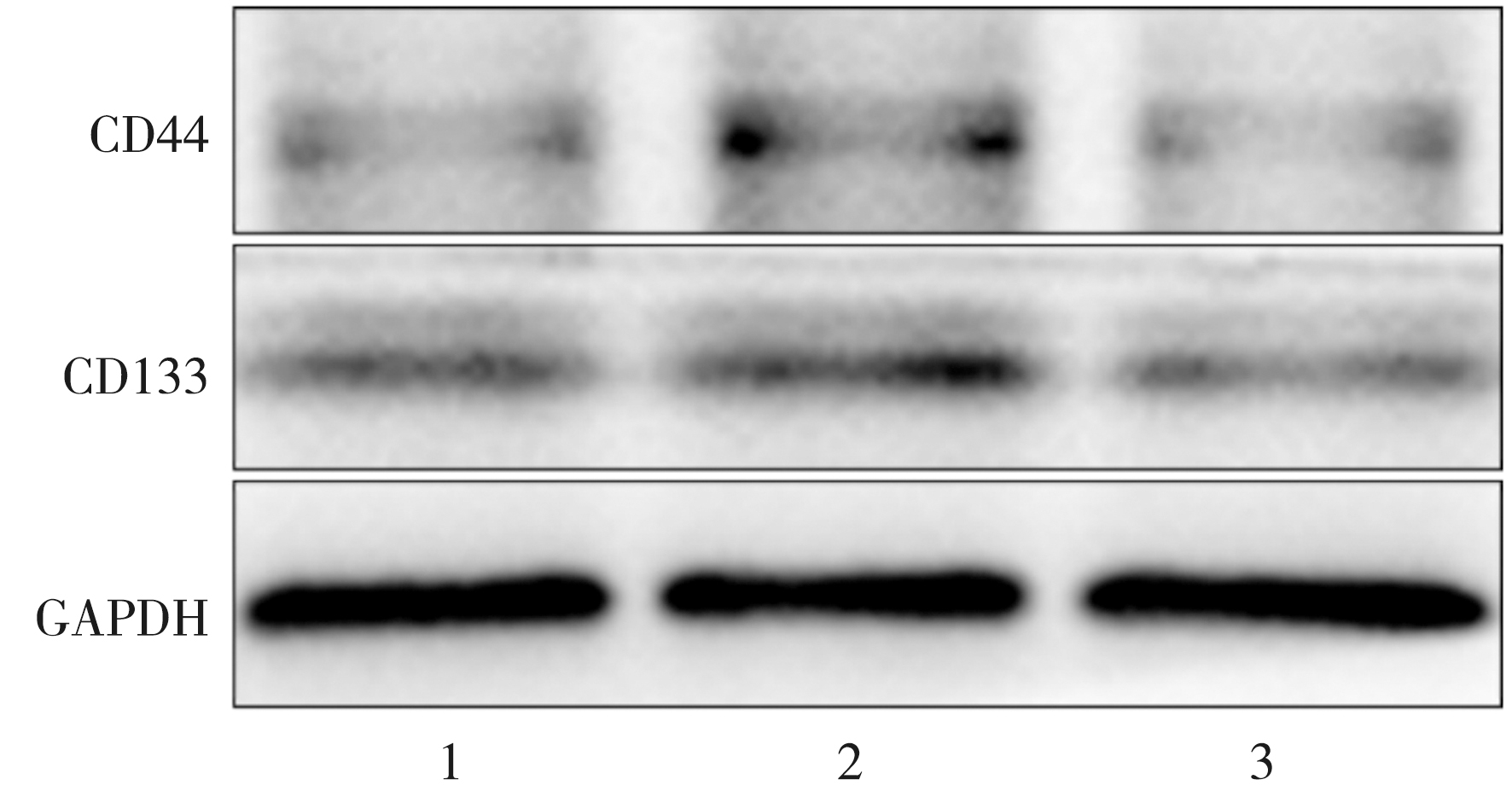
"
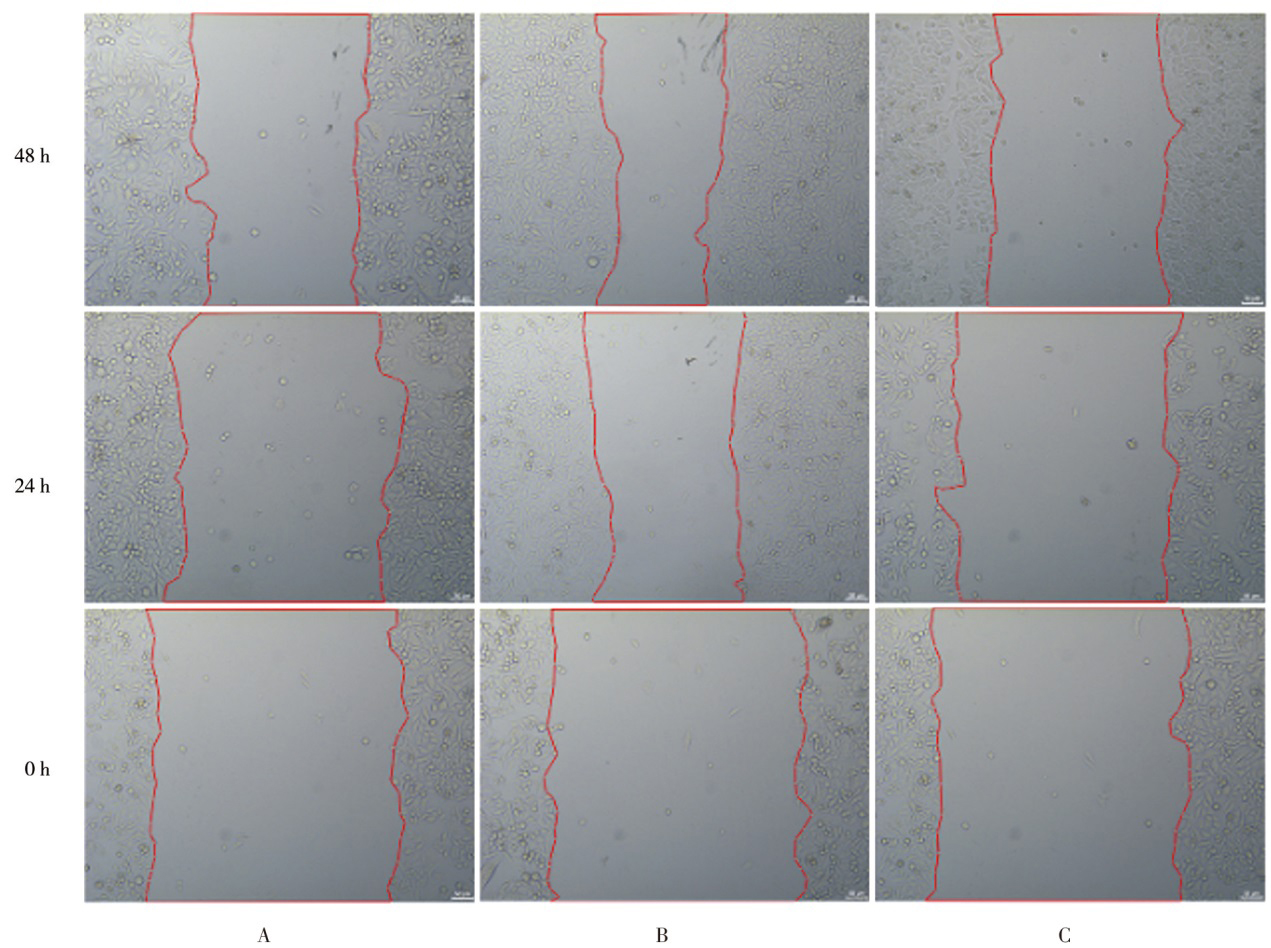
| 组别 | 细胞克隆形成数(个) | 细胞迁移率 | 侵袭细胞数(个) |
|---|---|---|---|
| 空载对照组 | 86.67±10.69 | 0.30±0.02 | 150.33±16.65 |
| CDX2沉默组 | 206.00±17.52a | 0.51±0.03a | 312.67±28.29a |
| CDX2过表达组 | 44.33±6.51ab | 0.22±0.03ab | 65.67±12.22ab |
| F值 | 136.42 | 82.21 | 115.56 |
| P值 | <0.001 | <0.001 | <0.001 |
"
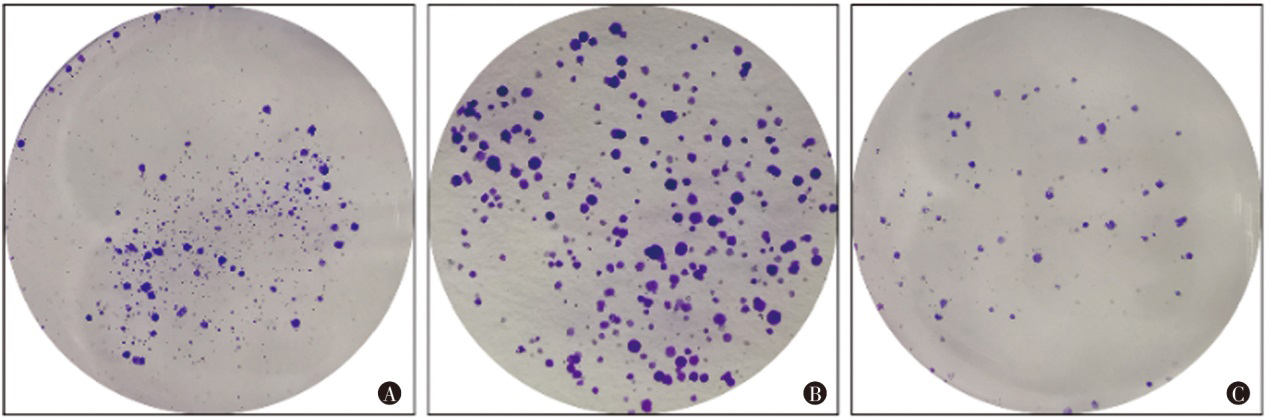
"
"
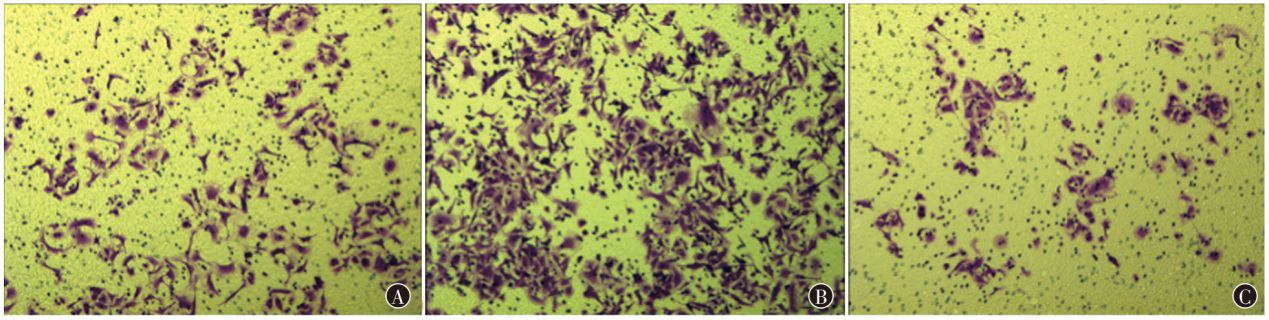
| [1] |
Dekker E, Tanis PJ, Vleugels JLA, et al. Colorectal cancer[J]. Lancet, 2019, 394(10207): 1467-1480. DOI: 10.1016/S0140-6736(19)32319-0.
pmid: 31631858 |
| [2] | Poturnajova M, Furielova T, Balintova S, et al. Molecular features and gene expression signature of metastatic colorectal cancer[J]. Oncol Rep, 2021, 45(4): 10. DOI: 10.3892/or.2021.7961. |
| [3] | Ahmad R, Singh JK, Wunnava A, et al. Emerging trends in colorectal cancer: dysregulated signaling pathways[J]. Int J Mol Med, 2021, 47(3): 14. DOI: 10.3892/ijmm.2021.4847. |
| [4] | Moskaluk CA, Zhang H, Powell SM, et al. Cdx2 protein expression in normal and malignant human tissues: an immunohistochemical survey using tissue microarrays[J]. Mod Pathol, 2003, 16(9): 913-919. DOI: 10.1097/01.MP.0000086073.92773.55. |
| [5] |
Asgari-Karchekani S, Karimian M, Mazoochi T, et al. CDX2 protein expression in colorectal cancer and its correlation with clinical and pathological characteristics, prognosis, and survival rate of patients[J]. J Gastrointest Cancer, 2020, 51(3): 844-849. DOI: 10.1007/s12029-019-00314-w.
pmid: 31630373 |
| [6] | Yu JH, Li S, Xu ZS, et al. CDX2 inhibits epithelial-mesenchymal transition in colorectal cancer by modulation of snail expression and β-catenin stabilisation via transactivation of PTEN expression[J]. Br J Cancer, 2021, 124(1): 270-280. DOI: 10.1038/s41416-020-01148-1. |
| [7] | Koide T, Koyanagi-Aoi M, Uehara K, et al. CDX2-induced intestinal metaplasia in human gastric organoids derived from induced pluripotent stem cells[J]. iScience, 2022, 25(5): 104314. DOI: 10.1016/j.isci.2022.104314. |
| [8] |
Ji JF, Yamashita T, Budhu A, et al. Identification of microRNA-181 by genome-wide screening as a critical player in EpCAM-positive hepatic cancer stem cells[J]. Hepatology, 2009, 50(2): 472-480. DOI: 10.1002/hep.22989.
pmid: 19585654 |
| [9] | Dalerba P, Sahoo D, Paik S, et al. CDX2 as a prognostic biomarker in stage Ⅱ and stage Ⅲ colon cancer[J]. N Engl J Med, 2016, 374(3): 211-222. DOI: 10.1056/NEJMoa1506597. |
| [10] | Nikolaos IN, Markus W, Anthony A, et al. Advances in colorectal cancer[J]. Biomed Res Int, 2016, 2016: 7347648. DOI: 10.1155/2016/7347648. |
| [11] | 王勇, 乌新林. 结直肠癌肝转移的相关分子机制[J]. 国际肿瘤学杂志, 2025, 52(6): 388-391. DOI: 10.3760/cma.j.cn371439-20250225-00066. |
| [12] |
Shigematsu Y, Inamura K, Yamamoto N, et al. Impact of CDX2 expression status on the survival of patients after curative resection for colorectal cancer liver metastasis[J]. BMC Cancer, 2018, 18(1): 980. DOI: 10.1186/s12885-018-4902-8.
pmid: 30326864 |
| [13] |
Bruun J, Sveen A, Barros R, et al. Prognostic, predictive, and pharmacogenomic assessments of CDX2 refine stratification of colorectal cancer[J]. Mol Oncol, 2018, 12(9): 1639-1655. DOI: 10.1002/1878-0261.
pmid: 29900672 |
| [14] | Hansen TF, Kjaer-Frifeldt S, Eriksen AC, et al. Prognostic impact of CDX2 in stage Ⅱ colon cancer: results from two nationwide cohorts[J]. Br J Cancer, 2018, 119(11): 1367-1373. DOI: 10.1038/s41416-018-0285-5. |
| [15] |
Graule J, Uth K, Fischer E, et al. CDX2 in colorectal cancer is an independent prognostic factor and regulated by promoter methylation and histone deacetylation in tumors of the serrated pathway[J]. Clin Epigenetics, 2018, 10(1): 120. DOI: 10.1186/s13148-018-0548-2.
pmid: 30257705 |
| [16] | Wei YC, Wei C, Kate W, et al. The prognostic and predictive utility of CDX2 in colorectal cancer[J]. Int J Mol Sci, 2024, 25(16): 8673. DOI: 10.3390/ijms25168673. |
| [17] |
Zahran AM, Rayan A, Fakhry H, et al. Pretreatment detection of circulating and tissue CD133+ CD44+ cancer stem cells as a prognostic factor affecting the outcomes in Egyptian patients with colorectal cancer[J]. Cancer Manag Res, 2019, 11: 1237-1248. DOI: 10.2147/CMAR.S189653.
pmid: 30799951 |
| [18] | Choi D, Lee HW, Hur KY, et al. Cancer stem cell markers CD133 and CD24 correlate with invasiveness and differentiation in colorectal adenocarcinoma[J]. World J Gastroenterol, 2009, 15(18): 2258-2264. DOI: 10.3748/wjg.15.2258. |
| [19] | Chen KL, Pan F, Jiang H, et al. Highly enriched CD133(+)CD44(+) stem-like cells with CD133(+)CD44(high) metastatic subset in HCT116 colon cancer cells[J]. Clin Exp Metastasis, 2011, 28(8): 751-763. DOI: 10.1007/s10585-011-9407-7. |
| [20] | Basu S, Haase G, Ben-Ze'ev A. Wnt signaling in cancer stem cells and colon cancer metastasis[J]. F1000Res, 2016, 5: F1000 Faculty Rev-699. DOI: 10.12688/f1000research.7579.1. |
| [21] |
Negri F, Bozzetti C, Pedrazzi G, et al. High levels of notch intracellular cleaved domain are associated with stemness and reduced bevacizumab efficacy in patients with advanced colon cancer[J]. Oncol Rep, 2019, 42(6): 2750-2758. DOI: 10.3892/or.2019.7349.
pmid: 31578584 |
| [22] | Skoda AM, Simovic D, Karin V, et al. The role of the hedgehog signaling pathway in cancer: a comprehensive review[J]. Bosn J Basic Med Sci, 2018, 18(1): 8-20. DOI: 10.17305/bjbms.2018.2756. |
| [23] | Wang YS, Kou Y, Zhu RT, et al. CDX2 as a predictive biomarker involved in immunotherapy response suppresses metastasis through EMT in colorectal cancer[J]. Dis Markers, 2022, 2022: 9025668. DOI: 10.1155/2022/9025668. |
| [24] |
Ye X, Weinberg RA. Epithelial-mesenchymal plasticity: a central regulator of cancer progression[J]. Trends Cell Biol, 2015, 25(11): 675-686. DOI: 10.1016/j.tcb.2015.07.012.
pmid: 26437589 |
| [1] | Shen Cailu, Wu Ruirong, Wu You, Ge Xiaosong. Construction of a postoperative survival prediction model for elderly patients with colorectal cancer based on machine learning algorithms [J]. Journal of International Oncology, 2026, 53(8): 476-484. |
| [2] | Wang Yong, Zhao Haiyan, Zhang Mingming, Wu Xinlin. Relationship between intestinal microecology and the occurrence and progression of colorectal cancer [J]. Journal of International Oncology, 2026, 53(6): 370-375. |
| [3] | Hai Yanan, Bao Wenfang, Shentu Hangxiao, Chen Jingde. Mechanism of immunotherapy resistance and the progress of post-resistance treatment for dMMR/MSI-H metastatic colorectal cancer [J]. Journal of International Oncology, 2025, 52(9): 598-602. |
| [4] | Chen Jun, Tang Dandan, Zhou Yuxin, Tan Yuting, Li Honglan, Xu Qun, Xiang Yongbing. Time trend analysis of the disease burden of colorectal cancer among young and middle-aged adults in China from 1990 to 2021 [J]. Journal of International Oncology, 2025, 52(8): 508-516. |
| [5] | Wu Xin, Ren Haipeng. Research progress of KRASG12C inhibitors in the treatment of advanced colorectal cancer [J]. Journal of International Oncology, 2025, 52(8): 538-542. |
| [6] | Wang Yong, Wu Xinlin. Related molecular mechanisms of liver metastasis from colorectal cancer [J]. Journal of International Oncology, 2025, 52(6): 388-391. |
| [7] | Guo Haiyang, Hong Yonggang, Hao Liqiang. Role and research progress of ferroptosis in colorectal cancer [J]. Journal of International Oncology, 2025, 52(5): 319-324. |
| [8] | Wang Yi, Wang Qiangli, Zhang Jia, Yang Yijin, Wang Sheng. Relationship between the expression of SUCNR1 and YBX1 in tissues of patients with colorectal cancer liver metastases and their clinicopathological characteristics and prognosis [J]. Journal of International Oncology, 2025, 52(3): 152-157. |
| [9] | Wen Bobin, Gan Jie, Wang Zheng. An experimental study on PD98059 reversing multiple drug resistance of human glioma stem cells by MEK/ERK signaling pathways [J]. Journal of International Oncology, 2025, 52(12): 737-744. |
| [10] | Zhan Haifeng, Tan Zixuan, Wang Wenxue, Geng Jiawei. Research progress of circadian genes in the occurrence, development and chronotherapy of colorectal cancer [J]. Journal of International Oncology, 2025, 52(1): 60-64. |
| [11] | Wei Wei, Cai Zhaoying, Qian Yayun. Effect of Marsdenia tenacissima combined with XELOX solution on disulfide apoptosis in human colorectal cancer HCT116 cells [J]. Journal of International Oncology, 2024, 51(9): 545-555. |
| [12] | Zhan Haifeng, Wang Wenxue, Geng Jiawei. Research progress in precise molecular targeted therapy for advanced colorectal cancer [J]. Journal of International Oncology, 2024, 51(9): 601-605. |
| [13] | Li Zhiwei, Zhai Chunbao. Research progress on the anti-cancer effect of traditional Chinese medicine polyphenols on colorectal cancer [J]. Journal of International Oncology, 2024, 51(8): 526-531. |
| [14] | Zhang Rui, Chu Yanliu. Research progress of colorectal cancer risk assessment models based on FIT and gut microbiota [J]. Journal of International Oncology, 2024, 51(6): 370-375. |
| [15] | Gao Fan, Wang Ping, Du Chao, Chu Yanliu. Research progress on intestinal flora and non-surgical treatment of the colorectal cancer [J]. Journal of International Oncology, 2024, 51(6): 376-381. |
| Viewed | ||||||
|
Full text |
|
|||||
|
Abstract |
|
|||||