Journal of International Oncology ›› 2026, Vol. 53 ›› Issue (4): 201-206.doi: 10.3760/cma.j.cn371439-20251015-00033
• Original Article • Previous Articles Next Articles
Efficacy of different treatment modalities in the real-world setting for advanced EGFR-mutant NSCLC patients after progression on third-generation EGFR-TKI treatment
Yang Junling1, Zhang Guifang2( ), Mu Zhuqing2, Huang Puchao2, Ma Xiaoyan2, Liang Jiaxin2
- 1
Fourth Clinical College of Henan Medical University Xinxiang 453000, China
2Second Department of Oncology ,Xinxiang Central Hospital of Henan Province Xinxiang 453000, China
-
Received:2025-10-15Online:2026-04-08Published:2026-04-01 -
Contact:Zhang Guifang E-mail:xxchzhangguifang@126.com

Cite this article
Yang Junling, Zhang Guifang, Mu Zhuqing, Huang Puchao, Ma Xiaoyan, Liang Jiaxin. Efficacy of different treatment modalities in the real-world setting for advanced EGFR-mutant NSCLC patients after progression on third-generation EGFR-TKI treatment[J]. Journal of International Oncology, 2026, 53(4): 201-206.
share this article

"
| 治疗方案 | 具体药物 |
|---|---|
| 第三代EGFR-TKI+抗血管生成药物 | 奥希替尼/阿美替尼+贝伐珠单抗/安罗替尼 |
| 第三代EGFR-TKI+化疗 | 奥希替尼+培美曲塞±铂类(卡铂/顺铂);奥希替尼+紫杉醇类(紫杉醇/多西他赛)±铂类(卡铂) |
| 第三代EGFR-TKI+化疗+抗血管生成药物 | 奥希替尼/阿美替尼+贝伐珠单抗+培美曲塞±铂类(卡铂/奈达铂);奥希替尼/阿美替尼+贝伐珠单抗+铂类(奈达铂/卡铂)±长春碱类(长春瑞滨);阿美替尼/奥希替尼+贝伐珠单抗+紫杉醇类(紫杉醇/多西他赛)+铂类(奈达铂/奥沙利铂) |
| 化疗 | 培美曲塞±铂类(卡铂/顺铂/奈达铂/洛铂);铂类(顺铂)±紫杉醇类(紫杉醇);紫杉醇类(紫杉醇) |
| 化疗+抗血管生成药物 | 培美曲塞±铂类(卡铂/奈达铂)+贝伐珠单抗;紫杉醇类(紫杉醇/多西他赛)±铂类(奈达铂)+贝伐珠单抗;长春碱类(长春瑞滨)+安罗替尼 |
| 化疗+免疫检查点抑制剂 | 替雷利珠单抗+培美曲塞+铂类(奈达铂);信迪利单抗+氟尿嘧啶类(吉西他滨) |
| 化疗+免疫检查点抑制剂+抗血管生成药物 | 信迪利单抗+培美曲塞±铂类(洛铂)+抗血管生成药物(贝伐珠单抗/安罗替尼);信迪利单抗+紫杉醇类(紫杉醇)+安罗替尼 |
"
| 临床特征 | A组(n=44) | B组(n=60) | χ2值 | P值 |
|---|---|---|---|---|
| 性别 | ||||
| 男 | 18(40.91) | 21(35.00) | 0.38 | 0.539 |
| 女 | 26(59.09) | 39(65.00) | ||
| 年龄(岁) | ||||
| <65 | 27(61.36) | 32(53.33) | 0.67 | 0.414 |
| ≥65 | 17(38.64) | 28(46.67) | ||
| 进展状态a | ||||
| 寡进展 | 18(40.91) | 14(23.33) | 3.68 | 0.055 |
| 广泛进展 | 26(59.09) | 46(76.67) | ||
| 局部治疗 | ||||
| 有 | 14(31.82) | 10(16.67) | 3.28 | 0.070 |
| 无 | 30(68.18) | 50(83.33) | ||
| ECOG评分(分) | ||||
| <2 | 28(63.64) | 37(61.67) | 0.04 | 0.838 |
| ≥2 | 16(36.36) | 23(38.33) | ||
| EGFR基因突变亚型 | ||||
| EGFR 19del | 19(43.18) | 33(55.00) | 1.42 | 0.234 |
| EGFR L858R | 25(56.82) | 27(45.00) | ||
| 病理类型 | ||||
| 腺癌 | 44(100) | 57(95.00) | 0.261 | |
| 鳞状细胞癌 | 0(0) | 3(5.00) | ||
| 合并T790M突变 | ||||
| 有 | 19(43.18) | 19(31.67) | 1.45 | 0.228 |
| 无 | 25(56.82) | 41(68.33) | ||
| 合并MET突变 | ||||
| 有 | 2(4.56) | 2(3.33) | >0.999 | |
| 无 | 42(95.44) | 58(96.67) | ||
| 脑转移 | ||||
| 有 | 27(61.36) | 32(53.33) | 0.67 | 0.414 |
| 无 | 17(38.64) | 28(46.67) | ||
| 骨转移 | ||||
| 有 | 29(65.91) | 30(50.00) | 2.62 | 0.106 |
| 无 | 15(34.09) | 30(50.00) | ||
| 肝转移 | ||||
| 有 | 8(18.18) | 12(20.00) | 0.05 | 0.816 |
| 无 | 36(81.82) | 48(80.00) |
"
| 组别 | CR | PR | SD | PD | 客观缓解 | 疾病控制 |
|---|---|---|---|---|---|---|
| A组(n=44) | 1 | 8 | 30 | 5 | 9 | 39 |
| B组(n=60) | 0 | 8 | 40 | 12 | 8 | 48 |
| χ2值 | 0.94 | 1.39 | ||||
| P值 | 0.332 | 0.239 |
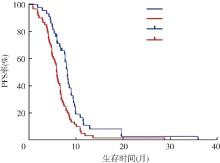
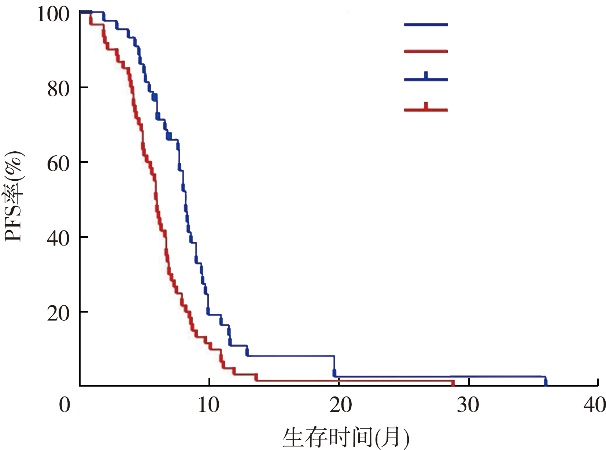
"
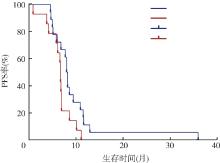
"
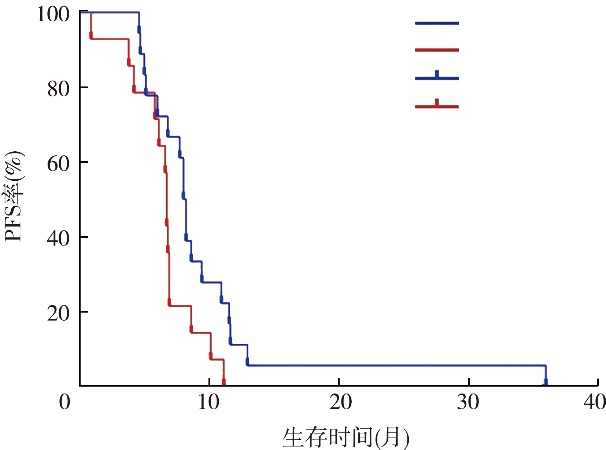
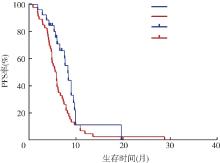
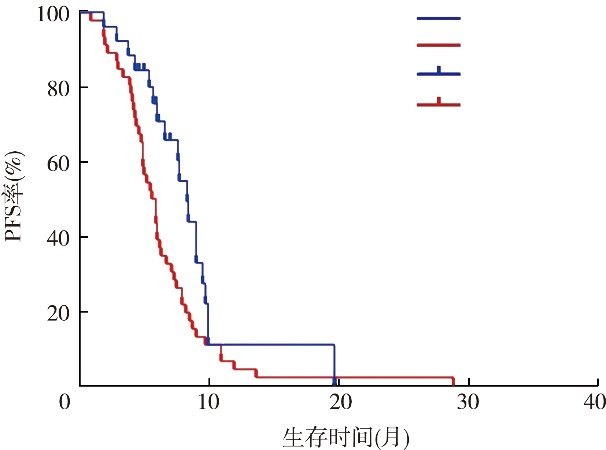
"
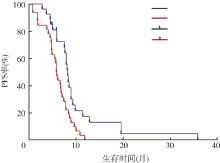
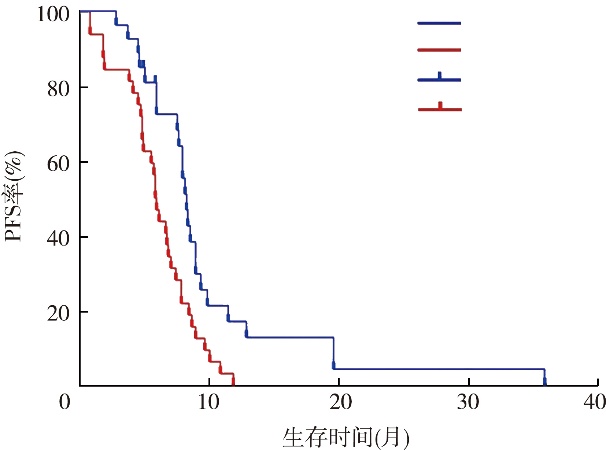
"
"
| 不良反应 | A组(n=44) | B组(n=60) | χ2值 | P值 | 不良反应 | A组(n=44) | B组(n=60) | χ2值 | P值 |
|---|---|---|---|---|---|---|---|---|---|
| 消化道反应 | 20(45.45) | 24(40.00) | 0.31 | 0.578 | 高血压 | 5(11.36) | 5(8.33) | 0.740 | |
| 1~2级 | 18(40.91) | 23(38.33) | 1~2级 | 5(11.36) | 5(8.33) | ||||
| ≥3级 | 2(4.54) | 1(1.67) | ≥3级 | 0(0) | 0(0) | ||||
| 贫血 | 21(47.72) | 25(41.67) | 0.38 | 0.539 | 蛋白尿 | 4(9.09) | 4(6.67) | 0.719 | |
| 1~2级 | 18(40.91) | 21(35.00) | 1~2级 | 4(9.09) | 4(6.67) | ||||
| ≥3级 | 3(6.81) | 4(6.67) | ≥3级 | 0(0) | 0(0) | ||||
| 中性粒细胞减少 | 14(31.82) | 18(30.00) | 0.04 | 0.843 | 肝功能异常 | 7(15.91) | 6(10.00) | 0.81 | 0.368 |
| 1~2级 | 7(15.91) | 10(16.67) | 1~2级 | 7(15.91) | 6(10.00) | ||||
| ≥3级 | 7(15.91) | 8(13.33) | ≥3级 | 0(0) | 0(0) | ||||
| 血小板减少 | 13(29.55) | 10(16.66) | 2.44 | 0.118 | 间质性肺炎 | 3(6.82) | 2(3.33) | 0.648 | |
| 1~2级 | 7(15.91) | 8(13.33) | 1~2级 | 3(6.82) | 2(3.33) | ||||
| ≥3级 | 6(13.64) | 2(3.33) | ≥3级 | 0(0) | 0(0) | ||||
| 皮疹 | 6(13.64) | 7(11.67) | 0.09 | 0.764 | 甲状腺功能减退 | 0(0) | 1(1.67) | >0.999 | |
| 1~2级 | 6(13.64) | 7(11.67) | 1~2级 | 0(0) | 1(1.67) | ||||
| ≥3级 | 0(0) | 0(0) | ≥3级 | 0(0) | 0(0) |
| [1] | Filho AM, Laversanne M, Ferlay J, et al. The GLOBOCAN 2022 cancer estimates: data sources, methods, and a snapshot of the cancer burden worldwide[J]. Int J Cancer, 2025, 156(7): 1336-1346. DOI: 10.1002/ijc.35278. |
| [2] | Oser MG, Niederst MJ, Sequist LV, et al. Transformation from non-small-cell lung cancer to small-cell lung cancer: molecular drivers and cells of origin[J]. Lancet Oncol, 2015, 16(4): e165-e172. DOI: 10.1016/S1470-2045(14)71180-5. |
| [3] | Soo RA, Reungwetwattana T, Perroud HA, et al. Prevalence of EGFR mutations in patients with resected stages Ⅰ to Ⅲ NSCLC: results from the EARLY-EGFR study[J]. J Thorac Oncol, 2024, 19(10): 1449-1459. DOI: 10.1016/j.jtho.2024.06.008. |
| [4] | Lu S, Dong X, Jian H, et al. AENEAS: a randomized phase Ⅲ trial of aumolertinib versus gefitinib as first-line therapy for locally advanced or metastatic non-small-cell lung cancer with EGFR exon 19 deletion or L858R mutations[J]. J Clin Oncol, 2022, 40(27): 3162-3171. DOI: 10.1200/JCO.21.02641. |
| [5] |
Shi YK, Chen GY, Wang X, et al. Furmonertinib (AST2818) versus gefitinib as first-line therapy for Chinese patients with locally advanced or metastatic EGFR mutation-positive non-small-cell lung cancer (FURLONG): a multicentre, double-blind, randomised phase 3 study[J]. Lancet Respir Med, 2022, 10(11): 1019-1028. DOI: 10.1016/S2213-2600(22)00168-0.
pmid: 35662408 |
| [6] | 中国临床肿瘤学会指南工作委员会. 中国临床肿瘤学会(CSCO)原发性肺癌诊疗指南[M]. 北京: 人民卫生出版社, 2017. |
| [7] | 中国临床肿瘤学会指南工作委员会. 中国临床肿瘤学会(CSCO)非小细胞肺癌诊疗指南2025[M]. 北京: 人民卫生出版社, 2025. |
| [8] | Yang JC, Lee DH, Lee JS, et al. Phase Ⅲ KEYNOTE-789 study of pemetrexed and platinum with or without pembrolizumab for tyrosine kinase inhibitor-resistant, EGFR-mutant, metastatic nonsquamous non-small cell lung cancer[J]. J Clin Oncol, 2024, 42(34): 4029-4039. DOI: 10.1200/JCO.23.02747. |
| [9] |
HARMONi-A Study Investigators, Fang WF, Zhao Y, et al. Ivonescimab plus chemotherapy in non-small cell lung cancer with EGFR variant: a randomized clinical trial[J]. JAMA, 2024, 332(7): 561-570. DOI: 10.1001/jama.2024.10613.
pmid: 38820549 |
| [10] |
Lu S, Wu L, Jian H, et al. Sintilimab plus chemotherapy for patients with EGFR-mutated non-squamous non-small-cell lung cancer with disease progression after EGFR tyrosine-kinase inhibitor therapy (ORIENT-31): second interim analysis from a double-blind, randomised, placebo-controlled, phase 3 trial[J]. Lancet Respir Med, 2023, 11(7): 624-636. DOI: 10.1016/S2213-2600(23)00135-2.
pmid: 37156249 |
| [11] | Peled N, Tufman A, Sequist LV, et al. COMPEL: osimertinib plus platinum-based chemotherapy in patients with EGFR-mutated advanced NSCLC and progression on first-line osimertinib[J]. ESMO Open, 2025, 10(10): 105807. DOI: 10.1016/j.esmoop.2025.105807. |
| [12] | Gibson AJW, Dean ML, Litt I, et al. Real-world analysis of post-progression treatment patterns and outcomes for EGFR mutation-positive patients treated with first-line osimertinib[J]. Curr Oncol, 2024, 31(5): 2427-2440. DOI: 10.3390/curroncol31050182. |
| [13] | Robinson ND, Canavan ME, Zhan PL, et al. Treatment patterns and clinical outcomes in patients with EGFR-mutated non-small-cell lung cancer after progression on osimertinib[J]. Clin Lung Cancer, 2025, 26(1): 9-17. DOI: 10.1016/j.cllc.2024.09.006. |
| [14] | Patil T, Gao DX, Watson A, et al. The efficacy of continuing osimertinib with platinum pemetrexed chemotherapy upon progression in patients with metastatic non-small cell lung cancer harboring sensitizing EGFR mutations[J]. Lung Cancer, 2025, 199: 108040. DOI: 10.1016/j.lungcan.2024.108040. |
| [15] | Long JL, Lei SY, Wu ZJ, et al. Efficacy and safety of original EGFR-TKI combined with bevacizumab in advanced lung adeno-carcinoma patients harboring EGFR-mutation experiencing gradual progression after EGFR-TKI treatment: a single-arm study[J]. Ann Transl Med, 2022, 10(24): 1334. DOI: 10.21037/atm-22-6101. |
| [16] |
White MN, Piotrowska Z, Stirling K, et al. Combining osimertinib with chemotherapy in EGFR-mutant NSCLC at progression[J]. Clin Lung Cancer, 2021, 22(3): 201-209. DOI: 10.1016/j.cllc.2021.01.010.
pmid: 33610453 |
| [17] |
Wong WKY, Mok KKS, Tsui GPC, et al. CNS outcomes of osimertinib plus chemotherapy in patients with EGFR mutation positive lung cancer beyond osimertinib progression[J]. Clin Lung Cancer, 2025, 26(3): e214-e222. DOI: 10.1016/j.cllc.2025.01.007.
pmid: 39933981 |
| Viewed | ||||||
|
Full text |
|
|||||
|
Abstract |
|
|||||