Journal of International Oncology ›› 2026, Vol. 53 ›› Issue (10): 591-599.doi: 10.3760/cma.j.cn371439-20251223-00094
• Original Article • Previous Articles Next Articles
Predictive value of F-PLR score and LMR for the prognosis of patients with esophageal cancer receiving neoadjuvant immunotherapy combined with chemotherapy
Cui Xiaohui, Miao Yanan, Cao Ranhua( )
)
Department of Oncology ,Affiliated Hospital of Inner Mongolia Medical University Hohhot 010050, China
-
Received:2025-12-23Online:2026-10-08Published:2026-10-10 -
Contact:Cao Ranhua E-mail:15034792565@163.com

Cite this article
Cui Xiaohui, Miao Yanan, Cao Ranhua. Predictive value of F-PLR score and LMR for the prognosis of patients with esophageal cancer receiving neoadjuvant immunotherapy combined with chemotherapy[J]. Journal of International Oncology, 2026, 53(10): 591-599.
share this article

"
| 临床病理特征 | 结果 |
|---|---|
| 性别 | |
| 男 | 101(89.4) |
| 女 | 12(10.6) |
| 年龄(岁) | |
| <65 | 59(52.2) |
| ≥65 | 54(47.8) |
| 吸烟 | |
| 是 | 48(42.5) |
| 否 | 65(57.5) |
| 恶性肿瘤家族史 | |
| 有 | 10(8.8) |
| 无 | 103(91.2) |
| 肿瘤部位 | |
| 胸上段/中段 | 35(31.0) |
| 胸下段 | 78(69.0) |
| 分化程度 | |
| 高-中分化 | 83(73.5) |
| 低分化 | 30(26.5) |
| 肿瘤长度(cm) | |
| <3.5 | 71(62.8) |
| ≥3.5 | 42(37.2) |
| 临床分期 | |
| Ⅰ~Ⅱ | 73(64.6) |
| Ⅲ~ⅣA | 40(35.4) |
| T分期 | |
| T1-2 | 54(47.8) |
| T3-4 | 59(52.2) |
| N分期 | |
| N0-1 | 103(91.2) |
| N2-3 | 10(8.8) |
"
"
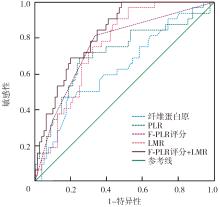
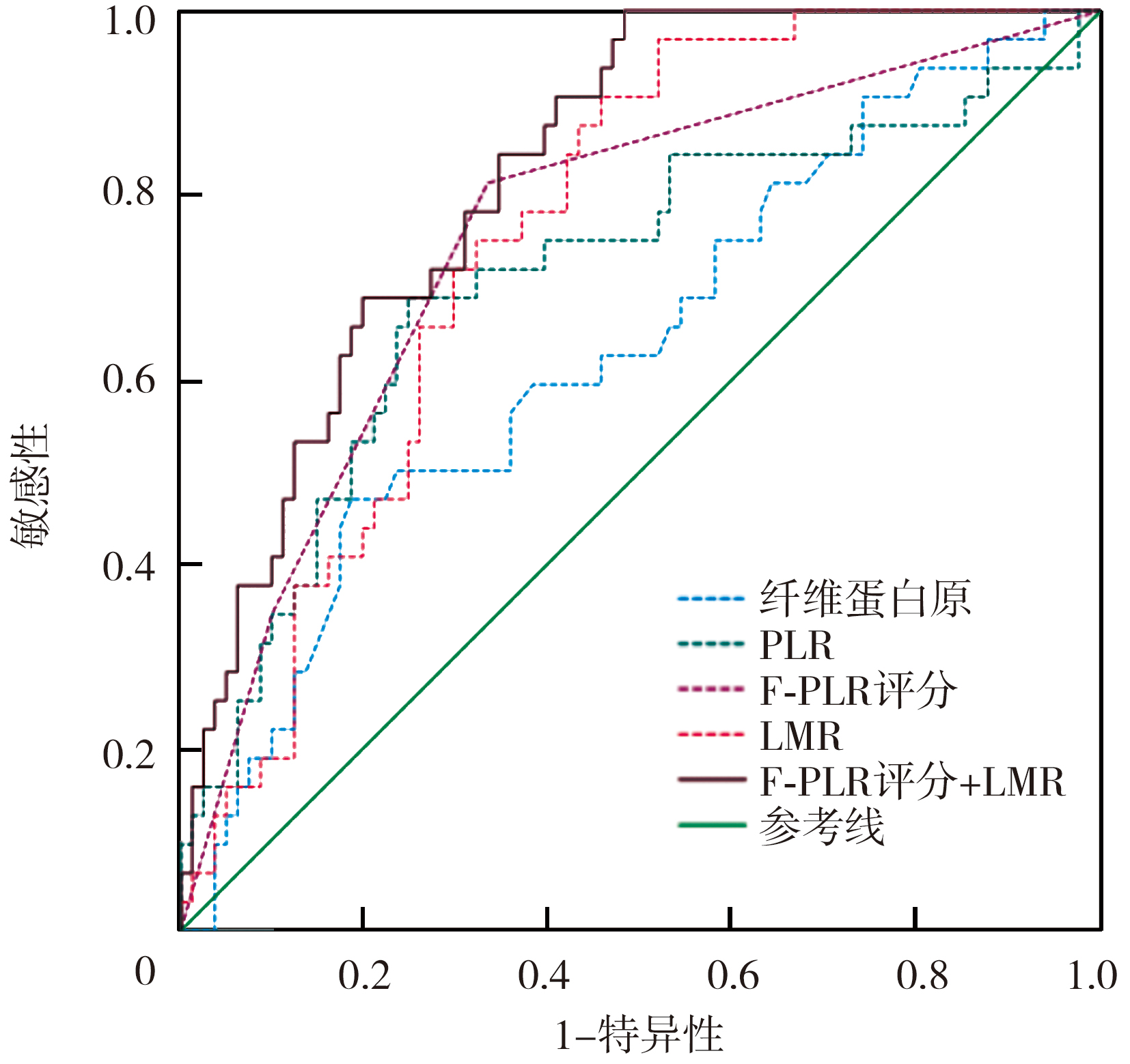
| 变量 | 最佳截断值 | 敏感性 | 特异性 | AUC |
|---|---|---|---|---|
| 纤维蛋白原 | 3.71 g/L | 0.469 | 0.815 | 0.635 |
| PLR | 129.19 | 0.688 | 0.753 | 0.710 |
| LMR | 4.36 | 0.031 | 0.519 | 0.757 |
| F-PLR评分 | 0.813 | 0.667 | 0.757 | |
| LMR联合F-PLR评分 | 1.000 | 0.519 | 0.825 |
"
| 临床病理 特征 | F-PLR评分 | LMR | ||||||||
|---|---|---|---|---|---|---|---|---|---|---|
| 0分 (n=60) | 1分 (n=34) | 2分 (n=19) | χ2值 | P值 | 低LMR组 (n=73) | 高LMR组 (n=40) | χ2值 | P值 | ||
| 性别 | ||||||||||
| 男 | 54 | 30 | 17 | 0.24 | >0.999 | 67 | 34 | 0.64 | 0.424 | |
| 女 | 6 | 4 | 2 | 6 | 6 | |||||
| 年龄(岁) | ||||||||||
| <65 | 31 | 17 | 11 | 0.32 | 0.852 | 36 | 23 | 0.69 | 0.405 | |
| ≥65 | 29 | 17 | 8 | 37 | 17 | |||||
| 吸烟 | ||||||||||
| 否 | 29 | 23 | 13 | 4.42 | 0.110 | 48 | 17 | 5.72 | 0.017 | |
| 是 | 31 | 11 | 6 | 25 | 23 | |||||
| 恶性肿瘤家族史 | ||||||||||
| 否 | 54 | 30 | 19 | 2.09 | 0.400 | 65 | 38 | 0.52 | 0.471 | |
| 是 | 6 | 4 | 0 | 8 | 2 | |||||
| 肿瘤部位 | ||||||||||
| 胸上段/中段 | 19 | 13 | 3 | 2.90 | 0.234 | 24 | 11 | 0.35 | 0.554 | |
| 胸下段 | 41 | 21 | 16 | 49 | 29 | |||||
| 病理类型 | ||||||||||
| 鳞状细胞癌 | 54 | 32 | 16 | 1.47 | 0.471 | 66 | 36 | <0.01 | >0.999 | |
| 腺癌 | 6 | 2 | 3 | 7 | 4 | |||||
| 分化程度 | ||||||||||
| 高-中分化 | 46 | 25 | 12 | 1.35 | 0.509 | 52 | 31 | 0.52 | 0.471 | |
| 低分化 | 14 | 9 | 7 | 21 | 9 | |||||
| 肿瘤长度(cm) | ||||||||||
| <3.5 | 44 | 20 | 7 | 8.56 | 0.014 | 46 | 25 | <0.01 | 0.957 | |
| ≥3.5 | 16 | 14 | 12 | 27 | 15 | |||||
| 临床分期 | ||||||||||
| Ⅰ~Ⅱ | 46 | 19 | 8 | 9.16 | 0.010 | 42 | 31 | 4.51 | 0.034 | |
| Ⅲ~ⅣA | 14 | 15 | 11 | 31 | 9 | |||||
| T分期 | ||||||||||
| T1-2 | 37 | 12 | 5 | 10.27 | 0.006 | 31 | 23 | 2.34 | 0.126 | |
| T3-4 | 23 | 22 | 14 | 42 | 17 | |||||
| N分期 | ||||||||||
| N0-1 | 41 | 20 | 11 | 1.18 | 0.553 | 45 | 27 | 0.38 | 0.536 | |
| N2-3 | 19 | 14 | 8 | 28 | 13 | |||||
| 治疗方案 | ||||||||||
| 紫杉类+顺铂+帕博利珠单抗 | 16 | 10 | 6 | 8.25 | 0.368 | 19 | 13 | 3.93 | 0.416 | |
| 紫杉类+顺铂+卡瑞利珠单抗 | 25 | 15 | 4 | 30 | 14 | |||||
| 紫杉类+顺铂+替雷利珠单抗 | 13 | 7 | 6 | 17 | 9 | |||||
| FLOT方案联合卡瑞利珠单抗 | 5 | 0 | 2 | 3 | 4 | |||||
| FLOT方案联合帕博利珠单抗 | 1 | 2 | 1 | 4 | 0 | |||||
"
| 临床病理特征 | P值 | ||
|---|---|---|---|
| 0分比1分 | 0分比2分 | 1分比2分 | |
| 肿瘤长度 | 0.441 | 0.011 | 0.374 |
| 临床分期 | 0.108 | 0.014 | >0.999 |
| T分期 | 0.042 | 0.021 | >0.999 |
"
"
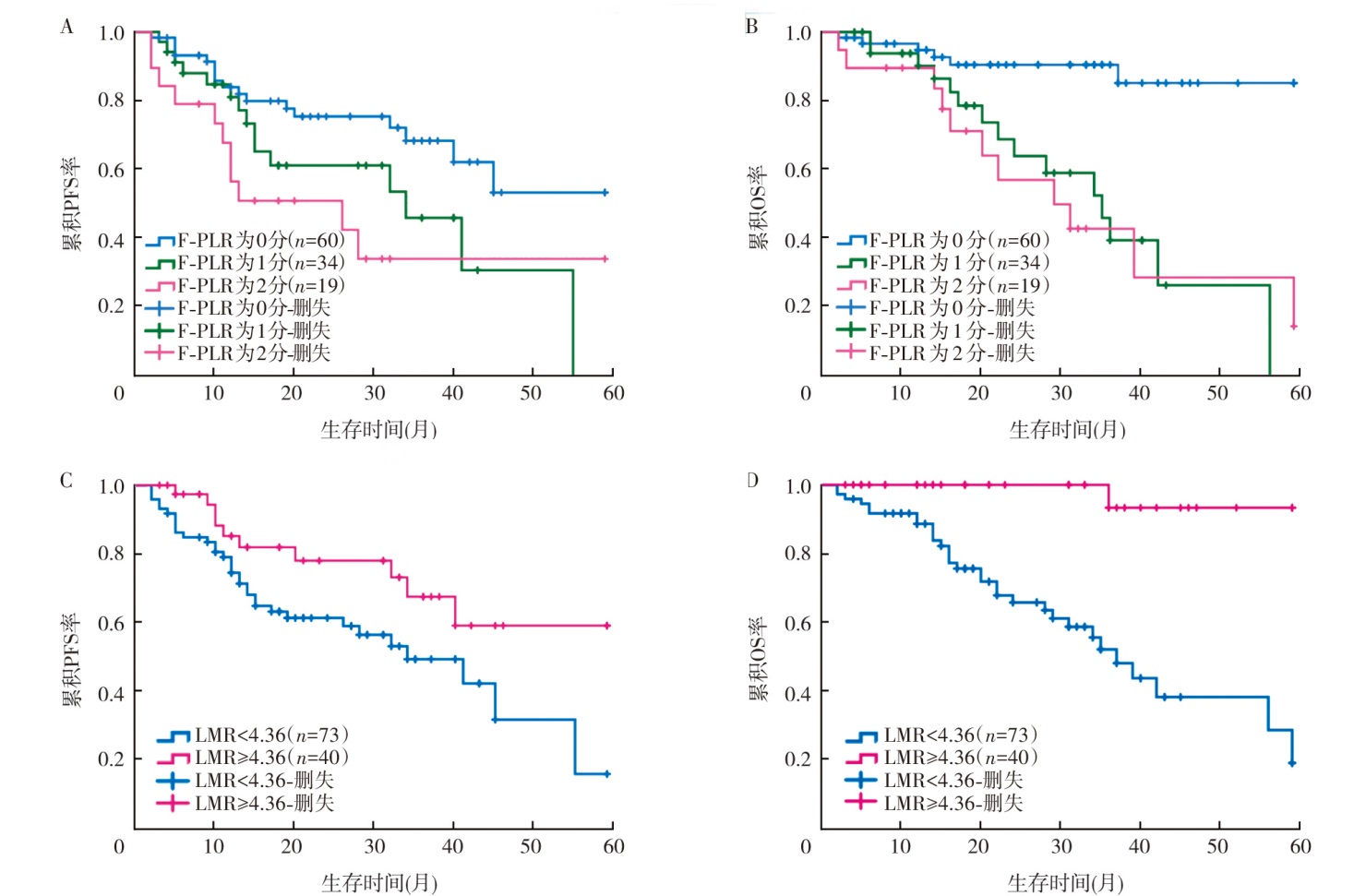
| 变量 | 单因素 | 多因素 | ||||||||
|---|---|---|---|---|---|---|---|---|---|---|
| HR值(95%CI) | P值 | HR值(95%CI) | P值 | |||||||
| 性别(男/女) | 0.93(0.33~2.63) | 0.892 | ||||||||
| 年龄(<65岁/≥65岁) | 0.69(0.35~1.33) | 0.267 | ||||||||
| 吸烟(否/是) | 1.10(0.58~2.06) | 0.778 | ||||||||
| 恶性肿瘤家族史(否/是) | 0.86(0.26~2.80) | 0.801 | ||||||||
| 肿瘤部位(胸上-中段/下段) | 0.52(0.28~0.97) | 0.041 | 0.36(0.19~0.71) | 0.003 | ||||||
| 分化程度(高-中分化/低分化) | 1.05(0.53~2.08) | 0.891 | ||||||||
| 病理类型(鳞状细胞癌/腺癌) | 2.29(0.89~5.91) | 0.086 | ||||||||
| 肿瘤长度(<3.5 cm/≥3.5 cm) | 1.39(0.74~2.61) | 0.309 | ||||||||
| 临床分期(Ⅰ~Ⅱ/Ⅲ~ⅣA) | 5.71(2.84~11.48) | <0.001 | 2.53(0.86~7.42) | 0.092 | ||||||
| T分期(T1-2/T3-4) | 2.49(1.28~4.85) | 0.007 | 1.16(0.51~2.66) | 0.721 | ||||||
| N分期(N0-1/N2-3) | 4.38(2.27~8.48) | <0.001 | 2.85(1.05~7.73) | 0.040 | ||||||
| 纤维蛋白原(<3.71 g/L/≥3.71 g/L) | 1.76(0.91~3.37) | 0.091 | ||||||||
| PLR(<129.19/≥129.19) | 2.43(1.30~4.53) | 0.005 | 2.17(0.59~7.94) | 0.243 | ||||||
| F-PLR评分(分) | ||||||||||
| 0 | Ref | Ref | ||||||||
| 1 | 1.99(0.96~4.13) | 0.066 | 0.76(0.20~2.84) | 0.681 | ||||||
| 2 | 2.86(1.31~6.26) | 0.008 | 1.20(0.24~6.11) | 0.822 | ||||||
| LMR(<4.36/≥4.36) | 0.51(0.25~1.05) | 0.068 | ||||||||
"
| 变量 | 单因素 | 多因素 | |||
|---|---|---|---|---|---|
| HR值(95%CI) | P值 | HR值(95%CI) | P值 | ||
| 性别(男/女) | 0.77(0.23~2.52) | 0.659 | |||
| 年龄(<65岁/≥65岁) | 1.12(0.55~2.30) | 0.750 | |||
| 吸烟(无/有) | 0.69(0.32~1.46) | 0.327 | |||
| 恶性肿瘤家族史(无/有) | 0.61(0.14~2.67) | 0.514 | |||
| 肿瘤部位(胸上-中段/下段) | 0.65(0.32~1.33) | 0.234 | |||
| 分化程度(高-中分化/低分化) | 1.85(0.91~3.78) | 0.090 | |||
| 病理类型(鳞状细胞癌/腺癌) | 3.46(1.41~8.51) | 0.007 | 0.56(0.19~1.71) | 0.309 | |
| 肿瘤长度(<3.5 cm/≥3.5 cm) | 1.09(0.54~2.22) | 0.810 | |||
| 临床分期(Ⅰ~Ⅱ/Ⅲ~ⅣA) | 5.66(2.69~11.92) | <0.001 | 3.00(0.60~14.98) | 0.181 | |
| T分期(T1-2/T3-4) | 5.01(2.05~12.29) | <0.001 | 4.34(1.51~12.42) | 0.006 | |
| N分期(N0-1/N2-3) | 2.90(1.42~5.92) | 0.003 | 0.98(0.20~4.87) | 0.983 | |
| 纤维蛋白原(<3.71 g/L/≥3.71 g/L) | 2.69(1.34~5.42) | 0.005 | — | — | |
| PLR(<129.19/≥129.19) | 4.27(2.01~9.05) | <0.001 | 2.28(0.68~7.65) | 0.375 | |
| F-PLR评分(分) | |||||
| 0 | Ref | Ref | |||
| 1 | 5.62(2.17~14.54) | <0.001 | 1.23(0.32~4.69) | 0.759 | |
| 2 | 6.46(2.36~17.65) | <0.001 | 0.42(0.07~2.46) | 0.333 | |
| LMR(<4.36/≥4.36) | 0.05(0.01~0.35) | 0.003 | 0.06(0.01~0.48) | 0.008 | |
| [1] | Han BF, Zheng RS, Zeng HM, et al. Cancer incidence and mortality in China, 2022[J]. J Natl Cancer Cent, 2024, 4(1): 47-53. DOI: 10.1016/j.jncc.2024.01.006. |
| [2] | Khoja L, Day D, Chen TWW, et al. Tumour- and class-specific patterns of immune-related adverse events of immune checkpoint inhibitors: a systematic review[J]. Ann Oncol, 2017, 28(10): 2377-2385. DOI: 10.1093/annonc/mdx286. |
| [3] | Xia WY, Zhu XR, Feng W, et al. Neutrophil-lymphocyte ratio and platelet-lymphocyte ratio associations with heart and body dose and their effects on patient outcomes in locally advanced non-small cell lung cancer treated with definitive radiotherapy[J]. Transl Lung Cancer Res, 2020, 9(5): 1996-2007. DOI: 10.21037/tlcr-20-831. |
| [4] |
Jaillon S, Ponzetta A, Di Mitri D, et al. Neutrophil diversity and plasticity in tumour progression and therapy[J]. Nat Rev Cancer, 2020, 20(9): 485-503. DOI: 10.1038/s41568-020-0281-y.
pmid: 32694624 |
| [5] | Zhang C, Yang Z, Li J, et al. Prognostic significance of dynamic lymphocyte changes in esophageal cancer patients receiving fluorouracil-cisplatin combined with radiotherapy: a systematic review and meta-analysis[J]. Technol Cancer Res Treat, 2025, 24: 15330338251341431. DOI: 10.1177/15330338251341431. |
| [6] | He Q, Li YM, Zhou XH, et al. The combination of fibrinogen concentrations and the platelet-to-lymphocyte ratio predicts survival in patients with advanced lung adenocarcinoma treated with EGFR-TKIs[J]. J Int Med Res, 2021, 49(4): 3000605211004021. DOI: 10.1177/03000605211004021. |
| [7] |
Huang JW, Yuan YC, Wang YQ, et al. Prognostic value of preoperative plasma fibrinogen level and platelet-to-lymphocyte ratio (F-PLR) in patients with localized upper tract urothelial carcinoma[J]. Oncotarget, 2017, 8(22): 36761-36771. DOI: 10.18632/oncotarget.13611.
pmid: 27901490 |
| [8] | 中国临床肿瘤学会指南工作委员会. 中国临床肿瘤学会(CSCO)食管癌诊疗指南2019[M]. 北京: 人民卫生出版社, 2019. |
| [9] | 国家癌症中心, 中国医师协会胸外科医师分会, 中华医学会胸心血管外科学分会, 等. 中国可切除食管癌围手术期诊疗实践指南(2023版)[J]. 中华医学杂志, 2023, 103(33): 2552-2570. DOI: 10.3760/cma.j.cn112137-20230604-00933. |
| [10] |
Morgan E, Soerjomataram I, Rumgay H, et al. The global landscape of esophageal squamous cell carcinoma and esophageal adenocarcinoma incidence and mortality in 2020 and projections to 2040: new estimates from GLOBOCAN 2020[J]. Gastroenterology, 2022, 163(3): 649-658.e2. DOI: 10.1053/j.gastro.2022.05.054.
pmid: 35671803 |
| [11] | Ajani JA, D'Amico TA, Bentrem DJ, et al. Esophageal and esophagogastric junction cancers, version 2.2023, NCCN Clinical Practice Guidelines in Oncology[J]. J Natl Compr Canc Netw, 2023, 21(4): 393-422. DOI: 10.6004/jnccn.2023.0019. |
| [12] | Eyck BM, van Lanschot J, Hulshof M, et al. Ten-year outcome of neoadjuvant chemoradiotherapy plus surgery for esophageal cancer: the randomized controlled CROSS trial[J]. J Clin Oncol, 2021, 39(18): 1995-2004. DOI: 10.1200/JCO.20.03614. |
| [13] |
Qin JJ, Xue LY, Hao AL, et al. Neoadjuvant chemotherapy with or without camrelizumab in resectable esophageal squamous cell carcinoma: the randomized phase 3 ESCORT-NEO/NCCES01 trial[J]. Nat Med, 2024, 30(9): 2549-2557. DOI: 10.1038/s41591-024-03064-w.
pmid: 38956195 |
| [14] | Zheng Y, Liang GH, Yuan DF, et al. Perioperative toripalimab plus neoadjuvant chemotherapy might improve outcomes in resectable esophageal cancer: an interim analysis of a phase Ⅲ randomized clinical trial[J]. Cancer Commun (Lond), 2024, 44(10): 1214-1227. DOI: 10.1002/cac2.12604. |
| [15] | Doki Y, Ajani JA, Kato K, et al. Nivolumab combination therapy in advanced esophageal squamous-cell carcinoma[J]. N Engl J Med, 2022, 386(5): 449-462. DOI: 10.1056/NEJMoa2111380. |
| [16] | Jiang Y, Xu D, Song H, et al. Inflammation and nutrition-based biomarkers in the prognosis of oesophageal cancer: a systematic review and meta-analysis[J]. BMJ Open, 2021, 11(9): e048324. DOI: 10.1136/bmjopen-2020-048324. |
| [17] |
Yang Y, Tan H, Lu Y, et al. Combined score based on plasma fibrinogen and platelet-lymphocyte ratio as a prognostic biomarker in esophageal squamous cell carcinoma[J]. BMC Cancer, 2024, 24(1): 249. DOI: 10.1186/s12885-024-11968-6.
pmid: 38389042 |
| [18] | Han YQ, Zheng S, Chen YJ. Prognostic value of lymphocyte to monocyte ratio in patients with esophageal cancer: a systematic review and meta-analysis[J]. Front Oncol, 2024, 14: 1401076. DOI: 10.3389/fonc.2024.1401076. |
| [19] | Hirahara N, Matsubara T, Mizota Y, et al. Prognostic value of pre-operative inflammatory response biomarkers in patients with esopha-geal cancer who undergo a curative thoracoscopic esophagectomy[J]. BMC Surg, 2016, 16(1): 66. DOI: 10.1186/s12893-016-0179-5. |
| [20] | Han LH, Jia YB, Song QX, et al. Prognostic significance of pre-operative lymphocyte-monocyte ratio in patients with resectable esophageal squamous cell carcinoma[J]. Asian Pac J Cancer Prev, 2015, 16(6): 2245-2250. DOI: 10.7314/apjcp.2015.16.6.2245. |
| [21] | Li KJ, Xia XF, Su M, et al. Predictive value of lymphocyte-to-monocyte ratio (LMR) and neutrophil-to-lymphocyte ratio (NLR) in patients with oesophageal cancer undergoing concurrent chemoradiotherapy[J]. BMC Cancer, 2019, 19(1): 1004. DOI: 10.1186/s12885-019-6157-4. |
| [1] | Wang Zhenli, Zhang Yaowen, Guo Yixiao, Lu Yukun, Huang Xiao, Sun Xiaodong, Wang Yinliang, Zheng Anping, Li Yazhou. Dosimetric comparison of carbon ion and photon radiotherapy for thoracic esophageal cancer [J]. Journal of International Oncology, 2026, 53(9): 521-526. |
| [2] | Shen Cailu, Wu Ruirong, Wu You, Ge Xiaosong. Construction of a postoperative survival prediction model for elderly patients with colorectal cancer based on machine learning algorithms [J]. Journal of International Oncology, 2026, 53(8): 476-484. |
| [3] | Ma Chiluan, Jia Dianjun, Wei Dongdong, Wang Jingrun, Li Xinping, Zhao Boyan, Zhao Yue. Efficacy and safety of concurrent radiotherapy combined with tegafur suppositories and immune checkpoint inhibitors in the treatment of elderly patients with esophageal cancer [J]. Journal of International Oncology, 2026, 53(7): 426-433. |
| [4] | Yan Kun, Xu Chenyang, Song Wenhua, Xia Tongliang, Wei Dongmin, Li Wenming, Qian Ye, Lei Dapeng. Analysis of prognosis and influencing factors of stage T3-4 laryngeal cancer patients based on propensity score matching [J]. Journal of International Oncology, 2026, 53(6): 331-338. |
| [5] | Li Yansong, Jia Junmei. Predictive value of the geriatric nutritional risk index for prognosis in advanced NSCLC treated with immunotherapy and immune-related adverse events [J]. Journal of International Oncology, 2026, 53(6): 355-360. |
| [6] | Yang Song, Zheng Xiangyun, Pan Yingxue, Wang Jiaming, Zhang Huanhu. Impact of imatinib adjuvant therapy on the postoperative prognosis of patients with non-gastric primary high-risk GIST [J]. Journal of International Oncology, 2026, 53(5): 283-289. |
| [7] | Wang Minjie, Lai Minghong, Cai Zhuoxin, Tang Yu, Zhang Caijin. Relationship between pan-immune inflammation value and clinicopathological features of non-small cell lung cancer and predictive analysis for bone metastasis [J]. Journal of International Oncology, 2026, 53(4): 207-212. |
| [8] | Xie Wenjuan, Zhu Yuan, Xu Jing. Construction of a prediction model for postoperative acute respiratory failure risk in patients with esophageal cancer based on SMOTE algorithm [J]. Journal of International Oncology, 2026, 53(4): 213-218. |
| [9] | Han Yufei, Li Fengmei, Zhang Weina, Zhang Ping, Hou Ping. Short-term efficacy and clinical outcomes of concurrent chemoradiotherapy followed by anlotinib maintenance treatment in patients with locally advanced cervical cancer [J]. Journal of International Oncology, 2026, 53(4): 219-223. |
| [10] | Tong Xinyu, Yang Jing, Wang Minglei, Huang Chengsuo, Luo Yingshu, Peng Jieqiong, Han Shumei, Liu Bo. Current status and advances in the medical treatment of esophageal cancer [J]. Journal of International Oncology, 2026, 53(4): 240-247. |
| [11] | Li Zhilei, Fang Jinman, Wei Dandan, Sun Ruixia, Zhang Yuanwei. Research progress on pathological response after neoadjuvant chemoradiotherapy in locally advanced middle and low rectal cancer [J]. Journal of International Oncology, 2026, 53(4): 248-252. |
| [12] | Yang Rui, Guo Xinwei, Liu Yangchen. Research progress on the impact of fibrinogen/prealbumin ratio for the prediction of prognosis of digestive system tumors [J]. Journal of International Oncology, 2026, 53(2): 111-114. |
| [13] | Yu Yunpeng, Dai Chunhua, Ling Rui. Efficacy and safety of tislelizumab combined with chemotherapy in the treatment of advanced esophageal cancer [J]. Journal of International Oncology, 2026, 53(1): 31-37. |
| [14] | Zhao Yuan, Yao Wentao. Current status and challenges of neoadjuvant immunotherapy in malignant tumors [J]. Journal of International Oncology, 2026, 53(1): 47-52. |
| [15] | Qiu Kexin, Li Mengzhen, Guo Haoran, Fan Mengsi, Yan Li. Prognostic analysis of different surgical approaches in elderly patients with advanced ovarian cancer [J]. Journal of International Oncology, 2025, 52(9): 576-582. |
| Viewed | ||||||
|
Full text |
|
|||||
|
Abstract |
|
|||||