Journal of International Oncology ›› 2026, Vol. 53 ›› Issue (6): 331-338.doi: 10.3760/cma.j.cn371439-20251229-00054
• Original Article • Previous Articles Next Articles
Analysis of prognosis and influencing factors of stage T3-4 laryngeal cancer patients based on propensity score matching
Yan Kun1,2,3, Xu Chenyang1,2, Song Wenhua1,2, Xia Tongliang1,2, Wei Dongmin1,2, Li Wenming1,2, Qian Ye1,2, Lei Dapeng1,2( )
)
- 1
Department of Otorhinolaryngology ,Qilu Hospital of Shandong University Jinan 250012, China
2National Health Commission Key Laboratory of Otorhinolaryngology(Shandong University) Jinan 250012, China
3Department of Otorhinolaryngology ,Junan People's Hospital,Shandong Province Junan 276600, China
-
Received:2025-12-29Online:2026-06-08Published:2026-06-05 -
Contact:Lei Dapeng E-mail:leidapeng@sdu.edu.cn -
Supported by:National Natural Science Foundation of China(82471149);Key Research and Development Project(Major Scientific and Technological Innovation Project)of Shandong Province of China(2025CXGC010603)

Cite this article
Yan Kun, Xu Chenyang, Song Wenhua, Xia Tongliang, Wei Dongmin, Li Wenming, Qian Ye, Lei Dapeng. Analysis of prognosis and influencing factors of stage T3-4 laryngeal cancer patients based on propensity score matching[J]. Journal of International Oncology, 2026, 53(6): 331-338.
share this article

"
| 一般临床资料 | PSM前 | PSM后 | |||||||
|---|---|---|---|---|---|---|---|---|---|
| 保留喉功能组 (n=180) | 未保留喉功能组 (n=178) | χ2值 | P值 | 保留喉功能组 (n=52) | 未保留喉功能组 (n=52) | χ2值 | P值 | ||
| 性别 | |||||||||
| 男 | 168(93.3) | 169(94.9) | 0.42 | 0.517 | 49(94.2) | 50(96.2) | <0.01 | >0.999 | |
| 女 | 12(6.7) | 9(5.1) | 3(5.8) | 2(3.8) | |||||
| 年龄(岁) | |||||||||
| ≤55 | 62(34.4) | 52(29.2) | 1.13 | 0.288 | 14(26.9) | 16(30.8) | 0.19 | 0.665 | |
| >55 | 118(65.6) | 126(70.8) | 38(73.1) | 36(69.2) | |||||
| 分化程度 | |||||||||
| 高分化 | 64(35.6) | 66(37.1) | 7.59 | 0.023 | 22(42.3) | 19(36.5) | 0.46 | 0.796 | |
| 中分化 | 58(32.2) | 76(42.7) | 14(26.9) | 16(30.8) | |||||
| 低分化 | 58(32.2) | 36(20.2) | 16(30.8) | 17(32.7) | |||||
| 肿瘤位置 | |||||||||
| 声门上型 | 32(17.8) | 28(15.7) | 11(21.1) | 8(15.4) | 0.91 | 0.636 | |||
| 声门型 | 140(77.8) | 132(74.2) | 4.79 | 0.091 | 37(71.2) | 38(73.1) | |||
| 声门下型 | 8(4.4) | 18(10.1) | 4(7.7) | 6(11.5) | |||||
| 肿瘤最大径(cm) | |||||||||
| <2 | 48(26.7) | 30(16.9) | 10(19.2) | 7(13.4) | |||||
| 2~5 | 90(50.0) | 62(34.8) | 30.16 | <0.001 | 24(46.2) | 25(48.1) | 0.65 | 0.723 | |
| >5 | 42(23.3) | 86(48.3) | 18(34.6) | 20(38.5) | |||||
| cT分期 | |||||||||
| 2 | 6(3.3) | 2(1.1) | 2(3.8) | 0(0) | |||||
| 3 | 164(91.1) | 116(65.2) | 43.14 | <0.001 | 46(88.5) | 45(86.5) | 2.88 | 0.237 | |
| 4 | 10(5.6) | 60(33.7) | 4(7.7) | 7(13.5) | |||||
| cN分期 | |||||||||
| 0 | 134(74.4) | 110(61.8) | 38(73.1) | 37(71.2) | |||||
| 1 | 30(16.7) | 26(14.6) | 13.06 | 0.001 | 6(11.5) | 2(3.8) | 3.01 | 0.222 | |
| 2 | 16(8.9) | 42(23.6) | 8(15.4) | 13(25.0) | |||||
| 术中出血量(ml) | |||||||||
| ≤50 | 112(62.2) | 90(50.6) | 4.91 | 0.027 | 28(53.8) | 29(55.8) | 0.04 | 0.844 | |
| >50 | 68(37.8) | 88(49.4) | 24(46.2) | 23(44.2) | |||||
| 术后拔管 | |||||||||
| 是 | 128(71.1) | 10(5.6) | 163.64 | <0.001 | 42(80.8) | 6(11.5) | 49.85 | <0.001 | |
| 否 | 52(28.9) | 168(94.4) | 10(19.2) | 46(88.5) | |||||
| 2周内经口进食 | |||||||||
| 是 | 174(96.7) | 124(69.7) | 45.49 | <0.001 | 46(88.5) | 48(92.3) | 0.44 | 0.505 | |
| 否 | 6(3.3) | 54(30.3) | 6(11.5) | 4(7.7) | |||||
| 术后放化疗 | |||||||||
| 是 | 138(76.7) | 146(82.0) | 1.52 | 0.218 | 38(73.1) | 41(78.8) | 0.47 | 0.494 | |
| 否 | 42(23.3) | 32(18.0) | 14(26.9) | 11(21.2) | |||||
| 合并术后并发症 | |||||||||
| 无 | 44(24.4) | 64(36.0) | 14(26.9) | 13(25.0) | |||||
| 轻微 | 126(70.0) | 96(53.9) | 10.37 | 0.006 | 34(65.4) | 33(63.5) | 0.47 | 0.790 | |
| 严重 | 10(5.6) | 18(10.1) | 4(7.7) | 6(11.5) | |||||
| 合并其他基础疾病 | |||||||||
| 是 | 42(23.3) | 56(31.5) | 2.95 | 0.086 | 12(23.1) | 11(21.2) | 0.05 | 0.816 | |
| 否 | 138(76.7) | 122(68.5) | 40(76.9) | 41(78.8) | |||||
| NNIS分级 | |||||||||
| 0 | 100(55.6) | 54(30.3) | 36.18 | <0.001 | 18(34.6) | 21(40.4) | 1.62 | 0.655 | |
| 1 | 34(18.9) | 92(51.7) | 16(30.8) | 19(36.5) | |||||
| 2 | 28(15.6) | 16(9.0) | 12(23.1) | 8(15.4) | |||||
| 3 | 18(10.0) | 16(9.0) | 6(11.5) | 4(7.7) | |||||
| ASA评分(分) | |||||||||
| 1 | 18(10.0) | 12(6.7) | 6(11.5) | 1(1.9) | |||||
| 2 | 152(84.4) | 130(73.0) | 16.97 | <0.001 | 40(76.9) | 43(82.7) | 3.94 | 0.140 | |
| 3 | 10(5.6) | 36(20.2) | 6(11.5) | 8(15.4) | |||||
"
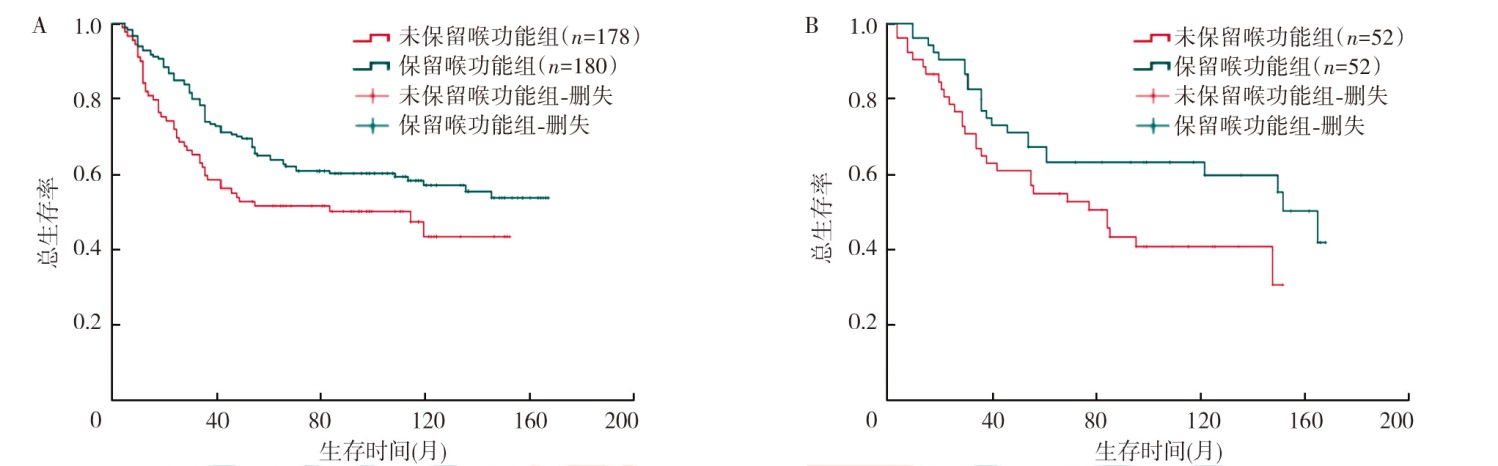
"
| 因素 | 单因素 | 多因素 | |||||
|---|---|---|---|---|---|---|---|
| HR值 | 95%CI | P值 | HR值 | 95%CI | P值 | ||
| 保留喉功能 | |||||||
| 未保留 | Ref | Ref | |||||
| 保留 | 0.57 | 0.33~0.94 | 0.048 | 0.24 | 0.11~0.51 | <0.001 | |
| 性别 | |||||||
| 男 | Ref | Ref | |||||
| 女 | 1.13 | 0.95~1.34 | 0.163 | 1.21 | 0.74~1.97 | 0.442 | |
| 年龄(岁) | |||||||
| ≤55 | Ref | Ref | |||||
| >55 | 1.40 | 0.76~2.59 | 0.280 | 0.90 | 0.36~2.25 | 0.822 | |
| 分化程度 | |||||||
| 高分化 | Ref | Ref | |||||
| 中分化 | 1.14 | 1.02~1.27 | 0.021 | 1.26 | 1.08~1.48 | 0.004 | |
| 低分化 | 0.73 | 0.37~1.44 | 0.362 | 0.37 | 0.13~1.06 | 0.064 | |
| 肿瘤位置 | |||||||
| 声门上型 | Ref | Ref | |||||
| 声门型 | 1.57 | 0.75~3.30 | 0.230 | 4.73 | 0.23~98.60 | 0.316 | |
| 声门下型 | 1.81 | 0.60~5.52 | 0.301 | 1.07 | 0.17~6.69 | 0.947 | |
| 肿瘤最大径(cm) | |||||||
| <2 | Ref | Ref | |||||
| 2~5 | 1.97 | 1.28~3.03 | 0.002 | 4.59 | 2.31~9.14 | <0.001 | |
| >5 | 1.63 | 1.02~2.60 | 0.041 | 2.03 | 1.34~3.08 | <0.001 | |
| cT分期 | |||||||
| 2 | Ref | Ref | |||||
| 3 | 0.19 | 0.05~1.12 | 0.066 | 0.28 | 0.03~2.95 | 0.288 | |
| 4 | 0.24 | 0.05~1.19 | 0.080 | 0.12 | 0.01~1.42 | 0.093 | |
| cN分期 | |||||||
| 0 | Ref | Ref | |||||
| 1 | 2.95 | 1.29~6.75 | 0.011 | 1.55 | 0.29~8.28 | 0.611 | |
| 2 | 1.64 | 0.86~3.15 | 0.135 | 1.94 | 0.50~7.57 | 0.339 | |
| 术中出血量(ml) | |||||||
| ≤50 | Ref | Ref | |||||
| >50 | 1.18 | 0.69~2.02 | 0.560 | 1.39 | 0.50~3.87 | 0.524 | |
| 术后拔管 | |||||||
| 否 | Ref | Ref | |||||
| 是 | 0.61 | 0.29~1.26 | 0.180 | 0.66 | 0.24~1.76 | 0.401 | |
| 2周内经口进食 | |||||||
| 否 | Ref | Ref | |||||
| 是 | 1.07 | 1.03~1.11 | <0.001 | 1.62 | 1.23~2.12 | <0.001 | |
| 术后放化疗 | |||||||
| 否 | Ref | Ref | |||||
| 是 | 1.28 | 0.68~2.42 | 0.450 | 0.15 | 0.01~2.42 | 0.180 | |
| 合并术后并发症 | |||||||
| 无 | Ref | Ref | |||||
| 轻微 | 2.81 | 1.31~6.00 | 0.008 | 2.66 | 0.91~7.82 | 0.075 | |
| 严重 | 1.12 | 0.30~4.24 | 0.865 | 0.39 | 0.07~2.19 | 0.285 | |
| 合并其他基础疾病 | |||||||
| 否 | Ref | Ref | |||||
| 是 | 1.89 | 1.04~3.43 | 0.035 | 1.26 | 0.43~3.66 | 0.676 | |
| NNIS分级 | |||||||
| 0 | Ref | Ref | |||||
| 1 | 0.75 | 0.40~1.40 | 0.360 | 0.59 | 0.18~1.87 | 0.366 | |
| 2 | 0.41 | 0.17~0.96 | 0.039 | 0.60 | 0.17~2.18 | 0.438 | |
| 3 | 0.59 | 0.21~1.65 | 0.315 | 0.97 | 0.19~4.90 | 0.974 | |
| ASA评分(分) | |||||||
| 1 | Ref | Ref | |||||
| 2 | 8.16 | 1.07~62.20 | 0.043 | 7.53 | 0.93~61.25 | 0.059 | |
| 3 | 7.05 | 0.83~59.90 | 0.074 | 6.21 | 0.90~50.14 | 0.058 | |
| [1] | Nobacht A, Meijer TWH, Oosting SF, et al. Oncological and functional outcomes in T3 and T4 laryngeal cancer patients: choice for larynx preservation or total laryngectomy based on expected laryngeal function[J]. J Laryngol Otol, 2024, 138(6): 672-678. DOI: 10.1017/S0022215124000112. |
| [2] | Zhang R, Ren L, Hou JB, et al. Exploring the therapeutic potential of oridonin in the treatment of laryngeal cancer: a comprehensive strategy involving network pharmacology, molecular docking, dynamic simulation, and experimental verification[J]. Chem Biol Drug Des, 2026, 107(1): e70222. DOI: 10.1111/cbdd.70222. |
| [3] | Pfuetzenreiter EG, Ferreron GF, Sadka JZ, et al. Total laryngectomy vs. non-surgical organ preservation in advanced laryngeal cancer: a metanalysis[J]. Braz J Otorhinolaryngol, 2024, 90(3): 101404. DOI: 10.1016/j.bjorl.2024.101404. |
| [4] |
Kane LT, Fang T, Galetta MS, et al. Propensity score matching: a statistical method[J]. Clin Spine Surg, 2020, 33(3): 120-122. DOI: 10.1097/BSD.0000000000000932.
pmid: 31913173 |
| [5] | Lydiatt WM, Patel SG, O'Sullivan B, et al. Head and neck cancers-major changes in the American Joint Committee on cancer eighth edition cancer staging manual[J]. CA Cancer J Clin, 2017, 67(2): 122-137. DOI: 10.3322/caac.21389. |
| [6] | Chen AY, Fedewa S, Zhu J. Temporal trends in the treatment of early- and advanced-stage laryngeal cancer in the United States, 1985—2007[J]. Arch Otolaryngol Head Neck Surg, 2011, 137(10): 1017-1024. DOI: 10.1001/archoto.2011.171. |
| [7] | 李梦婷, 夏立军, 李锦荣. 晚期喉癌的治疗进展[J]. 中国耳鼻咽喉颅底外科杂志, 2020, 26(3): 343-348. DOI: 10.11798/j.issn.1007-1520.202003025. |
| [8] | Grover S, Swisher-McClure S, Mitra N, et al. Total laryngectomy versus larynx preservation for T4a larynx cancer: patterns of care and survival outcomes[J]. Int J Radiat Oncol Biol Phys, 2015, 92(3): 594-601. DOI: 10.1016/j.ijrobp.2015.03.004. |
| [9] | Tang ZX, Gong JL, Wang YH, et al. Efficacy comparison between primary total laryngectomy and nonsurgical organ-preservation strategies in treatment of advanced stage laryngeal cancer: a meta-analysis[J]. Medicine (Baltimore), 2018, 97(21): e10625. DOI: 10.1097/MD.0000000000010625. |
| [10] | 胡愈强, 刘冰, 仲畅, 等. 行根治性切除治疗初诊T3-T4期喉癌患者同侧及对侧颈部淋巴结转移的危险因素分析[J]. 临床肿瘤学杂志, 2022, 27(11): 1009-1014. DOI: 10.3969/j.issn.1009-0460.2022.11.008. |
| [11] | 闫文润, 杨亚萍, 汤洁. 局部晚期喉癌非手术与手术综合治疗的远期疗效比较[J]. 实用癌症杂志, 2023, 38(5): 793-795, 802. |
| [12] | Lechien JR, Hans S. Survival, surgical, and functional outcomes of transoral laser microsurgery for cT1-T3 supraglottic laryngeal cancers: a systematic review[J]. Oral Oncol, 2024, 158: 107009. DOI: 10.1016/j.oraloncology.2024.107009. |
| [13] | Crosetti E, Lorenzi A, Prizio C, et al. Opportunities and limits of open partial horizontal laryngectomies for naïve T3-T4a laryngeal cancer: a systematic review and meta-analysis[J]. Front Oncol, 2025, 15: 1550079. DOI: 10.3389/fonc.2025.1550079. |
| [14] | Akmal SR, Beier MA, August DA. Propensity score methods in the surgical oncology literature[J]. Surg Oncol, 2022, 42: 101776. DOI: 10.1016/j.suronc.2022.101776. |
| [15] | Lee MY, Belfiglio M, Zeng J, et al. Primary total laryngectomy versus organ preservation for locally advanced T3/T4a laryngeal cancer[J]. Laryngoscope, 2023, 133(5): 1122-1131. DOI: 10.1002/lary.30254. |
| [16] | Zarei M, Mirzaee M, Alizadeh H, et al. Investigation of the affective factors on the survival rate of patients with laryngeal cancer using cox proportional hazards and Lin-Ying's additive hazards models[J]. Med J Islam Repub Iran, 2021, 35: 16. DOI: 10.47176/mjiri.35.16. |
| [17] |
Ramroth H, Schoeps A, Rudolph E, et al. Factors predicting survival after diagnosis of laryngeal cancer[J]. Oral Oncol, 2011, 47(12): 1154-1158. DOI: 10.1016/j.oraloncology.2011.08.003.
pmid: 21873105 |
| [18] |
Takes RP, Halmos GB, Ridge JA, et al. Value and quality of care in head and neck oncology[J]. Curr Oncol Rep, 2020, 22(9): 92. DOI: 10.1007/s11912-020-00952-5.
pmid: 32651680 |
| [19] | Yang H, Han DF, Ren XY, et al. Investigation of swallowing function and swallowing-related quality of life after partial laryngectomy in Chinese patients with laryngeal carcinoma[J]. Health Qual Life Outcomes, 2019, 17(1): 132. DOI: 10.1186/s12955-019-1199-5. |
| [20] | Aydil U, Akmansu M, Gümüşay Ö, et al. Failure of concurrent chemoradiotherapy for organ preservation in laryngeal cancer: survival outcomes and recurrence patterns[J]. Ear Nose Throat J, 2019, 98(7): E92-E96. DOI: 10.1177/0145561319839788. |
| [21] |
Miśkiewicz-Orczyk K, Ścierski W, Lisowska G, et al. Salvage surgery in laryngeal cancer after radiotherapy and partial surgery-comparative results[J]. J Cancer Res Ther, 2023, 19(3): 579-584. DOI: 10.4103/jcrt.jcrt_1548_21.
pmid: 37470578 |
| [22] | Hintze JM, Cleere E, Soo A, et al. Margins do not impact recurrence and survival in advanced laryngeal cancer—a retrospective cohort analysis[J]. Oral Oncol, 2025, 167: 107402. DOI: 10.1016/j.oraloncology.2025.107402. |
| [1] | Li Yansong, Jia Junmei. Predictive value of the geriatric nutritional risk index for prognosis in advanced NSCLC treated with immunotherapy and immune-related adverse events [J]. Journal of International Oncology, 2026, 53(6): 355-360. |
| [2] | Yang Song, Zheng Xiangyun, Pan Yingxue, Wang Jiaming, Zhang Huanhu. Impact of imatinib adjuvant therapy on the postoperative prognosis of patients with non-gastric primary high-risk GIST [J]. Journal of International Oncology, 2026, 53(5): 283-289. |
| [3] | Wang Minjie, Lai Minghong, Cai Zhuoxin, Tang Yu, Zhang Caijin. Relationship between pan-immune inflammation value and clinicopathological features of non-small cell lung cancer and predictive analysis for bone metastasis [J]. Journal of International Oncology, 2026, 53(4): 207-212. |
| [4] | Han Yufei, Li Fengmei, Zhang Weina, Zhang Ping, Hou Ping. Short-term efficacy and clinical outcomes of concurrent chemoradiotherapy followed by anlotinib maintenance treatment in patients with locally advanced cervical cancer [J]. Journal of International Oncology, 2026, 53(4): 219-223. |
| [5] | Yang Rui, Guo Xinwei, Liu Yangchen. Research progress on the impact of fibrinogen/prealbumin ratio for the prediction of prognosis of digestive system tumors [J]. Journal of International Oncology, 2026, 53(2): 111-114. |
| [6] | Qiu Kexin, Li Mengzhen, Guo Haoran, Fan Mengsi, Yan Li. Prognostic analysis of different surgical approaches in elderly patients with advanced ovarian cancer [J]. Journal of International Oncology, 2025, 52(9): 576-582. |
| [7] | Liu Mei, Hu Yuchong, Li Fengtong, Chao Lemen, Liu Meng, Kang Linlin. Mechanism of action of SHCBP1 in malignant tumors and progress in clinical research [J]. Journal of International Oncology, 2025, 52(9): 583-586. |
| [8] | Lu Bing, Xiong Siyu, Jiang Wenhong, Yu Tingting. Progress in the study of fructose-bisphosphate aldolase A in lung cancer [J]. Journal of International Oncology, 2025, 52(4): 242-245. |
| [9] | Yang Shengjun, Ren Jiang, Yang Dan, Long Yu, Shang Qunxian. Expression levels and clinical significance of miR-4262,NRG1 in non-small cell lung cancer tissues [J]. Journal of International Oncology, 2025, 52(3): 129-135. |
| [10] | Wang Yi, Wang Qiangli, Zhang Jia, Yang Yijin, Wang Sheng. Relationship between the expression of SUCNR1 and YBX1 in tissues of patients with colorectal cancer liver metastases and their clinicopathological characteristics and prognosis [J]. Journal of International Oncology, 2025, 52(3): 152-157. |
| [11] | Han Tao, Jia Peipei, Lu Jing. Predictive value of iRhom1,iRhom2 and TNF-α levels for the prognosis of patients with cervical cancer [J]. Journal of International Oncology, 2025, 52(3): 158-162. |
| [12] | Ye Yongying, Zou Yan, Chen Tianming, Wu Weili. Research progress of clock gene Period family in head and neck squamous cell carcinoma [J]. Journal of International Oncology, 2025, 52(2): 113-118. |
| [13] | Chen Danlei, Deng Junjun, Li Miao. Progress of clinical application of circulating tumor cells in lung cancer [J]. Journal of International Oncology, 2025, 52(2): 119-123. |
| [14] | Ji Haitao, Wang Yanfeng, Liu Yongcheng, Hao Nan. Expression and clinical significance of DHCR7 in gastric cancer based on bioinformatics analysis [J]. Journal of International Oncology, 2025, 52(2): 94-100. |
| [15] | Yipala·Yilihamu , Ma Tao, Wang Yan, Gao Chunjie, Liu Jing, Zhao Ting, Wang Lei. Relationship between body mass indexes and survival prognosis of breast cancer patients with different menopausal status and molecular subtypes [J]. Journal of International Oncology, 2025, 52(12): 745-757. |
| Viewed | ||||||
|
Full text |
|
|||||
|
Abstract |
|
|||||