Journal of International Oncology ›› 2025, Vol. 52 ›› Issue (12): 777-781.doi: 10.3760/cma.j.cn371439-20250429-00132
• Original Article • Previous Articles Next Articles
Diagnostic value of MRI combined with serum AIF-1 and NDRG4 for cervical cancer
Zumurelaiti·Ainiwa'er , Xian Jun, Han Lili( )
)
Gynecological Medical Treatment Center ,People's Hospital of Xinjiang Uygur Autonomous Region Urumqi 830000, China
-
Received:2025-04-29Revised:2025-05-29Online:2025-12-08Published:2025-12-31 -
Contact:Han Lili E-mail:hanliliabcd@163.com -
Supported by:Key Research and Development Project in Xinjiang Uygur Autonomous Region of China(2022B03018-1);Young Scientific and Technological Talents Outstanding Program of Xinjiang Uygur Autono-mous Region of China(2022TSYCCX0110)

Cite this article
Zumurelaiti·Ainiwa'er , Xian Jun, Han Lili. Diagnostic value of MRI combined with serum AIF-1 and NDRG4 for cervical cancer[J]. Journal of International Oncology, 2025, 52(12): 777-781.
share this article

"
| 一般临床资料 | 正常宫颈组(n=108) | 宫颈良性病变组(n=175) | 宫颈癌组(n=108) | F/χ2值 | P值 |
|---|---|---|---|---|---|
| 年龄(岁) | 50.02±4.83 | 49.34±4.65 | 50.26±4.71 | 1.46 | 0.233 |
| 产次(次) | |||||
| >1 | 57(52.78) | 83(47.43) | 61(56.48) | 2.30 | 0.316 |
| ≤1 | 51(47.22) | 92(52.57) | 47(43.52) | ||
| 初次性生活年龄(岁) | |||||
| ≤18 | 15(13.89) | 22(12.57) | 17(15.74) | 0.56 | 0.754 |
| >18 | 93(86.11) | 153(87.43) | 91(84.26) | ||
| 是否绝经 | |||||
| 是 | 35(32.41) | 41(23.43) | 32(29.63) | 2.99 | 0.224 |
| 否 | 73(67.59) | 134(76.57) | 76(70.37) | ||
| HPV状态 | |||||
| 阳性 | - | 89(50.86) | 65(60.19) | 2.34 | 0.126 |
| 阴性 | - | 86(49.14) | 43(39.81) |
"
| 组别 | AIF-1 | NDRG4 |
|---|---|---|
| 正常宫颈组(n=108) | 122.75±23.69 | 134.25±12.33 |
| 宫颈良性病变组(n=175) | 183.50±28.33a | 97.48±10.95a |
| 宫颈癌组(n=108) | 212.73±36.14ab | 86.62±10.27ab |
| F值 | 263.60 | 581.83 |
| P值 | <0.001 | <0.001 |
"
| FIGO分期 | AIF-1 | NDRG4 |
|---|---|---|
| Ⅰ~Ⅱ期(n=67) | 200.35±34.14 | 91.73±9.21 |
| Ⅲ期(n=41) | 232.96±36.22 | 78.26±8.93 |
| t值 | 4.71 | 7.46 |
| P值 | <0.001 | <0.001 |
"
| 诊断方法 | 最佳截断值 | AUC | 95%CI | 敏感性(%) | 特异性(%) | 准确性(%) | 阳性预测值(%) | 阴性预测值(%) |
|---|---|---|---|---|---|---|---|---|
| MRI | - | 0.78 | - | 78.70 | 81.14 | 80.21 | 72.03 | 86.06 |
| AIF-1 | 200.10 pg/ml | 0.76 | 0.70~0.82 | 71.30 | 70.86 | 71.02 | 60.16 | 80.00 |
| NDRG4 | 92.22 pg/ml | 0.76 | 0.70~0.82 | 74.07 | 69.14 | 71.02 | 59.70 | 81.21 |
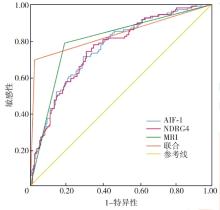
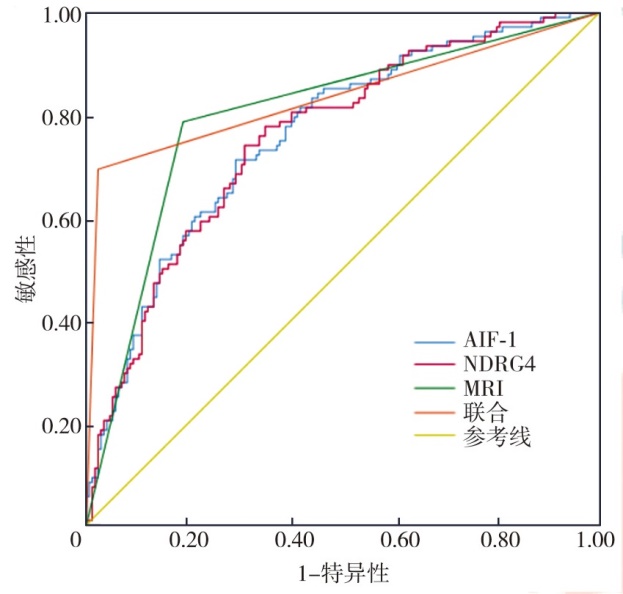
| 3项联合 | - | 0.85 | - | 69.44 | 97.71 | 86.93 | 94.94 | 83.82 |
"
| [1] | 尚忠华, 蒋芝月, 黄朝晖, 等. 1990—2021年中国宫颈癌疾病负担趋势分析及2022—2035年预测研究[J/OL]. 中国全科医学, 2025: 1-7[2025-04-07] [2025-04-18]. http://kns.cnki.net/kcms/detail/13.1222.R.20250403.1614.018.html. DOI: 10.12114/j.issn.1007-9572.2024.0595. |
| [2] |
Caruso G, Wagar MK, Hsu HC, et al. Cervical cancer: a new era[J]. Int J Gynecol Cancer, 2024, 34(12): 1946-1970. DOI: 10.1136/ijgc-2024-005579.
pmid: 39117381 |
| [3] | Avesani G, Perazzolo A, Amerighi A, et al. The utility of contrast-enhanced magnetic resonance imaging in uterine cervical cancer: a systematic review[J]. Life (Basel), 2023, 13(6): 1368. DOI: 10.3390/life13061368. |
| [4] | De Leon-Oliva D, Garcia-Montero C, Fraile-Martinez O, et al. AIF1: function and connection with inflammatory diseases[J]. Biology (Basel), 2023, 12(5): 694-716. DOI: 10.3390/biology12050694. |
| [5] | Yang Y, Xu S, Jia G, et al. Integrating genomics and proteomics data to identify candidate plasma biomarkers for lung cancer risk among European descendants[J]. Br J Cancer, 2023, 129(9): 1510-1515. DOI: 10.1038/s41416-023-02419-3. |
| [6] | Casanova-Martín C, Liviu Boaru D, Fraile-Martinez O, et al. Identification of new tissue markers for the monitoring and standardization of penile cancer according to the degree of differentiation[J]. Histol Histopathol, 2025, 40(7): 1013-1039. DOI: 10.14670/HH-18-846. |
| [7] | Rao M, Yang Z, Huang K, et al. Correlation of AIF-1 expression with immune and clinical features in 1270 glioma samples[J]. J Mol Neurosci, 2022, 72(2): 420-432. DOI: 10.1007/s12031-021-01948-x. |
| [8] | Zhao F, Zhu S, Fang J, et al. Correlation of DNA methylation and lymph node metastasis in papillary thyroid carcinoma[J]. Head Neck, 2023, 45(7): 1654-1662. DOI: 10.1002/hed.27377. |
| [9] |
Tian T, Li S, Hu S, et al. Causal inference of the effect of plasma proteins on the incidence of oral cancer: two-sample Mendelian randomization[J]. BMC Oral Health, 2024, 24(1): 1049. DOI: 10.1186/s12903-024-04837-y.
pmid: 39245738 |
| [10] | 中国抗癌协会妇科肿瘤专业委员会. 子宫颈癌诊断与治疗指南(2021年版)[J]. 中国癌症杂志, 2021, 31(6): 474-489. DOI: 10.19401/j.cnki.1007-3639.2021.06.06. |
| [11] | 张钦和, 刘爱连. MRI功能成像及定量成像技术在宫颈癌诊疗中的应用述评[J]. 磁共振成像, 2024, 15(8): 1-11, 24. DOI: 10.12015/issn.1674-8034.2024.08.001. |
| [12] | Xu X, Wang D, Li N, et al. The novel tumor microenvironment-related prognostic gene AIF1 may influence immune infiltrates and is correlated with TIGIT in esophageal cancer[J]. Ann Surg Oncol, 2022, 29(5): 2930-2940. DOI: 10.1245/s10434-021-10928-9. |
| [13] | Zong C, Meng Y, Ye F, et al. AIF1+CSF1R+MSCs, induced by TNF-α, act to generate an inflammatory microenvironment and promote hepatocarcinogenesis[J]. Hepatology, 2023, 78(2): 434-451. DOI: 10.1002/hep.32738. |
| [14] | Wang L, Zhao X, Zheng H, et al. AIF-1, a potential biomarker of aggressive tumor behavior in patients with non-small cell lung cancer[J]. PLoS One, 2022, 17(12): e0279211. DOI: 10.1371/journal.pone.0279211. |
| [15] | 王汇博, 陈慧君, 朱敏. 血清AIF-1、Bmi-1、MAP19联合诊断宫颈癌的价值分析[J]. 疑难病杂志, 2024, 23(8): 971-975. DOI: 10.3969/j.issn.1671-6450.2024.08.015. |
| [16] |
Li R, He C, Shen L, et al. NDRG4 sensitizes CRC cells to 5-FU by upregulating DDIT3 expression[J]. Oncol Lett, 2021, 22(5): 782. DOI: 10.3892/ol.2021.13043.
pmid: 34594423 |
| [17] | Zuo H, Liu S, Li X, et al. miR-23a-3p promotes the development of colon cancer by inhibiting the expression of NDRG4[J]. Clin Transl Oncol, 2023, 25(4): 933-940. DOI: 10.1007/s12094-022-02996-4. |
| [18] | 海斯莱提·艾尔肯, 夏木西卡玛尔·阿布都克热木, 热娜柯孜·图尔荪. β-榄香烯上调NDRG4表达水平抑制宫颈癌细胞增殖与侵袭[J]. 遵义医科大学学报, 2022, 45(3): 304-309. DOI: 10.14169/j.cnki.zunyixuebao.2022.0058. |
| [19] | 梁俊明, 黄健威, 符立辉. 双能CT联合血清PIVKA-Ⅱ、NDRG4诊断卵巢癌效能[J]. 中国计划生育学杂志, 2024, 32(2): 337-342. DOI: 10.3969/j.issn.1004-8189.2024.02.017. |
| [20] | 柯楠, 刘凯, 陈娇, 等. MRI联合血清TSGF、NDRG4在上皮性卵巢癌诊断中的作用[J]. 中国CT和MRI杂志, 2024, 22(4): 119-121. DOI: 10.3969/j.issn.1672-5131.2024.04.037. |
| [1] | Chen Qiaoliang, Qin Xinyan, Lai Ruihe, Tan Shuangxiu. Diagnostic value of multimodal Nomogram model combining 18F-FDG PET/CT and ultrasound for triple negative breast cancer [J]. Journal of International Oncology, 2025, 52(9): 560-565. |
| [2] | Radiation Oncology Professional Committee of the Chinese Research Hospital Association, Hebei Society of Mathematical and Physical Medicine, Tianjin Precision Medicine Society. Expert consensus on the clinical diagnosis and treatment of post-obstructive pneumonia in newly diagnosed lung cancer patients [J]. Journal of International Oncology, 2025, 52(8): 484-494. |
| [3] | Li Xiaoxuan, Xia Zhipeng, Luan Rumei, Wan Yunyan, Yao Zhouhong, Lin Xinshan, Lin Dianjie. Clinical value of metabolomics in assessing the malignant risk of pulmonary nodules [J]. Journal of International Oncology, 2025, 52(7): 409-413. |
| [4] | Yang Xiaobin, Jiang Jinquan. Predictive value of serum MMP-9, FABP5 combined with MRI for the efficacy and recurrence of primary liver cancer after percutaneous radiofrequency ablation [J]. Journal of International Oncology, 2025, 52(6): 360-365. |
| [5] | Li Jinxin, Gu Fenfen. Efficacy of sintilimab combined with docetaxel in the treatment of cervical cancer and its impact on laboratory indicators [J]. Journal of International Oncology, 2025, 52(6): 366-373. |
| [6] | Zhou Xiaoyu, Pu Xuefeng, Long Shulin, Li Lu, He Wenying. Changes of T lymphocyte subsets and the relationship with postoperative lymph node metastasis in patients with stage Ⅰ and Ⅱ cervical cancer [J]. Journal of International Oncology, 2025, 52(4): 224-230. |
| [7] | Han Tao, Jia Peipei, Lu Jing. Predictive value of iRhom1,iRhom2 and TNF-α levels for the prognosis of patients with cervical cancer [J]. Journal of International Oncology, 2025, 52(3): 158-162. |
| [8] | Chen Danlei, Deng Junjun, Li Miao. Progress of clinical application of circulating tumor cells in lung cancer [J]. Journal of International Oncology, 2025, 52(2): 119-123. |
| [9] | Chinese Society of Clinical Oncology-Supportive Care and Rehabilitation Committee, Chinese Expert Consensus Working Group on Cancer-related Anorexia . Chinese expert consensus on the diagnosis and treatment of cancer-related anorexia [J]. Journal of International Oncology, 2025, 52(2): 67-78. |
| [10] | Wang Zhibao, Li Guangxian, Zhang Xinxin, Cui Wei, Zhang Wei. Predictive value of MRI combined with serum lncRNA KCNQ1OT1, miR-204-5p for axillary lymph node metastasis of breast cancer [J]. Journal of International Oncology, 2025, 52(2): 89-93. |
| [11] | Ji Haitao, Wang Yanfeng, Liu Yongcheng, Hao Nan. Expression and clinical significance of DHCR7 in gastric cancer based on bioinformatics analysis [J]. Journal of International Oncology, 2025, 52(2): 94-100. |
| [12] | Wu Huoyou, Wu Zujiao, Lin Sibo, Qu Yiyang. A predictive model for the efficacy of neoadjuvant chemotherapy in rectal cancer constructed based on multimodal MRI quantitative parameters [J]. Journal of International Oncology, 2025, 52(12): 770-776. |
| [13] | Hou Xiaoxuan, Tang Wenjie, Xie Peng. Mechanism and research progress of ferroptosis in cervical cancer treatment [J]. Journal of International Oncology, 2025, 52(12): 791-794. |
| [14] | Ye Rui, Chen Zhen, Hao Ningning, Li Rongrong. Diagnostic value of MRI combined with serum LRG1 and LOXL2 for prostate cancer [J]. Journal of International Oncology, 2025, 52(11): 695-699. |
| [15] | Ma Yongjia, Peng Siyu, Sun Pengfei. Research progress on combined radiotherapy, chemotherapy, and immunotherapy for cervical cancer [J]. Journal of International Oncology, 2025, 52(11): 726-731. |
| Viewed | ||||||
|
Full text |
|
|||||
|
Abstract |
|
|||||