


国际肿瘤学杂志 ›› 2025, Vol. 52 ›› Issue (12): 745-757.doi: 10.3760/cma.j.cn371439-20241125-00128
依帕拉·伊力哈木1, 马涛1, 王岩2, 高春洁1, 刘静1, 赵婷3, 王蕾4( )
)
收稿日期:2024-11-25
修回日期:2025-04-15
出版日期:2025-12-08
发布日期:2025-12-31
通讯作者:
王蕾
E-mail:wlei81@126.com
作者简介:依帕拉·伊力哈木现工作单位为吐鲁番职业技术学院现代农业学院
基金资助:
Yipala·Yilihamu 1, Ma Tao1, Wang Yan2, Gao Chunjie1, Liu Jing1, Zhao Ting3, Wang Lei4()
Received:2024-11-25
Revised:2025-04-15
Online:2025-12-08
Published:2025-12-31
Contact:
Wang Lei
E-mail:wlei81@126.com
About author:Yipala·Yilihamu is currently working at the College of Modern Agriculture, Turpan Vocational and Technical College
Supported by:摘要:
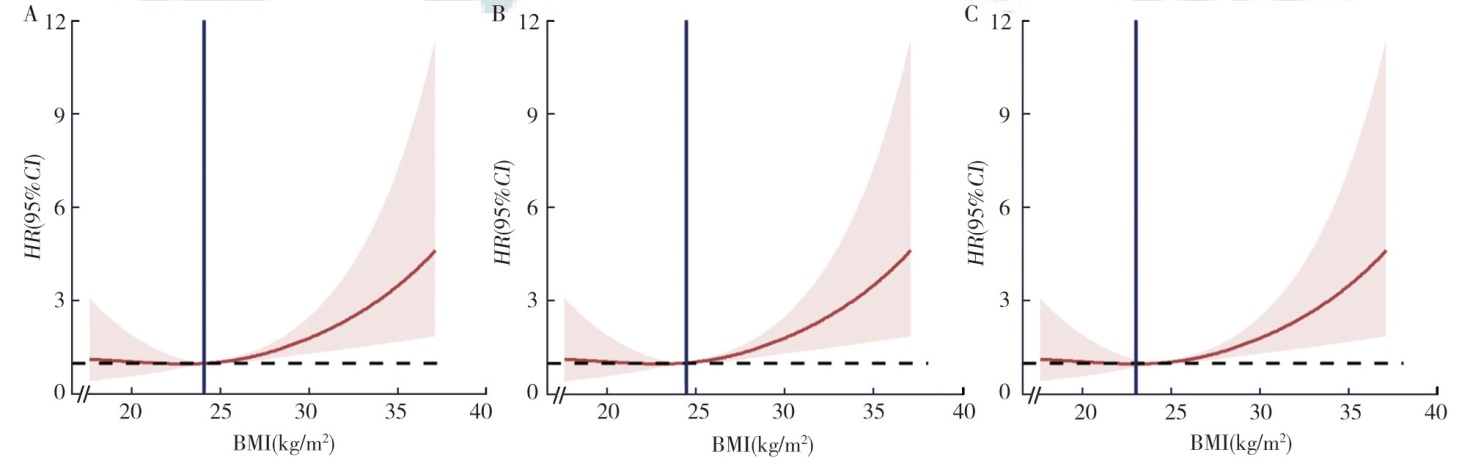
目的 探讨体质量指数(BMI)与不同绝经状态及分子分型浸润性乳腺癌患者生存预后的关系。方法 选取2015年1月1日至2019年12月31日在新疆医科大学附属肿瘤医院接受诊治的2 823例浸润性乳腺癌患者为研究对象。按照BMI临床分级标准划分为4个等级:BMI<18.5 kg/m2为过轻(n=57)、18.5 kg/m2≤BMI<24.0 kg/m2为正常(n=1 289)、24.0 kg/m2≤BMI<28.0 kg/m2为超重(n=1 061)、BMI≥28.0 kg/m2为肥胖(n=461)。绘制Kaplan-Meier生存曲线图,比较不同BMI乳腺癌患者的5年总生存(OS)率差异,并采用Cox比例风险回归模型分析BMI对不同绝经状态和分子分型乳腺癌患者预后的影响。采用RCS函数进一步研究BMI水平与全因死亡风险间的剂量-反应关系。结果 过轻、正常、超重、肥胖浸润性乳腺癌患者5年OS率分别为92.98%、96.59%、94.88%、90.67%,差异有统计学意义(χ2=22.11,P<0.001);正常患者5年OS率优于肥胖患者,差异有统计学意义(χ2=15.15,P<0.001)。单因素分析显示,肥胖是全体(HR=2.63,95%CI为1.73~4.00,P<0.001)、已绝经(HR=2.47,95%CI为1.52~4.02,P<0.001)、Luminal B型(HR=3.02,95%CI为1.64~5.59,P<0.001)、Luminal B已绝经(HR=2.65,95%CI为1.27~5.50,P=0.009)浸润性乳腺癌患者OS的影响因素。多因素分析显示,肥胖是全体(HR=1.79,95%CI为1.17~2.76,P=0.008)、已绝经(HR=1.98,95%CI为1.20~3.26,P=0.008)、Luminal B型(HR=2.36,95%CI为1.27~4.42,P=0.007)、Luminal B已绝经(HR=2.39,95%CI为1.12~5.11,P=0.024)浸润性乳腺癌患者OS的独立影响因素。BMI作为连续变量时,与全体、已绝经患者的OS呈“U”型曲线剂量-反应关系,最低风险点分别为24.04、24.43 kg/m2。结论 相对于BMI正常,肥胖显著降低了浸润性乳腺癌患者的OS率,而且肥胖是全体、已绝经、Luminal B型、Luminal B已绝经浸润性乳腺癌患者OS的独立影响因素。BMI水平与全体、已绝经浸润性乳腺癌患者OS呈现 “U”型曲线剂量-反应关系,患者BMI水平超过最低风险值,其死亡风险随BMI水平的增加而增加。
依帕拉·伊力哈木, 马涛, 王岩, 高春洁, 刘静, 赵婷, 王蕾. 体质量指数与不同绝经状态及分子分型乳腺癌患者生存预后的关系[J]. 国际肿瘤学杂志, 2025, 52(12): 745-757.
Yipala·Yilihamu , Ma Tao, Wang Yan, Gao Chunjie, Liu Jing, Zhao Ting, Wang Lei. Relationship between body mass indexes and survival prognosis of breast cancer patients with different menopausal status and molecular subtypes[J]. Journal of International Oncology, 2025, 52(12): 745-757.

表1
不同BMI水平浸润性乳腺癌患者一般临床资料比较[M(Q1,Q3)/例]"
| 一般临床资料 | 过轻(n=57) | 正常(n=1 289) | 超重 (n=1 016) | 肥胖(n=461) | H/χ2值 | P值 |
|---|---|---|---|---|---|---|
| 年龄(岁) | 48.87(39.09,56.25) | 50.39(45.71,56.85) | 53.70(48.37,59.59) | 56.45(49.93,65.28) | 156.64 | <0.001 |
| 绝经状态 | ||||||
| 未绝经 | 30 | 623 | 330 | 119 | 103.45 | <0.001 |
| 已绝经 | 27 | 666 | 686 | 342 | ||
| TNM分期 | ||||||
| Ⅰ | 24 | 523 | 341 | 113 | ||
| Ⅱ(ⅡA~ⅡB) | 27 | 552 | 491 | 230 | 49.50 | <0.001 |
| Ⅲ(ⅢA~ⅢC) | 6 | 214 | 184 | 118 | ||
| T分期 | ||||||
| T1 | 33 | 705 | 480 | 172 | 53.42 | <0.001 |
| T2 | 22 | 501 | 470 | 247 | ||
| T3 | 1 | 60 | 41 | 35 | ||
| T4 | 1 | 23 | 25 | 7 | ||
| N分期 | ||||||
| N0 | 35 | 764 | 558 | 206 | 30.16 | <0.001 |
| ≥N1 | 22 | 525 | 458 | 255 | ||
| 分子分型 | ||||||
| Luminal A型 | 5 | 198 | 174 | 66 | 7.91 | 0.544 |
| Luminal B型 | 39 | 749 | 577 | 279 | ||
| HER2阳性型 | 3 | 140 | 110 | 51 | ||
| TNBC | 10 | 202 | 155 | 65 | ||
| ER状态 | ||||||
| 阴性 | 44 | 923 | 738 | 333 | 1.03 | 0.794 |
| 阳性 | 13 | 366 | 278 | 128 | ||
| PR状态 | ||||||
| 阴性 | 40 | 826 | 667 | 307 | 1.82 | 0.611 |
| 阳性 | 17 | 463 | 349 | 154 | ||
| HER2状态 | ||||||
| 阴性 | 14 | 274 | 220 | 89 | 1.50 | 0.682 |
| 阳性 | 43 | 1 015 | 796 | 372 | ||
| 化疗 | ||||||
| 否 | 29 | 611 | 501 | 260 | 11.09 | 0.011 |
| 是 | 28 | 678 | 515 | 201 | ||
| 放疗 | ||||||
| 否 | 50 | 1 070 | 854 | 389 | 1.38 | 0.711 |
| 是 | 7 | 219 | 162 | 72 | ||
| 内分泌治疗 | ||||||
| 否 | 38 | 856 | 695 | 347 | 12.51 | 0.006 |
| 是 | 19 | 433 | 321 | 114 |
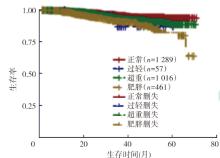
图1
不同BMI水平浸润性乳腺癌患者生存曲线图 注:BMI为体质量指数;过轻为BMI<18.5 kg/m2;正常为18.5 kg/m2≤BMI<24.0 kg/m2;超重为24.0 kg/m2≤BMI<28.0 kg/m2;肥胖为BMI≥28.0 kg/m2"
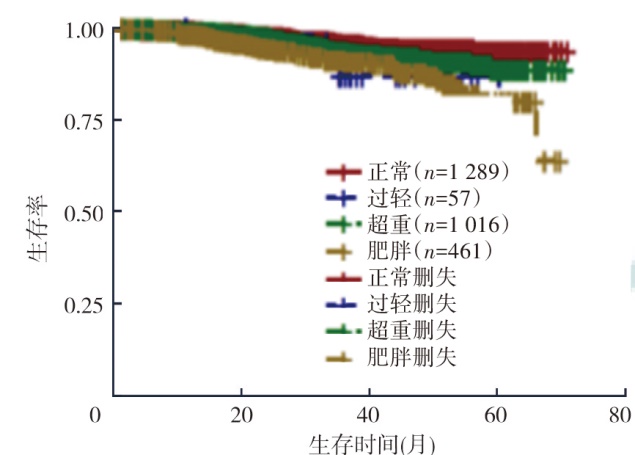
表2
影响2 823例浸润性乳腺癌患者OS的因素分析"
| 因素 | 单因素 | 多因素 | |||||
|---|---|---|---|---|---|---|---|
| HR值 | 95%CI | P值 | HR值 | 95%CI | P值 | ||
| BMI | |||||||
| 18.5 kg/m2≤BMI<24.0 kg/m2 | Ref | Ref | |||||
| BMI<18.5 kg/m2 | 2.22 | 0.80~6.18 | 0.127 | 3.68 | 1.30~10.37 | 0.014 | |
| 24.0 kg/m2≤BMI<28.0 kg/m2 | 1.50 | 1.01~2.24 | 0.048 | 1.41 | 0.94~2.12 | 0.099 | |
| BMI≥28.0 kg/m2 | 2.63 | 1.73~4.00 | <0.001 | 1.79 | 1.17~2.76 | 0.008 | |
| 绝经状态 | |||||||
| 未绝经 | Ref | Ref | |||||
| 已绝经 | 1.46 | 1.02~2.10 | 0.040 | 1.35 | 0.93~1.97 | 0.114 | |
| TNM分期 | |||||||
| Ⅰ | Ref | Ref | |||||
| Ⅱ(ⅡA~ⅡB) | 3.90 | 1.98~7.69 | <0.001 | 1.50 | 0.61~3.73 | 0.378 | |
| Ⅲ(ⅢA~ⅢC) | 16.26 | 8.43~31.36 | <0.001 | 4.82 | 1.77~13.13 | 0.002 | |
| T分期 | |||||||
| T1 | Ref | Ref | |||||
| T2 | 4.06 | 2.56~6.45 | <0.001 | 1.97 | 1.09~3.54 | 0.024 | |
| T3 | 10.18 | 5.71~18.16 | <0.001 | 2.28 | 1.11~4.68 | 0.025 | |
| T4 | 16.80 | 8.76~32.20 | <0.001 | 3.44 | 1.56~7.58 | 0.002 | |
| N分期 | |||||||
| N0 | Ref | Ref | |||||
| ≥N1 | 3.97 | 2.71~5.81 | <0.001 | 1.47 | 0.88~2.45 | 0.144 | |
| 分子分型 | |||||||
| Luminal A型 | Ref | Ref | |||||
| Luminal B型 | 2.49 | 1.14~5.42 | 0.021 | 1.44 | 0.65~3.17 | 0.366 | |
| HER2阳性型 | 4.20 | 1.78~9.94 | 0.001 | 0.47 | 0.11~1.91 | 0.288 | |
| TNBC | 6.47 | 2.92~14.32 | <0.001 | 0.99 | 0.25~3.91 | 0.992 | |
| ER状态 | |||||||
| 阴性 | Ref | Ref | |||||
| 阳性 | 2.67 | 1.92~3.71 | <0.001 | 2.63 | 1.04~6.63 | 0.041 | |
| PR状态 | |||||||
| 阴性 | Ref | Ref | |||||
| 阳性 | 2.50 | 1.80~3.48 | <0.001 | 1.61 | 0.89~2.92 | 0.114 | |
| HER2状态 | |||||||
| 阴性 | Ref | ||||||
| 阳性 | 0.74 | 0.51~1.08 | 0.117 | ||||
| 化疗 | |||||||
| 否 | Ref | Ref | |||||
| 是 | 0.42 | 0.29~0.61 | <0.001 | 0.56 | 0.38~0.82 | 0.003 | |
| 放疗 | |||||||
| 否 | Ref | ||||||
| 是 | 0.99 | 0.53~1.85 | 0.970 | ||||
| 内分泌治疗 | |||||||
| 否 | Ref | Ref | |||||
| 是 | 0.22 | 0.11~0.42 | <0.001 | 0.41 | 0.21~0.81 | 0.010 | |
表3
影响1 102例未绝经浸润性乳腺癌患者OS的因素分析"
| 因素 | 单因素 | 多因素 | |||||
|---|---|---|---|---|---|---|---|
| HR值 | 95%CI | P值 | HR值 | 95%CI | P值 | ||
| BMI | |||||||
| 18.5 kg/m2≤BMI<24.0 kg/m2 | Ref | ||||||
| BMI<18.5 kg/m2 | 2.62 | 0.60~11.45 | 0.202 | 4.43 | 0.95~20.65 | 0.058 | |
| 24.0 kg/m2≤BMI<28.0 kg/m2 | 2.27 | 1.14~4.50 | 0.019 | 2.03 | 0.99~4.13 | 0.050 | |
| BMI≥28.0 kg/m2 | 2.02 | 0.79~5.22 | 0.144 | 1.11 | 0.43~2.89 | 0.825 | |
| TNM分期 | |||||||
| Ⅰ | Ref | Ref | |||||
| Ⅱ(ⅡA~ⅡB) | 4.49 | 1.01~19.89 | 0.048 | 0.20 | 0.02~1.98 | 0.170 | |
| Ⅲ(ⅢA~ⅢC) | 23.66 | 5.62~99.69 | <0.001 | 0.75 | 0.08~7.52 | 0.809 | |
| T分期 | |||||||
| T1 | Ref | Ref | |||||
| T2 | 13.23 | 3.13~55.86 | <0.001 | 16.91 | 1.83~155.88 | 0.013 | |
| T3 | 26.72 | 5.55~128.67 | <0.001 | 15.57 | 1.49~163.10 | 0.022 | |
| T4 | 53.55 | 11.12~257.89 | <0.001 | 23.71 | 2.21~253.84 | 0.009 | |
| N分期 | |||||||
| N0 | Ref | Ref | |||||
| ≥N1 | 5.92 | 2.62~13.35 | <0.001 | 2.22 | 0.82~6.05 | 0.119 | |
| 分子分型 | |||||||
| Luminal A型 | Ref | Ref | |||||
| Luminal B型 | 4.38 | 0.59~32.42 | 0.149 | 2.16 | 0.29~16.32 | 0.457 | |
| HER2阳性型 | 9.74 | 1.17~80.96 | 0.035 | 2.86×10⁷ | 0.00~Inf | 0.996 | |
| TNBC | 8.18 | 1.05~63.42 | 0.044 | 4.12×10⁷ | 0.00~Inf | 0.996 | |
| ER状态 | |||||||
| 阴性 | Ref | Ref | |||||
| 阳性 | 2.12 | 1.14~3.94 | 0.018 | 0.00 | 0.00~Inf | 0.996 | |
| PR状态 | |||||||
| 阴性 | Ref | Ref | |||||
| 阳性 | 2.00 | 1.08~3.70 | 0.027 | 0.75 | 0.17~3.28 | 0.705 | |
| HER2状态 | |||||||
| 阴性 | Ref | ||||||
| 阳性 | 0.58 | 0.29~1.13 | 0.107 | ||||
| 化疗 | |||||||
| 否 | Ref | Ref | |||||
| 是 | 0.26 | 0.13~0.55 | <0.001 | 0.44 | 0.20~0.95 | 0.037 | |
| 放疗 | |||||||
| 否 | Ref | ||||||
| 是 | 0.91 | 0.27~3.03 | 0.873 | ||||
| 内分泌治疗 | |||||||
| 否 | Ref | Ref | |||||
| 是 | 0.18 | 0.05~0.58 | 0.004 | 0.37 | 0.11~1.27 | 0.109 | |
表4
影响1 721例已绝经浸润性乳腺癌患者OS的因素分析"
| 因素 | 单因素 | 多因素 | |||||
|---|---|---|---|---|---|---|---|
| HR值 | 95%CI | P值 | HR值 | 95%CI | P值 | ||
| BMI | |||||||
| 18.5 kg/m2≤BMI<24.0 kg/m2 | Ref | Ref | |||||
| BMI<18.5 kg/m2 | 2.11 | 0.50~8.87 | 0.306 | 2.73 | 0.64~1.67 | 0.175 | |
| 24.0 kg/m2≤BMI<28.0 kg/m2 | 1.19 | 0.72~1.95 | 0.498 | 1.24 | 0.75~2.06 | 0.410 | |
| BMI≥28.0 kg/m2 | 2.47 | 1.52~4.02 | <0.001 | 1.98 | 1.20~3.26 | 0.008 | |
| TNM分期 | |||||||
| Ⅰ | Ref | Ref | |||||
| Ⅱ(ⅡA~ⅡB) | 3.89 | 1.81~8.34 | <0.001 | 2.29 | 0.85~6.19 | 0.103 | |
| Ⅲ(ⅢA~ⅢC) | 14.47 | 6.89~30.36 | <0.001 | 6.85 | 2.23~21.06 | <0.001 | |
| T分期 | |||||||
| T1 | Ref | Ref | |||||
| T2 | 3.23 | 1.96~5.32 | <0.001 | 1.34 | 0.72~2.49 | 0.353 | |
| T3 | 9.45 | 4.93~18.12 | <0.001 | 1.77 | 0.80~3.91 | 0.160 | |
| T4 | 14.71 | 6.51~33.25 | <0.001 | 2.95 | 1.13~7.67 | 0.027 | |
| N分期 | |||||||
| N0 | Ref | Ref | |||||
| ≥N1 | 3.51 | 2.27~5.43 | <0.001 | 1.20 | 0.66~2.19 | 0.556 | |
| 分子分型 | |||||||
| Luminal A型 | Ref | Ref | |||||
| Luminal B型 | 2.25 | 0.96~5.28 | 0.061 | 1.26 | 0.53~3.02 | 0.597 | |
| HER2阳性型 | 3.30 | 1.27~8.58 | 0.015 | 0.22 | 0.05~1.01 | 0.051 | |
| TNBC | 6.63 | 2.79~15.75 | <0.001 | 0.53 | 0.12~2.34 | 0.401 | |
| ER状态 | |||||||
| 阴性 | Ref | Ref | |||||
| 阳性 | 2.88 | 1.95~4.24 | <0.001 | 3.98 | 1.52~10.41 | 0.005 | |
| PR状态 | |||||||
| 阴性 | Ref | Ref | |||||
| 阳性 | 2.66 | 1.79~3.96 | <0.001 | 2.05 | 1.05~4.02 | 0.036 | |
| HER2状态 | |||||||
| 阴性 | Ref | ||||||
| 阳性 | 0.83 | 0.52~1.31 | 0.422 | ||||
| 化疗 | |||||||
| 否 | Ref | Ref | |||||
| 是 | 0.52 | 0.34~0.80 | 0.003 | 0.61 | 0.39~0.95 | 0.030 | |
| 放疗 | |||||||
| 否 | Ref | ||||||
| 是 | 1.06 | 0.51~2.21 | 0.878 | ||||
| 内分泌治疗 | |||||||
| 否 | Ref | Ref | |||||
| 是 | 0.26 | 0.12~0.55 | <0.001 | 0.47 | 0.21~1.05 | 0.066 | |
表5
影响443例Luminal A型浸润性乳腺癌患者OS的单因素分析"
| 因素 | HR值 | 95%CI | P值 | 因素 | HR值 | 95%CI | P值 |
|---|---|---|---|---|---|---|---|
| BMI | N分期 | ||||||
| 18.5 kg/m2≤BMI<24.0 kg/m2 | Ref | N0 | Ref | ||||
| BMI<18.5 kg/m2 | 0.00 | 0.00~Inf | 0.999 | ≥N1 | 2.68 | 0.60~11.97 | 0.197 |
| 24.0 kg/m2≤BMI<28.0 kg/m2 | 3.49 | 0.36~33.52 | 0.280 | ER状态 | |||
| BMI≥28.0 kg/m2 | 9.40 | 0.98~90.37 | 0.052 | 阴性 | Ref | ||
| 绝经状态 | 阳性 | 0.00 | 0.00~Inf | 0.998 | |||
| 未绝经 | Ref | PR 状态 | |||||
| 已绝经 | 2.82 | 0.34~23.55 | 0.337 | 阴性 | Ref | ||
| TNM分期 | 阳性 | 2.12 | 0.25~17.59 | 0.487 | |||
| Ⅰ | Ref | 化疗 | |||||
| Ⅱ(ⅡA~ⅡB) | 3.58×10⁸ | 0.00~Inf | 0.998 | 否 | Ref | ||
| Ⅲ(ⅢA~ⅢC) | 1.65×10⁹ | 0.00~Inf | 0.998 | 是 | 0.28 | 0.03~2.32 | 0.237 |
| T分期 | 放疗 | ||||||
| T1 | Ref | 否 | Ref | ||||
| T2 | 6.89 | 0.72~66.23 | 0.095 | 是 | 0.00 | 0.00~Inf | 0.998 |
| T3 | 49.27 | 4.44~547.06 | 0.002 | 内分泌治疗 | |||
| T4 | 56.66 | 3.53~909.31 | 0.004 | 否 | Ref | ||
| 是 | 0.00 | 0.00~Inf | 0.998 |
表6
影响1 644例Luminal B型浸润性乳腺癌患者OS的因素分析"
| 因素 | 单因素 | 多因素 | |||||
|---|---|---|---|---|---|---|---|
| HR值 | 95%CI | P值 | HR值 | 95%CI | P值 | ||
| BMI | |||||||
| 18.5 kg/m2≤BMI<24.0 kg/m2 | Ref | Ref | |||||
| BMI<18.5 kg/m2 | 3.31 | 0.98~11.20 | 0.054 | 5.12 | 1.48~17.71 | 0.010 | |
| 24.0 kg/m2≤BMI<28.0 kg/m2 | 1.65 | 0.91~2.99 | 0.101 | 1.71 | 0.94~3.13 | 0.081 | |
| BMI≥28.0 kg/m2 | 3.02 | 1.64~5.59 | <0.001 | 2.36 | 1.27~4.42 | 0.007 | |
| 绝经状态 | |||||||
| 未绝经 | Ref | ||||||
| 已绝经 | 1.29 | 0.78~2.13 | 0.314 | ||||
| TNM分期 | |||||||
| Ⅰ | Ref | Ref | |||||
| Ⅱ(ⅡA~ⅡB) | 3.71 | 1.42~9.70 | 0.007 | 2.62 | 0.74~9.25 | 0.135 | |
| Ⅲ(ⅢA~ⅢC) | 13.80 | 5.44~35.03 | <0.001 | 9.23 | 2.19~38.84 | 0.002 | |
| T分期 | |||||||
| T1 | Ref | Ref | |||||
| T2 | 3.38 | 1.85~6.18 | <0.001 | 1.38 | 0.66~2.87 | 0.392 | |
| T3 | 5.20 | 2.00~13.54 | <0.001 | 0.99 | 0.33~2.94 | 0.988 | |
| T4 | 8.69 | 3.34~22.63 | <0.001 | 1.37 | 0.46~4.08 | 0.569 | |
| N分期 | |||||||
| N0 | Ref | Ref | |||||
| ≥N1 | 4.09 | 2.31~7.25 | <0.001 | 1.13 | 0.51~2.51 | 0.767 | |
| ER状态 | |||||||
| 阴性 | Ref | Ref | |||||
| 阳性 | 2.65 | 1.07~6.61 | 0.036 | 2.60 | 1.03~6.56 | 0.043 | |
| PR状态 | |||||||
| 阴性 | Ref | ||||||
| 阳性 | 1.61 | 0.88~2.94 | 0.124 | ||||
| HER2状态 | |||||||
| 阴性 | Ref | ||||||
| 阳性 | 0.63 | 0.36~1.10 | 0.106 | ||||
| 化疗 | |||||||
| 否 | Ref | Ref | |||||
| 是 | 0.44 | 0.26~0.75 | 0.002 | 0.49 | 0.28~0.85 | 0.012 | |
| 放疗 | |||||||
| 否 | Ref | ||||||
| 是 | 1.14 | 0.45~2.92 | 0.777 | ||||
| 内分泌治疗 | |||||||
| 否 | Ref | Ref | |||||
| 是 | 0.41 | 0.21~0.81 | 0.010 | 0.57 | 0.29~1.13 | 0.105 | |
表7
影响304例HER2浸润性乳腺癌患者OS的因素分析"
| 因素 | 单因素 | 多因素 | |||||
|---|---|---|---|---|---|---|---|
| HR值 | 95%CI | P值 | HR值 | 95%CI | P值 | ||
| BMI | |||||||
| 18.5 kg/m2≤BMI<24.0 kg/m2 | Ref | ||||||
| BMI<18.5 kg/m2 | 0.00 | 0.00~Inf | 0.997 | ||||
| 24.0 kg/m2≤BMI<28.0 kg/m2 | 0.87 | 0.28~2.65 | 0.804 | ||||
| BMI≥28.0 kg/m2 | 2.48 | 0.90~6.84 | 0.080 | ||||
| 绝经状态 | |||||||
| 未绝经 | Ref | ||||||
| 已绝经 | 0.91 | 0.35~2.36 | 0.842 | ||||
| TNM分期 | |||||||
| Ⅰ | Ref | Ref | |||||
| Ⅱ(ⅡA~ⅡB) | 1.38 | 0.27~7.10 | 0.704 | 0.10 | 0.01~1.26 | 0.075 | |
| Ⅲ(ⅢA~ⅢC) | 7.31 | 1.65~32.47 | 0.009 | 0.12 | 0.01~1.90 | 0.133 | |
| T分期 | |||||||
| T1 | Ref | Ref | |||||
| T2 | 2.81 | 0.60~13.30 | 0.192 | 5.10 | 0.40~64.71 | 0.209 | |
| T3 | 13.78 | 2.92~65.17 | <0.001 | 16.98 | 1.09~264.73 | 0.043 | |
| T4 | 40.74 | 5.67~292.72 | <0.001 | 43.87 | 2.14~897.22 | 0.014 | |
| N分期 | |||||||
| N0 | Ref | Ref | |||||
| ≥N1 | 8.71 | 2.02~37.54 | 0.004 | 8.05 | 1.05~61.71 | 0.045 | |
| 化疗 | |||||||
| 否 | Ref | ||||||
| 是 | 0.56 | 0.22~1.41 | 0.216 | ||||
| 放疗 | |||||||
| 否 | Ref | ||||||
| 是 | 0.43 | 0.06~3.25 | 0.414 | ||||
| 内分泌治疗 | |||||||
| 否 | Ref | ||||||
| 是 | 0.00 | 0.00~Inf | 0.997 | ||||
表8
影响432例TNBC浸润性乳腺癌患者OS的因素分析"
| 因素 | 单因素 | 多因素 | |||||
|---|---|---|---|---|---|---|---|
| HR值 | 95%CI | P值 | HR值 | 95%CI | P值 | ||
| BMI | |||||||
| 18.5 kg/m2≤BMI<24.0 kg/m2 | Ref | ||||||
| BMI<18.5 kg/m2 | 1.52 | 0.20~11.52 | 0.685 | ||||
| 24.0 kg/m2≤BMI<28.0 kg/m2 | 1.58 | 0.81~3.07 | 0.180 | ||||
| BMI≥28.0 kg/m2 | 1.89 | 0.88~4.08 | 0.104 | ||||
| 绝经状态 | |||||||
| 未绝经 | Ref | Ref | |||||
| 已绝经 | 2.10 | 1.07~4.13 | 0.031 | 1.80 | 0.91~3.56 | 0.093 | |
| TNM分期 | |||||||
| Ⅰ | Ref | Ref | |||||
| Ⅱ(ⅡA~ⅡB) | 3.43 | 1.01~11.64 | 0.048 | 0.94 | 0.18~5.06 | 0.944 | |
| Ⅲ(ⅢA~ⅢC) | 17.24 | 5.22~56.99 | <0.001 | 3.06 | 0.51~18.25 | 0.220 | |
| T分期 | |||||||
| T1 | Ref | Ref | |||||
| T2 | 4.06 | 1.68~9.80 | 0.002 | 3.21 | 0.99~10.42 | 0.052 | |
| T3 | 7.48 | 2.51~22.26 | <0.001 | 3.55 | 0.90~14.07 | 0.071 | |
| T4 | 23.46 | 7.51~73.22 | <0.001 | 6.12 | 1.41~26.61 | 0.016 | |
| N分期 | |||||||
| N0 | Ref | Ref | |||||
| ≥N1 | 3.74 | 2.02~6.90 | <0.001 | 1.77 | 0.82~3.83 | 0.146 | |
| 化疗 | |||||||
| 否 | Ref | Ref | |||||
| 是 | 0.30 | 0.15~0.58 | <0.001 | 0.47 | 0.23~0.96 | 0.037 | |
| 放疗 | |||||||
| 否 | Ref | ||||||
| 是 | 1.16 | 0.45~3.00 | 0.760 | ||||
| 内分泌 | |||||||
| 否 | Ref | ||||||
| 是 | 0.00 | 0.00~Inf | 0.995 | ||||
表9
影响691例Luminal B未绝经浸润性乳腺癌患者OS的因素分析"
| 因素 | 单因素 | 多因素 | |||||
|---|---|---|---|---|---|---|---|
| HR值 | 95%CI | P值 | HR值 | 95%CI | P值 | ||
| BMI | |||||||
| 18.5 kg/m2≤BMI<24.0 kg/m2 | Ref | ||||||
| BMI<18.5 kg/m2 | 4.91 | 1.02~23.68 | 0.048 | 6.28 | 1.28~30.81 | 0.024 | |
| 24.0 kg/m2≤BMI<28.0 kg/m2 | 2.64 | 1.01~6.95 | 0.049 | 1.94 | 0.73~5.13 | 0.183 | |
| BMI≥28.0 kg/m2 | 3.05 | 0.89~10.42 | 0.075 | 1.96 | 0.57~6.77 | 0.288 | |
| TNM分期 | |||||||
| Ⅰ | Ref | ||||||
| Ⅱ(ⅡA~ⅡB) | 1.33×10⁸ | 0.00~Inf | 0.997 | ||||
| Ⅲ(ⅢA~ⅢC) | 5.57×10⁸ | 0.00~Inf | 0.997 | ||||
| T分期 | |||||||
| T1 | Ref | ||||||
| T2 | 5.73×10⁸ | 0.00~Inf | 0.997 | ||||
| T3 | 7.21×10⁸ | 0.00~Inf | 0.997 | ||||
| T4 | 1.12×10⁹ | 0.00~Inf | 0.997 | ||||
| N分期 | |||||||
| N0 | Ref | Ref | |||||
| ≥N1 | 7.04 | 2.09~23.69 | 0.002 | 6.84 | 1.99~23.51 | 0.002 | |
| ER状态 | |||||||
| 阴性 | Ref | ||||||
| 阳性 | 0.00 | 0.00~Inf | 0.997 | ||||
| PR状态 | |||||||
| 阴性 | Ref | ||||||
| 阳性 | 1.00 | 0.23~4.26 | 0.998 | ||||
| 化疗 | |||||||
| 否 | Ref | Ref | |||||
| 是 | 0.36 | 0.14~0.91 | 0.032 | 0.35 | 0.14~0.88 | 0.027 | |
| 放疗 | |||||||
| 否 | Ref | ||||||
| 是 | 0.83 | 0.11~6.50 | 0.859 | ||||
| 内分泌治疗 | |||||||
| 否 | Ref | ||||||
| 是 | 0.30 | 0.09~1.03 | 0.055 | ||||
表10
影响953例Luminal B已绝经浸润性乳腺癌患者OS的因素分析"
| 因素 | 单因素 | 多因素 | |||||
|---|---|---|---|---|---|---|---|
| HR值 | 95%CI | P值 | HR值 | 95%CI | P值 | ||
| BMI | |||||||
| 18.5 kg/m2≤BMI<24.0 kg/m2 | Ref | Ref | |||||
| BMI<18.5 kg/m2 | 2.15 | 0.28~16.53 | 0.463 | 3.37 | 0.41~27.46 | 0.257 | |
| 24.0 kg/m2≤BMI<28.0 kg/m2 | 1.24 | 0.58~2.66 | 0.575 | 1.42 | 0.66~3.09 | 0.372 | |
| BMI≥28.0 kg/m2 | 2.65 | 1.27~5.50 | 0.009 | 2.39 | 1.12~5.11 | 0.024 | |
| TNM分期 | |||||||
| Ⅰ | Ref | ||||||
| Ⅱ(ⅡA~ⅡB) | 2.64 | 0.97~7.15 | 0.057 | 2.71 | 0.70~10.58 | 0.151 | |
| Ⅲ(ⅢA~ⅢC) | 9.01 | 3.43~23.65 | <0.001 | 8.97 | 1.84~43.77 | 0.007 | |
| T分期 | |||||||
| T1 | Ref | Ref | |||||
| T2 | 2.04 | 1.06~3.90 | 0.032 | 0.86 | 0.38~1.93 | 0.715 | |
| T3 | 3.89 | 1.12~13.55 | 0.033 | 0.81 | 0.20~3.26 | 0.770 | |
| T4 | 6.42 | 1.84~22.40 | 0.004 | 1.11 | 0.28~4.48 | 0.884 | |
| N分期 | |||||||
| N0 | Ref | Ref | |||||
| ≥N1 | 3.38 | 1.74~6.54 | <0.001 | 1.06 | 0.40~2.81 | 0.905 | |
| ER状态 | |||||||
| 阴性 | Ref | Ref | |||||
| 阳性 | 3.39 | 1.33~8.63 | 0.010 | 3.61 | 1.37~9.47 | 0.009 | |
| PR状态 | |||||||
| 阴性 | Ref | ||||||
| 阳性 | 1.74 | 0.88~3.43 | 0.109 | ||||
| 化疗 | |||||||
| 否 | Ref | Ref | |||||
| 是 | 0.49 | 0.26~0.93 | 0.030 | 0.48 | 0.25~0.93 | 0.029 | |
| 放疗 | |||||||
| 否 | Ref | ||||||
| 是 | 1.34 | 0.47~3.85 | 0.583 | ||||
| 内分泌治疗 | |||||||
| 否 | Ref | ||||||
| 是 | 0.52 | 0.23~1.17 | 0.113 | ||||
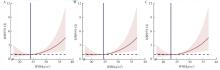
图2
BMI水平与浸润性乳腺癌患者不同终点间的多变量限制3次样条图 A为全体患者;B为已绝经;C为Luminal B型 注:BMI为体质量指数;红色实线代表HR,阴影部分代表95%CI,蓝色实线代表发生风险的转折点;根据绝经状态、TNM分期、T分期、 N分期、分子分型、雌激素受体状态、孕激素受体状态、人表皮生长因子受体状态、化疗、内分泌治疗进行了调整"
| [1] | Kivimäki M, Strandberg T, Pentti J, et al. Body-mass index and risk of obesity-related complex multimorbidity: an observational multicohort study[J]. Lancet Diabetes Endocrinol, 2022, 10(4): 253-263. DOI: 10.1016/S2213-8587(22)00033-X. |
| [2] | Ma L, Liu A, Gao J, et al. The prognostic impact of body mass index on female breast cancer patients in underdeveloped regions of northern China differs by menopause status and tumor molecular subtype[J]. Open Life Sci, 2023, 18(1): 20220748. DOI: 10.1515/biol-2022-0748. |
| [3] | Bellini A, Keegan THM, Li Q, et al. The effect of body mass index on breast cancer stage and breast cancer specific survival[J]. Breast Cancer Res Treat, 2025, 211(3): 649-656. DOI: 10.1007/s10549-025-07678-7. |
| [4] | Kawai M, Tomotaki A, Miyata H, et al. Body mass index and survival after diagnosis of invasive breast cancer: a study based on the Japanese national clinical database-breast cancer registry[J]. Cancer Med, 2016, 5(6): 1328-1340. DOI: 10.1002/cam4.678. |
| [5] | Moon HG, Han W, Noh DY. Underweight and breast cancer recurrence and death: a report from the Korean Breast Cancer Society[J]. J Clin Oncol, 2009, 27(35): 5899-5905. DOI: 10.1200/JCO.2009.22.4436. |
| [6] |
Obermair A, Kurz C, Hanzal E, et al. The influence of obesity on the disease-free survival in primary breast cancer[J]. Anticancer Res, 1995, 15(5B): 2265-2269.
pmid: 8572635 |
| [7] |
Dignam JJ, Wieand K, Johnson KA, et al. Obesity, tamoxifen use, and outcomes in women with estrogen receptor-positive early-stage breast cancer[J]. J Natl Cancer Inst, 2003, 95(19): 1467-1476. DOI: 10.1093/jnci/djg060.
pmid: 14519753 |
| [8] | Lacroix M, Toillon RA, Leclercq G. Stable 'portrait' of breast tumors during progression: data from biology, pathology and genetics[J]. Endocr Relat Cancer, 2004, 11(3): 497-522. DOI: 10.1677/erc.1.00758. |
| [9] | Youn HJ, Han W. A review of the epidemiology of breast cancer in Asia: focus on risk factors[J]. Asian Pac J Cancer Prev, 2020, 21(4): 867-880. DOI: 10.31557/APJCP.2020.21.4.867. |
| [10] |
Biglia N, Peano E, Sgandurra P, et al. Body mass index (BMI) and breast cancer: impact on tumor histopathologic features, cancer subtypes and recurrence rate in pre and postmenopausal women[J]. Gynecol Endocrinol, 2013, 29(3): 263-267. DOI: 10.3109/09513 590.2012.736559.
pmid: 23174088 |
| [11] | 中国抗癌协会乳腺癌专业委员会. 中国抗癌协会乳腺癌诊治指南与规范(2013版)[J]. 中国癌症杂志, 2013(8): 637-684. |
| [12] | 祁玉娟, 李积德, 赵君慧, 等. 西宁市女性乳腺癌影响因素及对策分析[J]. 中国肿瘤临床, 2009, 36(20): 1167-1168. DOI: 10.3969/j.issn.1000-8179.2009.20.008. |
| [13] |
Chan DSM, Vieira AR, Aune D, et al. Body mass index and survival in women with breast cancer—systematic literature review and meta-analysis of 82 follow-up studies[J]. Ann Oncol, 2014, 25(10): 1901-1914. DOI: 10.1093/annonc/mdu042.
pmid: 24769692 |
| [14] | 张钰梓, 瞿晴, 毛艳, 等. 身体质量指数对中国女性乳腺癌患者预后的影响[J]. 中华肿瘤杂志, 2015(5): 395-399. DOI: 10.3760/cma.j.issn.0253-3766.2015.05.018. |
| [15] | 黄良平, 耿兴荣, 于永进. 体质量指数对乳腺癌女性生存状况的影响[J]. 检验医学与临床, 2017, 14(3): 423-425. DOI: 10.3969/j.issn.1672-9455.2017.03.045. |
| [16] | Wang K, Wu YT, Zhang X, et al. Clinicopathologic and prognostic significance of body mass index (BMI) among breast cancer patients in Western China: a retrospective multicenter cohort based on Western China Clinical Cooperation Group (WCCCG)[J]. Biomed Res Int, 2019, 2019: 3692093. DOI: 10.1155/2019/3692093. |
| [17] | Lin AD, Mannikarottu A, Kogan BA, et al. Estrogen induces angiogenesis of the female rabbit bladder[J]. J Endocrinol, 2006, 190(2): 241-246. DOI: 10.1677/joe.1.06701. |
| [18] | Maehle BO, Tretli S. Pre-morbid body-mass-index in breast cancer: reversed effect on survival in hormone receptor negative patients[J]. Breast Cancer Res Treat, 1996, 41(2): 123-130. DOI: 10.1007/BF01807157. |
| [19] |
Griggs JJ, Sorbero MES, Lyman GH. Undertreatment of obese women receiving breast cancer chemotherapy[J]. Arch Intern Med, 2005, 165(11): 1267-1273. DOI: 10.1001/archinte.165.11.1267.
pmid: 15956006 |
| [20] |
Zhang M, Cai H, Bao P, et al. Body mass index, waist-to-hip ratio and late outcomes: a report from the Shanghai breast cancer survival study[J]. Sci Rep, 2017, 7(1): 6996. DOI: 10.1038/s41598-017-07320-7.
pmid: 28765555 |
| [21] | Wei W, Wei S, Huang Z, et al. The relationship between women's body mass index and breast cancer outcomes was U-shaped[J]. Front Oncol, 2023, 13: 1191093. DOI: 10.3389/fonc.2023.1191093. |
| [22] |
Lee KR, Hwang IC, Han KD, et al. Waist circumference and risk of breast cancer in Korean women: a nationwide cohort study[J]. Int J Cancer, 2018, 142(8): 1554-1559. DOI: 10.1002/ijc.31180.
pmid: 29193045 |
| [1] | 邱可欣, 李梦真, 国浩然, 凡梦思, 闫莉. 老年晚期卵巢癌患者不同手术方式的预后分析[J]. 国际肿瘤学杂志, 2025, 52(9): 576-582. |
| [2] | 刘美, 胡玉崇, 李凤桐, 朝乐门, 柳檬, 亢琳琳. SHCBP1在恶性肿瘤中的作用机制及临床研究进展[J]. 国际肿瘤学杂志, 2025, 52(9): 583-586. |
| [3] | 郭俊龙, 邹睿琪, 陈少强, 梁雨欣, 李菁, 雍苏南, 何玉婷, 谢小兵, 李萍. RNA m6A修饰在乳腺癌中的研究进展[J]. 国际肿瘤学杂志, 2025, 52(8): 532-537. |
| [4] | 李成强, 王云刚, 余以珊, 吴仕章, 陶城, 马星民, 戴天缘, 段敬豪, 陈进琥, 白曈, 朱健. 乳腺癌4例质子放疗剂量学特点分析[J]. 国际肿瘤学杂志, 2025, 52(7): 448-454. |
| [5] | 黎立喜, 段博识, 钱海利, 马飞. 乳腺癌类器官在临床及转化应用中的进展[J]. 国际肿瘤学杂志, 2025, 52(6): 379-381. |
| [6] | 周文考, 黄何森, 潘艺梅, 黄灵炎, 王明山, 赵方俐, 王娅, 唐慧敏. 基于2型糖尿病的乳腺癌患者无复发生存预测模型构建与效能比较[J]. 国际肿瘤学杂志, 2025, 52(5): 295-303. |
| [7] | 芦兵, 熊思玉, 蒋汶宏, 俞婷婷. 果糖二磷酸醛缩酶A在肺癌中的研究进展[J]. 国际肿瘤学杂志, 2025, 52(4): 242-245. |
| [8] | 杨胜军, 任江, 杨丹, 龙宇, 商群献. 非小细胞肺癌组织中miR-4262、NRG1的表达水平及临床意义[J]. 国际肿瘤学杂志, 2025, 52(3): 129-135. |
| [9] | 王逸, 王强力, 张甲, 杨懿瑾, 王盛. 结直肠癌肝转移患者组织中SUCNR1和YBX1的表达与临床病理特征及预后的关系[J]. 国际肿瘤学杂志, 2025, 52(3): 152-157. |
| [10] | 韩涛, 贾沛沛, 鲁静. iRhom1、iRhom2、TNF-α水平对宫颈癌患者预后的预测价值[J]. 国际肿瘤学杂志, 2025, 52(3): 158-162. |
| [11] | 叶永英, 邹艳, 陈天明, 吴伟莉. 时钟基因Period家族在头颈鳞状细胞癌中的研究进展[J]. 国际肿瘤学杂志, 2025, 52(2): 113-118. |
| [12] | 陈丹蕾, 邓隽军, 李淼. 循环肿瘤细胞在肺癌中的临床应用进展[J]. 国际肿瘤学杂志, 2025, 52(2): 119-123. |
| [13] | 王智宝, 李广现, 张昕昕, 崔伟, 张微. MRI联合血清lncRNA KCNQ1OT1、miR-204-5p对乳腺癌腋窝淋巴结转移的预测价值[J]. 国际肿瘤学杂志, 2025, 52(2): 89-93. |
| [14] | 姬海涛, 王延峰, 刘永成, 郝楠. 基于生物信息学分析DHCR7在胃癌中的表达及临床意义[J]. 国际肿瘤学杂志, 2025, 52(2): 94-100. |
| [15] | 刘萍萍, 王俊毅, 林志伟, 陈大朝. 胃癌术后腹膜转移患者预后的影响因素分析[J]. 国际肿瘤学杂志, 2025, 52(12): 764-769. |
| 阅读次数 | ||||||
|
全文 |
|
|||||
|
摘要 |
|
|||||
