国际肿瘤学杂志 ›› 2025, Vol. 52 ›› Issue (9): 566-575.doi: 10.3760/cma.j.cn371439-20250417-00096

• 论著 • 上一篇    下一篇

直肠癌盆腔调强放疗中腹围对肠道受照剂量体积及急性肠道毒性影响的前瞻性队列研究

吴松友1,2, 王刚1,2,3(), 王文玲1,2,3, 董洪敏1,2,3, 陈唯唯1,2,3, 李小凯1,2,3, 陈望花1,2,3, 左凯1,2,3   

  1. 1贵州医科大学临床医学院肿瘤学教研室,贵阳 550004
    2贵州医科大学附属肿瘤医院腹部肿瘤科,贵阳 550008
    3贵州医科大学附属医院肿瘤科,贵阳 550001
  • 收稿日期:2025-04-17 修回日期:2025-05-18 出版日期:2025-09-08 发布日期:2025-10-21
  • 通讯作者: 王刚 E-mail:389896586@qq.com
  • 基金资助:
    贵州省抗癌协会科技计划(Kang Xie Ke Ji 010 〔2023〕)

Prospective cohort study on the effect of abdominal circumference on the intestinal radiation dose volume and the acute intestinal toxicity in pelvic intensity modulated radiation therapy for rectal cancer patients

Wu Songyou1,2, Wang Gang1,2,3(), Wang Wenling1,2,3, Dong Hongmin1,2,3, Chen Weiwei1,2,3, Li Xiaokai1,2,3, Chen Wanghua1,2,3, Zuo Kai1,2,3   

  1. 1Department of Oncology, Clinical Medical College of Guizhou Medical University, Guiyang 550004, China
    2Department of Abdominal Oncology, Affiliated Cancer Hospital of Guizhou Medical University, Guiyang 550008, China
    3Department of Oncology, Affiliated Hospital of Guizhou Medical University, Guiyang 550001, China
  • Received:2025-04-17 Revised:2025-05-18 Online:2025-09-08 Published:2025-10-21
  • Contact: Wang Gang E-mail:389896586@qq.com
  • Supported by:
    Science and Technology Program of Guizhou Province Anti-Cancer Association(Kang Xie Ke Ji 010 〔2023〕)

摘要:

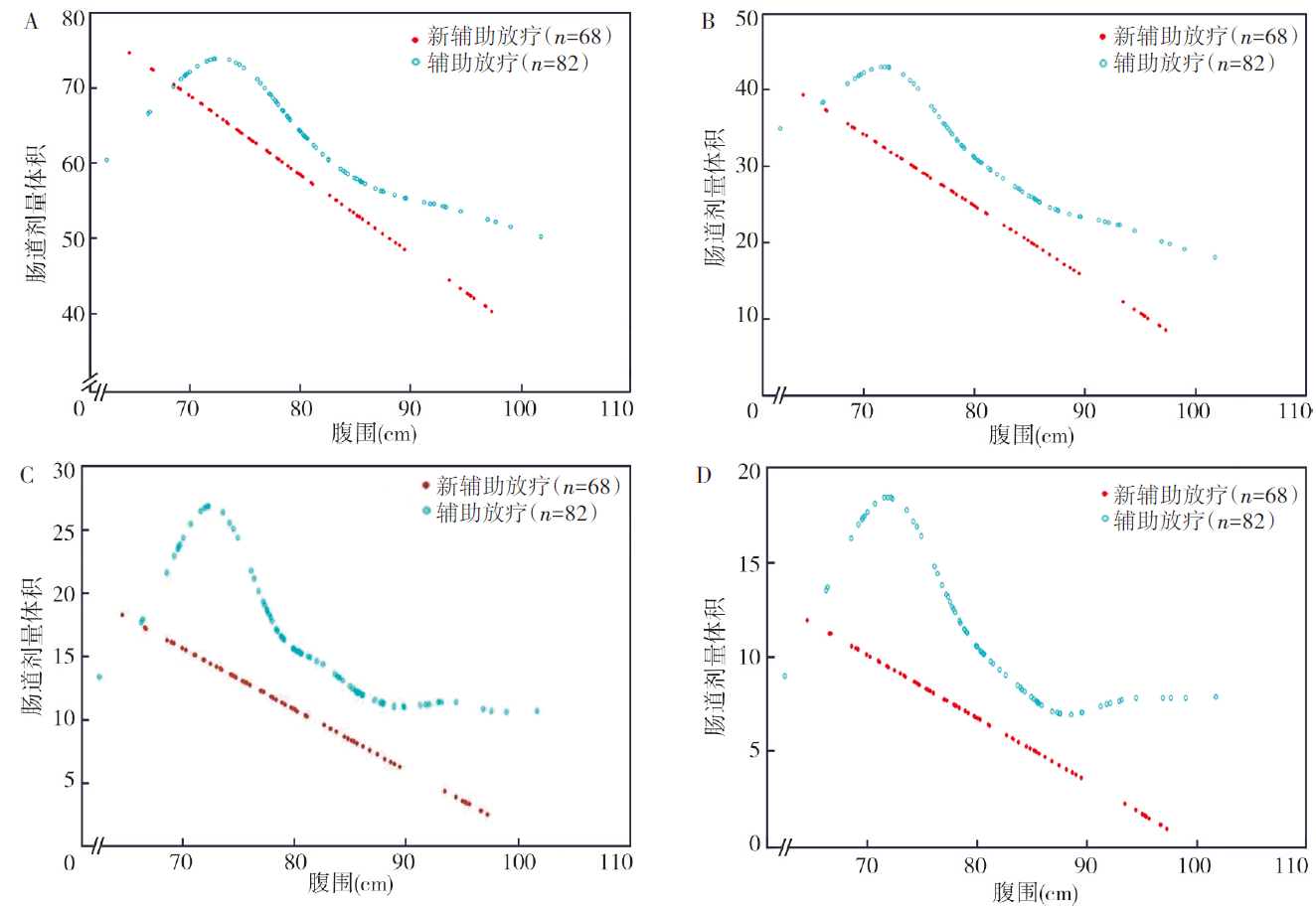
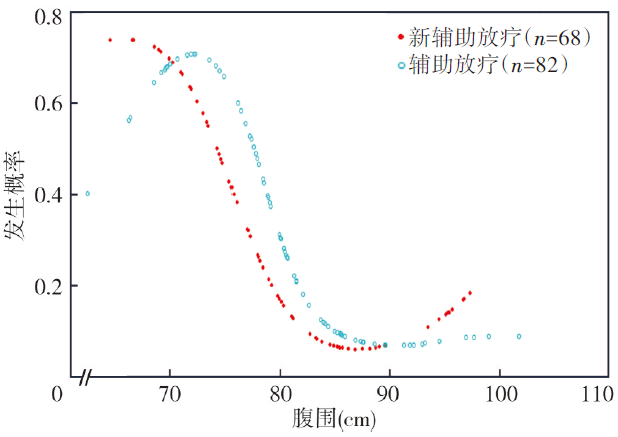
目的 探究直肠癌盆腔调强放疗中腹围对肠道受照剂量体积及急性肠道毒性的影响。方法 收集2023年3月至2025年1月在贵州医科大学附属肿瘤医院接受辅助和新辅助同步放化疗治疗的150例局部进展期直肠癌(LARC)患者,其中辅助放疗82例,新辅助放疗68例。所有患者均按俯卧位垫腹板并膀胱充盈的标准模式进行放疗CT模拟定位。根据是否发生≥2级急性肠道毒性将肠道毒性处理为二分类变量。采用线性及logistic回归模型分析LARC患者各个肠道受照剂量体积(V10、V20、V30、V40)、急性肠道毒性的影响因素,采用广义相加模型和分段线性及logistic回归分析腹围与肠道受照剂量体积和急性肠道毒性的阈值效应。根据阈值95%CI上限确定腹围界值,利用差异性检验验证小腹围和中大腹围在肠道受照剂量体积和急性肠道毒性的差异。结果 单因素分析显示,性别、体质量、腹围、计划靶区(PTV)、肠道体积均是辅助放疗LARC患者各个肠道受照剂量体积(V10、V20、V30、V40)的影响因素(均P<0.05),体质量、腹围、肠道体积均是新辅助放疗LARC患者各个肠道受照剂量体积(V10、V20、V30、V40)的影响因素(均P<0.05),体质量指数(BMI)、腹围、肠道体积、各个肠道受照体积(V10、V20、V30、V40)均是辅助放疗LARC患者急性肠道毒性的影响因素(均P<0.05),体质量、BMI、腹围、多个肠道受照剂量体积(V20、V30、V40)均是新辅助放疗LARC患者急性肠道毒性的影响因素(均P<0.05)。多因素分析显示,腹围(V10β=-1.01,95%CI为-1.68~-0.33,P=0.004;V20β=-0.94,95%CI为-1.28~-0.60,P<0.001;V30β=-0.58,95%CI为-0.82~-0.34,P<0.001;V40β=-0.41,95%CI为-0.60~-0.23,P<0.001)是辅助放疗LARC患者各个肠道受照剂量体积的独立影响因素,腹围(V10β=-0.92,95%CI为-1.62~-0.22,P=0.010;V20β=-0.84,95%CI为-1.11~-0.57,P<0.001;V30β=-0.42,95%CI为-0.57~-0.28,P<0.001;V40β=-0.30,95%CI为-0.41~-0.19,P<0.001)是新辅助放疗LARC患者各个肠道受照剂量体积的独立影响因素,腹围(OR=0.86,95%CI为0.78~0.95,P=0.002)是辅助放疗LARC患者急性肠道毒性的独立影响因素,腹围(OR=0.87,95%CI为0.79~0.96,P=0.004)是新辅助放疗LARC患者急性肠道毒性的独立影响因素。广义相加模型发现腹围与辅助放疗患者肠道受照剂量体积和急性肠道毒性存在非线性关系。进一步分段回归分析结果显示,腹围与肠道受照剂量体积(V10、V20、V30、V40)和急性肠道毒性间存在阈值效应,腹围与辅助放疗LARC患者肠道受照剂量体积V10、V20、V30、V40间的拐点值均为71.9 cm;腹围与新辅助放疗LARC患者肠道受照剂量体积V10、V20、V30、V40间的拐点值分别为69.0、69.0、69.0、68.6 cm;腹围与辅助放疗、新辅助放疗LARC患者急性肠道毒性的拐点值分别为71.9、69.0 cm。根据阈值95%CI上限将辅助和新辅助放疗患者的小腹围与中大腹围界值分别设定为76.1 cm和71.9 cm。在辅助放疗患者中,小腹围患者(n=22)不同水平肠道受照剂量体积V10[(7.65±2.29)cm3比(5.88±2.68)cm3t=2.76,P=0.007]、V20[(4.28±1.27)cm3比(2.72±1.31)cm3t=4.81,P<0.001]、V30[(2.42±1.07)cm3比(1.37±0.76)cm3t=4.95,P<0.001]、V40[(1.69±0.74)cm3比(0.92±0.58)cm3t=4.93,P<0.001]均显著高于中大腹围患者(n=60);在新辅助放疗患者中,小腹围患者(n=11)V20[(3.09±0.84)cm3比(2.28±1.17)cm3t=2.17,P=0.033]、V30[1.44(1.22,1.53)cm3比0.91(0.56,1.22)cm3Z=-3.04,P=0.002]、V40[0.93(0.84,1.09)cm3比0.44(0.30,0.81)cm3Z=-3.19,P=0.001]均显著高于中大腹围患者(n=57)。在辅助放疗及新辅助放疗患者中,小腹围患者与中大腹围患者急性肠道毒性差异均有统计学意义(χ2 =10.46,P=0.001;χ2 =8.13,P=0.004)。结论 在标准模式下(俯卧位垫腹板并充盈膀胱),腹围是直肠癌放疗患者肠道受照剂量体积及急性放射性肠道毒性的独立影响因素。腹围与不同水平的肠道受照剂量体积和急性肠道毒性间存在明显的非线性阈值效应,在拐点值前后腹围对肠道受照剂量体积和毒性的影响存在显著差异。小腹围患者在现有标准放疗模式下不仅未获得预期获益,反而面临更高的肠道受照体积和毒性风险。


关键词: 直肠肿瘤, 化放疗, 腹围, 肠道剂量体积, 急性肠道毒性

Abstract:

Objective To investigate the effect of abdominal circumference on intestinal radiation dose volume and acute intestinal toxicity in pelvic intensity modulated radiation therapy for rectal cancer. Methods A total of 150 patients with locally advanced rectal cancer (LARC) who received adjuvant and neoadjuvant concurrent chemoradiotherapy at the Affiliated Cancer Hospital of Guizhou Medical University from March 2023 to January 2025 were enrolled, including 82 cases of adjuvant radiotherapy and 68 cases of neoadjuvant radiotherapy. All patients underwent radiotherapy CT simulation positioning in the standard mode of prone position with abdominal board padding and bladder filling. Intestinal toxicity was categorized as a binary variable based on the occurrence of ≥2 grade acute intestinal toxicity. Linear and logistic regression models were used to analyze the factors influencing intestinal radiation dose volumes (V10, V20, V30, V40) and acute intestinal toxicity in LARC patients. Generalized additive models and piecewise linear and logistic regression analyses were employed to examine the threshold effects of abdominal circumference on intestinal radiation dose volumes and acute intestinal toxicity. The threshold value for abdominal circumference was determined based on the upper limit of the 95%CI for the threshold. A difference test was used to validate the differences in intestinal radiation dose volume and acute intestinal toxicity between small and medium-to-large abdominal circumferences. Results Univariate analysis showed that, gender, body mass, abdominal circumference, planning target volume (PTV), intestinal volume were all influencing factors for the radiation dose volumes (V10, V20, V30, V40) of each intestinal segment of patients with LARC undergoing adjuvant radiotherapy (all P<0.05). Body mass, abdominal circumference, intestinal volume were all influencing factors for the radiation dose volumes (V10, V20, V30, V40) of each intestinal segment of patients with LARC undergoing neoadjuvant radiotherapy (all P<0.05). Body mass index (BMI), abdominal circumference, intestinal volume and individual intestinal radiation volumes (V10, V20, V30, V40) were all influencing factors for the acute intestinal toxicity of patients with LARC undergoing adjuvant radiotherapy (all P<0.05). Body mass, BMI, abdominal circumference, multiple intestinal radiation dose volumes(V20, V30, V40) were all influencing factors for the acute intestinal toxicity of patients with LARC undergoing neoadjuvant radiotherapy (all P<0.05). Multivariate analysis showed that, abdominal circumference (V10β=-1.01, 95%CI: -1.68--0.33, P=0.004; V20β=-0.94, 95%CI: -1.28--0.60, P<0.001; V30β=-0.58, 95%CI: -0.82--0.34, P<0.001; V40β=-0.41, 95%CI: -0.60--0.23, P<0.001) was an independent influencing factor for the radiation dose volume of each intestinal segment of patients with LARC undergoing adjuvant radiotherapy. Abdominal circumference (V10β=-0.92, 95%CI: -1.62--0.22, P=0.010; V20β=-0.84, 95%CI: -1.11--0.57, P<0.001; V30β=-0.42, 95%CI: -0.57--0.28, P<0.001; V40β=-0.30, 95%CI: -0.41--0.19, P<0.001) was an independent influencing factor for the radiation dose volume of each intestinal segment of patients with LARC undergoing neoadjuvant radiotherapy. Abdominal circumference (OR=0.86, 95%CI: 0.78-0.95, P=0.002) was an independent influencing factor for the acute intestinal toxicity of patients with LARC undergoing adjuvant radiotherapy. Abdominal circumference (OR=0.87, 95%CI: 0.79-0.96, P=0.004) was an independent influencing factor for the acute intestinal toxicity of patients with LARC undergoing neoadjuvant radiotherapy. The generalized additive model revealed a nonlinear relationship between abdominal circumference and intestinal radiation dose volume and acute intestinal toxicity of adjuvant radiotherapy patients. Further segmented regression analysis results showed that there was a threshold effect between abdominal circumference and intestinal radiation dose volume (V10, V20, V30, V40) and acute intestinal toxicity. The inflection point values between abdominal circumference and intestinal radiation dose volume V10, V20, V30, V40 in LARC patients undergoing adjuvant radiotherapy were all 71.9 cm; the inflection point values between abdominal circumference and the intestinal radiation dose volume V10, V20, V30, V40 in LARC patients undergoing neoadjuvant radiotherapy were 69.0, 69.0, 69.0, 68.6 cm, respectively; The inflection point values between abdominal circumference and acute intestinal toxicity in LARC patients undergoing adjuvant radiotherapy and neoadjuvant radiotherapy were 71.9 , 69.0 cm, respectively. Based on the upper limit of the 95%CI threshold, the cutoff values for small and medium-to-large abdominal circumferences for patients undergoing adjuvant and neoadjuvant radiotherapy were set at 76.1, 71.9 cm, respectively. In patients undergoing adjuvant radiotherapy, the levels of intestinal radiation dose volume V10 [(7.65±2.29) cm3 vs. (5.88±2.68) cm3t=2.76, P=0.007], V20 [(4.28±1.27) cm3 vs. (2.72±1.31) cm3t=4.81, P<0.001], V30 [(2.42±1.07) cm3 vs. (1.37±0.76) cm3t=4.95, P<0.001], V40 [(1.69±0.74) cm3 vs. (0.92±0.58) cm3t=4.93, P<0.001] in the small abdominal circumference group (n=22) were significantly higher than those in patients with medium-to-large abdominal circumferences (n=60); In patients undergoing neoadjuvant radiotherapy, patients with small abdominal circumferences (n=11) had significantly higher V20 [(3.09±0.84) cm3 vs. (2.28±1.17) cm3t=2.17, P=0.033], V30 [1.44 (1.22, 1.53) cm3 vs. 0.91 (0.56, 1.22) cm3Z=-3.04, P=0.002], V40 [0.93 (0.84, 1.09) cm3 vs. 0.44 (0.30, 0.81) cm3Z=-3.19, P=0.001] than patients with medium-to-large abdominal circumferences (n=57). In patients receiving adjuvant radiotherapy and neoadjuvant radiotherapy, there were statistically significant differences in acute intestinal toxicity between patients with small abdominal circumferences and with medium-to-large abdominal circumferences (χ²=10.46, P=0.001; χ²=8.13, P=0.004). Conclusions In the standard mode (prone position with abdominal board padding and bladder filling), abdominal circumference is an independent factor influencing the intestinal radiation dose volume and acute intestinal toxicity in rectal cancer radiotherapy patients. There is a significant non-linear threshold effect between abdominal circumference and different levels of intestinal radiation dose volume and acute intestinal toxicity. The impact of abdominal circumference on intestinal radiation dose volume and toxicity differs significantly before and after the inflection point value. Patients with smaller abdominal circumferences not only fail to achieve the expected benefits under the current standard radiotherapy regimen but also face higher risks of intestinal radiation dose volume and toxicity.

Key words: Rectal neoplasms, Chemoradiotherapy, Abdominal circumference, Intestinal dose volume, Acute intestinal toxicity