Journal of International Oncology ›› 2026, Vol. 53 ›› Issue (3): 157-162.doi: 10.3760/cma.j.cn371439-20250616-00025
• Original Article • Previous Articles Next Articles
Analysis of influencing factors and predictive efficacy of biochemical persistence/recurrence after radical resection for high-risk localized prostate cancer
Guo Xuetao1, Qiao Julong1, Shao Hongjiang1, Wang Xin1, Su Riguge1, Liu Lu1, Liang Lu2( )
)
- 1Department of Urology Surgery,Baotou City Central Hospital,Inner Mongolia Autonomous Region,Baotou 014040,China
2Department of Hepatobiliary Surgery,Baotou City Central Hospital,Inner Mongolia Autonomous Region,Baotou 014040,China
-
Received:2025-06-16Online:2026-03-08Published:2026-02-09 -
Contact:Liang Lu E-mail:guoxuetao008@163.com

Cite this article
Guo Xuetao, Qiao Julong, Shao Hongjiang, Wang Xin, Su Riguge, Liu Lu, Liang Lu. Analysis of influencing factors and predictive efficacy of biochemical persistence/recurrence after radical resection for high-risk localized prostate cancer[J]. Journal of International Oncology, 2026, 53(3): 157-162.
share this article

"
| 临床病理特征 | 生化持续/复发(n=74) | 未生化持续/复发(n=98) | t/χ2值 | P值 |
|---|---|---|---|---|
| 年龄(岁)a | 65.69±8.16 | 66.12±8.54 | -0.33 | 0.739 |
| 体质量指数(kg/m2)a | 24.70±3.20 | 24.31±3.46 | 0.76 | 0.451 |
| 实验室指标a | ||||
| 基线PSA水平(ng/ml) | 15.29±5.46 | 14.03±3.12 | 1.91 | 0.058 |
| 基线PSAD[ng/(ml·cm3)] | 0.68±0.20 | 0.51±0.12 | 6.93 | <0.001 |
| 基线睾酮水平(ng/ml) | 4.51±0.87 | 4.60±0.93 | -0.65 | 0.519 |
| 穿刺阳性针数百分比(%)a | 59.21±10.64 | 57.70±9.82 | 0.96 | 0.337 |
| 穿刺病灶线性长度最大占比(%)a | 84.21±15.64 | 82.70±14.82 | 0.65 | 0.519 |
| 病理ISUP分级b | ||||
| 1~3级 | 32 | 73 | 17.31 | <0.001 |
| 4~5级 | 42 | 25 | ||
| 病理分期b | ||||
| <T3a期 | 37 | 58 | 1.44 | 0.230 |
| ≥T3a期 | 37 | 40 | ||
| 淋巴结转移b | ||||
| 是 | 8 | 4 | 2.94 | 0.086 |
| 否 | 66 | 94 | ||
| 切缘状态b | ||||
| 阳性 | 55 | 32 | 29.29 | <0.001 |
| 阴性 | 19 | 66 |
"
| 影响因素 | β值 | SE值 | Wald χ2值 | OR值 | 95%CI | P值 |
|---|---|---|---|---|---|---|
| 基线PSAD | -5.99 | 1.36 | 19.32 | 0.01 | 0.00~0.04 | <0.001 |
| 病理ISUP分级 | -1.32 | 0.42 | 9.91 | 0.27 | 0.12~0.61 | 0.002 |
| 切缘状态 | -1.72 | 0.42 | 17.20 | 0.18 | 0.08~0.40 | <0.001 |
| 常量 | 4.84 | 0.90 | 28.65 | 126.00 | - | <0.001 |
"
"
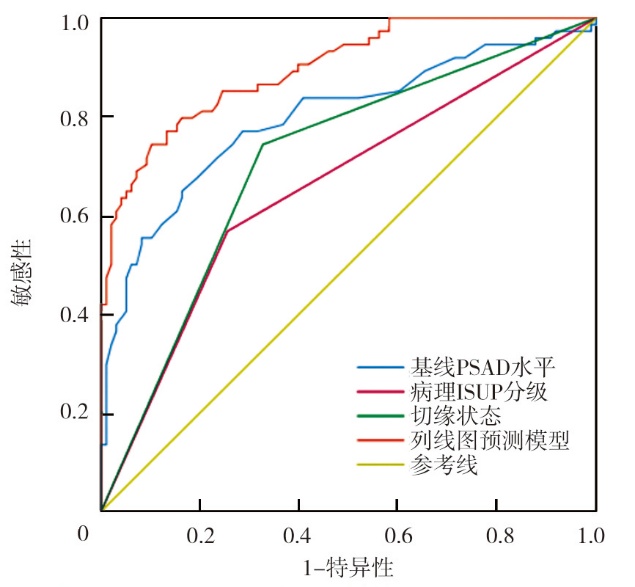
| 项目 | 最佳截断值 | AUC | P值 | 敏感性(%) | 特异性(%) | 约登指数(%) |
|---|---|---|---|---|---|---|
| 基线PSAD | 0.56 ng/(ml·cm3) | 0.76 | <0.001 | 74.32 | 72.45 | 46.77 |
| 病理ISUP分级 | - | 0.66 | <0.001 | 56.76 | 74.49 | 31.25 |
| 切缘状态 | - | 0.71 | <0.001 | 74.32 | 67.35 | 41.67 |
| 列线图模型 | - | 0.88 | <0.001 | 74.32 | 87.76 | 62.08 |
"
"
| [1] | Siegel RL, Giaquinto AN, Jemal A. Cancer statistics, 2024[J]. CA Cancer J Clin, 2024, 74(1): 12-49. DOI: 10.3322/caac.21820. |
| [2] |
Liu X, Yu C, Bi Y, et al. Trends and age-period-cohort effect on incidence and mortality of prostate cancer from 1990 to 2017 in China[J]. Public Health, 2019, 172: 70-80. DOI: 10.1016/j.puhe.2019.04.016.
pmid: 31220754 |
| [3] |
Emam A, Hermann G, Attwood K, et al. Oncologic outcome of radical prostatectomy versus radiotherapy as primary treatment for high and very high risk localized prostate cancer[J]. Prostate, 2021, 81(4): 223-230. DOI: 10.1002/pros.24089.
pmid: 33471385 |
| [4] |
Kim WT, Kim J, Kim WJ. How can we best manage biochemical failure after radical prostatectomy?[J]. Investig Clin Urol, 2022, 63(6): 592-601. DOI: 10.4111/icu.20220294.
pmid: 36347548 |
| [5] | 那彦群, 叶章群, 孙颖浩, 等. 2014版中国泌尿外科疾病诊断治疗指南[M] 北京: 人民卫生出版社, 2013. |
| [6] |
Heidenreich A, Bastian PJ, Bellmunt J, et al. EAU guidelines on prostate cancer. part 1: screening, diagnosis, and local treatment with curative intent-update 2013[J]. Eur Urol, 2014, 65(1): 124-137. DOI: 10.1016/j.eururo.2013.09.046.
pmid: 24207135 |
| [7] | Mottet N, Bergh R, Briers E, et al. EAU-ESTRO-SIOG guidelines on prostate cancer[M]. Arnhem, the Netherlands: European Association of Urology, 2018: 1-146. |
| [8] |
Tilki D, Chen MH, Wu J, et al. Persistent prostate-specific antigen following radical prostatectomy for prostate cancer and mortality risk[J]. JAMA Oncol, 2025, 11(5): 502-510. DOI: 10.1001/jamaoncol.2025.0110.
pmid: 40080000 |
| [9] | Roberts MJ, Papa N, Veerman H, et al. Prediction of biochemical recurrence after radical prostatectomy from primary tumour characte-ristics[J]. BJU Int, 2024, Suppl 2(Suppl 2): 47-55. DOI: 10.1111/bju.16482. |
| [10] | McCormick BZ, Mahmoud AM, Williams SB, et al. Biochemical recurrence after radical prostatectomy: current status of its use as a treatment endpoint and early management strategies[J]. Indian J Urol, 2019, 35(1): 6-17. DOI: 10.4103/iju.IJU_355_18. |
| [11] | Takeda H, Akatsuka J, Yuki E, et al. Long-term oncological outcomes for histologically confirmed high-risk prostate cancer[J]. J Nippon Med Sch, 2023, 90(2): 202-209. DOI: 10.1272/jnms.JNMS.2023_90-210. |
| [12] | Sood A, Grauer R, Diaz-Insua M, et al. 15-year biochemical failure, metastasis, salvage therapy, and cancer-specific and overall survival rates in men treated with robotic radical prostatectomy for PSA-screen detected prostate cancer[J]. Prostate Cancer Prostatic Dis, 2023, 26(4): 778-786. DOI: 10.1038/s41391-023-00674-2. |
| [13] |
Moris L, Cumberbatch MG, Van den Broeck T, et al. Benefits and risks of primary treatments for high-risk localized and locally advanced prostate cancer: an international multidisciplinary systematic review[J]. Eur Urol, 2020, 77(5): 614-627. DOI: 10.1016/j.eururo.2020.01.033.
pmid: 32146018 |
| [14] |
Matsumoto K, Niwa N, Hagiwara M, et al. Long-term follow-up comparing salvage radiation therapy and androgen-deprivation therapy for biochemical recurrence after radical prostatectomy[J]. Int J Clin Oncol, 2021, 26(4): 744-752. DOI: 10.1007/s10147-020-01839-y.
pmid: 33387085 |
| [15] |
Marra G, Valerio M, Heidegger I, et al. Management of patients with node-positive prostate cancer at radical prostatectomy and pelvic lymph node dissection: a systematic review[J]. Eur Urol Oncol, 2020, 3(5): 565-581. DOI: 10.1016/j.euo.2020.08.005.
pmid: 32933887 |
| [16] |
Efstathiou E, Davis JW, Pisters L, et al. Clinical and biological characterisation of localised high-risk prostate cancer: results of a randomised preoperative study of a luteinising hormone-releasing hormone agonist with or without abiraterone acetate plus prednisone[J]. Eur Urol, 2019, 76(4): 418-424. DOI: 10.1016/j.eururo.2019.05.010.
pmid: 31176622 |
| [17] |
Preisser F, Coxilha G, Heinze A, et al. Impact of positive surgical margin length and Gleason grade at the margin on biochemical recurrence in patients with organ-confined prostate cancer[J]. Prostate, 2019, 79(16): 1832-1836. DOI: 10.1002/pros.23908.
pmid: 31553506 |
| [18] | Omri N, Kamil M, Alexander K, et al. Association between PSA density and pathologically significant prostate cancer: the impact of prostate volume[J]. Prostate, 2020, 80(16): 1444-1449. DOI: 10.1002/pros.24078. |
| [19] | 王方明, 韩苏军, 杨飞亚, 等. 高危前列腺癌腹腔镜根治性前列腺切除术后切缘阳性的危险因素[J]. 中华泌尿外科杂志, 2021, 42(5): 349-354. DOI: 10.3760/cma.j.cn112330-20201013-00716. |
| [20] | Martini A, Gandaglia G, Fossati N, et al. Defining clinically mea-ningful positive surgical margins in patients undergoing radical prostatectomy for localised prostate cancer[J]. Eur Urol Oncol, 2021, 4(1): 42-48. DOI: 10.1016/j.euo.2019.03.006. |
| [21] | McKay RR, Xie W, Ye H, et al. Results of a randomized phase Ⅱ trial of intense androgen deprivation therapy prior to radical prostatectomy in men with high-risk localized prostate cancer[J]. J Urol, 2021, 206(7): 80-87. DOI: 10.1097/JU.0000000000001702. |
| [1] | Yipala·Yilihamu , Ma Tao, Wang Yan, Gao Chunjie, Liu Jing, Zhao Ting, Wang Lei. Relationship between body mass indexes and survival prognosis of breast cancer patients with different menopausal status and molecular subtypes [J]. Journal of International Oncology, 2025, 52(12): 745-757. |
| [2] | Ye Rui, Chen Zhen, Hao Ningning, Li Rongrong. Diagnostic value of MRI combined with serum LRG1 and LOXL2 for prostate cancer [J]. Journal of International Oncology, 2025, 52(11): 695-699. |
| [3] | Li Tian, Wu Yang, Zhang Jiangming, Xi Chunsheng. Construction of a nomogram prediction model for lung metastasis in elderly patients with clear cell renal cell carcinoma [J]. Journal of International Oncology, 2024, 51(12): 755-762. |
| [4] | Zhao Mingjun, Yu Chunhu. Analysis of incidence and mortality of male urogenital system tumors in China from 1990 to 2019 [J]. Journal of International Oncology, 2024, 51(10): 632-638. |
| [5] | Zhao Xin, Fan Xuewu, Tian Long, Hu Yimin. Application and evaluation study of 3D ultrasound in image guided radiotherapy for prostate cancer [J]. Journal of International Oncology, 2024, 51(1): 43-49. |
| [6] | Du Xiao, Zhou Juying. Stereotactic body radiotherapy for localized prostate cancer [J]. Journal of International Oncology, 2021, 48(5): 313-316. |
| [7] | Zhang Xiaofei, Hu Jianpeng, Cui Feilun. Mechanism of long non-coding RNA in prostate cancer [J]. Journal of International Oncology, 2021, 48(2): 117-120. |
| [8] | Ji Chundong, Liu Kai, Feng Yue, Wang Fei, Yang Jun, Xue Rongbo. Predictive value of PSAMR combined with PI-RADS v2 score in high-grade prostate cancer [J]. Journal of International Oncology, 2020, 47(12): 723-727. |
| [9] | Zhang Jiawei, Wu Jianchen. Application of exosomes in prostates cancer [J]. Journal of International Oncology, 2020, 47(10): 634-636. |
| [10] | XU Yao-Zong, GU Xiao, WANG Fei, DING Xue-Fei. Molecular mechanisms of castrationresistant prostate cancer progressed from prostate cancer by androgen deprivation treatment [J]. Journal of International Oncology, 2018, 45(8): 506-509. |
| [11] | Huang Geng, Jiang Weidong, Mao Qing, Gui Dingwen. Effect of microRNA206 on the growth of prostate cancer cells by interfering with the expression of CDK4 and GAK [J]. Journal of International Oncology, 2017, 44(7): 485-489. |
| [12] | Zhou Qidong, Jiang Guangliang, Xu Ke. Research progress of glucocorticoid receptor in urological malignant tumors [J]. Journal of International Oncology, 2017, 44(6): 476-. |
| [13] | FAN Lu-Lu, LIAO Cheng-Gong, HUANG Jian-Guo, YIN Hang, QIAN Men-Long, WAN Nao, LU Ning. Prognostic value of prechemotherapy serum cystatin C in patients with castrationresistant prostate cancer [J]. Journal of International Oncology, 2017, 44(5): 356-360. |
| [14] | Shen Junlong, Liu Quanhai, Liu Li, Nan Shuliang, Cheng Yongyi, Zhou Jiancheng.. Application of improved 13-core prostate biopsy in the diagnosis of prostate cancer [J]. Journal of International Oncology, 2017, 44(12): 907-910. |
| [15] | Liu Weishuai, Zeng Yaqi, Shao Yuejuan, Wang Kun. Dietary fiber intake and risk of prostate cancer: a Metaanalysis [J]. Journal of International Oncology, 2016, 43(10): 758-764. |
| Viewed | ||||||
|
Full text |
|
|||||
|
Abstract |
|
|||||