Journal of International Oncology ›› 2026, Vol. 53 ›› Issue (8): 476-484.doi: 10.3760/cma.j.cn371439-20250823-00077
• Original Article • Previous Articles Next Articles
Construction of a postoperative survival prediction model for elderly patients with colorectal cancer based on machine learning algorithms
Shen Cailu, Wu Ruirong, Wu You, Ge Xiaosong( )
)
Department of Medical Oncology ,Affiliated Hospital of Jiangnan University Wuxi 214100, China
-
Received:2025-08-23Online:2026-08-08Published:2026-07-21 -
Contact:Ge Xiaosong, Email: gexiaosong@qq.com -
Supported by:National Natural Science Foundation of China(81502042);Natural Science Foundation of Jiangsu Province of China(BK20140171);Guiding Project of Jiangsu Provincial Health Commission(Z2023020)

Cite this article
Shen Cailu, Wu Ruirong, Wu You, Ge Xiaosong. Construction of a postoperative survival prediction model for elderly patients with colorectal cancer based on machine learning algorithms[J]. Journal of International Oncology, 2026, 53(8): 476-484.
share this article

"
| 临床病理 特征 | 例数 (n=3 576) | 训练集 (n=2 503) | 验证集 (n=1 073) | χ2值 | P值 | 临床病理 特征 | 例数 (n=3 576) | 训练集 (n=2 503) | 验证集 (n=1 073) | χ2值 | P值 |
|---|---|---|---|---|---|---|---|---|---|---|---|
| 种族 | 组织学类型 | ||||||||||
| 白人 | 2 930(81.9) | 2 063(82.4) | 867(80.8) | 1.33 | 0.249 | 腺癌 | 3 245(90.7) | 2 270(90.7) | 975(90.9) | 0.03 | 0.868 |
| 其他 | 646(18.1) | 440(17.6) | 206(19.2) | 黏液腺癌/印戒细胞癌 | 331(9.3) | 233(9.3) | 98(9.1) | ||||
| 性别 | 组织学分级 | ||||||||||
| 男 | 1 496(41.8) | 1 047(41.8) | 449(41.8) | <0.01 | 0.993 | Ⅰ~Ⅱ | 2 897(81.0) | 2 034(81.3) | 863(80.4) | 0.34 | 0.560 |
| 女 | 2 080(58.2) | 1 456(58.2) | 624(58.2) | Ⅲ~Ⅳ | 679(19.0) | 469(18.7) | 210(19.6) | ||||
| 年龄(岁) | 清扫淋巴结数量(个) | ||||||||||
| 75~84 | 2 512(70.2) | 1 750(69.9) | 762(71.0) | 0.44 | 0.510 | ≥12 | 3 394(94.9) | 2 375(94.9) | 1 019(95.0) | 0.01 | 0.919 |
| ≥85 | 1 064(29.8) | 753(30.1) | 311(29.0) | <12 | 182(5.1) | 128(5.1) | 54(5.0) | ||||
| 婚姻状况 | 神经周围浸润 | ||||||||||
| 已婚 | 1 703(47.6) | 1 198(47.9) | 505(47.1) | 0.19 | 0.661 | 无 | 414(11.6) | 291(11.6) | 123(11.5) | 0.02 | 0.889 |
| 其他 | 1 873(52.4) | 1 305(52.1) | 568(52.9) | 有 | 3 162(88.4) | 2 212(88.4) | 950(88.5) | ||||
| 肿瘤部位 | 术前血清CEA | ||||||||||
| 左半结肠 | 847(23.7) | 570(22.8) | 277(25.8) | 3.85 | 0.050 | 阴性 | 2 120(59.3) | 1 486(59.4) | 634(59.1) | 0.03 | 0.875 |
| 右半结肠 | 2 729(76.3) | 1 933(77.2) | 796(74.2) | 阳性 | 1 456(40.7) | 1 017(40.6) | 439(40.9) | ||||
| 肿瘤最大径(cm) | 阳性淋巴结比率 | ||||||||||
| <5 | 1 897(53.0) | 1 320(52.7) | 577(53.8) | 0.33 | 0.569 | <0.09 | 2 921(81.7) | 2 059(82.3) | 862(80.3) | 1.86 | 0.172 |
| ≥5 | 1 679(47.0) | 1 183(47.3) | 496(46.2) | ≥0.09 | 655(18.3) | 444(17.7) | 211(19.7) | ||||
| T分期 | 术后辅助化疗 | ||||||||||
| T1-2 | 879(24.6) | 606(24.2) | 273(25.4) | 0.62 | 0.433 | 是 | 690(19.3) | 493(19.7) | 197(18.4) | 0.86 | 0.353 |
| T3-4 | 2 697(75.4) | 1 897(75.8) | 800(74.6) | 否 | 2 886(80.7) | 2 010(80.3) | 876(81.6) | ||||
| N分期 | |||||||||||
| N0 | 2 317(64.8) | 1 619(64.7) | 698(65.1) | 4.87 | 0.088 | ||||||
| N1 | 913(25.5) | 657(26.2) | 256(23.9) | ||||||||
| N2 | 346(9.7) | 227(9.1) | 119(11.1) |
"
"
| 变量 | β值 | SE值 | Wald χ2值 | HR值(95%CI) | P值 |
|---|---|---|---|---|---|
| N分期 | |||||
| N0 | Ref | ||||
| N1 | 0.89 | 0.14 | 42.46 | 2.43(1.86~3.17) | <0.001 |
| N2 | 1.25 | 0.21 | 35.57 | 3.49(2.32~5.27) | <0.001 |
| 术后辅助化疗 | |||||
| 是 | Ref | ||||
| 否 | 0.66 | 0.13 | 26.45 | 1.94(1.51~2.50) | <0.001 |
| 年龄(岁) | |||||
| 75~84 | Ref | ||||
| ≥85 | 0.40 | 0.10 | 14.75 | 1.49(1.22~1.82) | <0.001 |
| 神经周围浸润 | |||||
| 无 | Ref | ||||
| 有 | 0.47 | 0.12 | 14.77 | 1.61(1.26~2.04) | <0.001 |
| 术前血清CEA | |||||
| 阴性 | Ref | ||||
| 阳性 | 0.36 | 0.10 | 13.44 | 1.44(1.19~1.75) | <0.001 |
| 组织学分级 | |||||
| Ⅰ~Ⅱ | Ref | ||||
| Ⅲ~Ⅳ | 0.40 | 0.11 | 13.21 | 1.49(1.20~1.85) | <0.001 |
| 阳性淋巴结比率 | |||||
| <0.09 | Ref | ||||
| ≥0.09 | 0.39 | 0.16 | 6.31 | 1.48(1.09~2.01) | 0.012 |
| T分期 | |||||
| T1-2 | Ref | ||||
| T3-4 | 0.39 | 0.15 | 6.28 | 1.47(1.09~1.99) | 0.012 |
"
"
| 指标 | LASSO-Cox模型 | DeepSurv模型 | |||
|---|---|---|---|---|---|
| 训练集 | 验证集 | 训练集 | 验证集 | ||
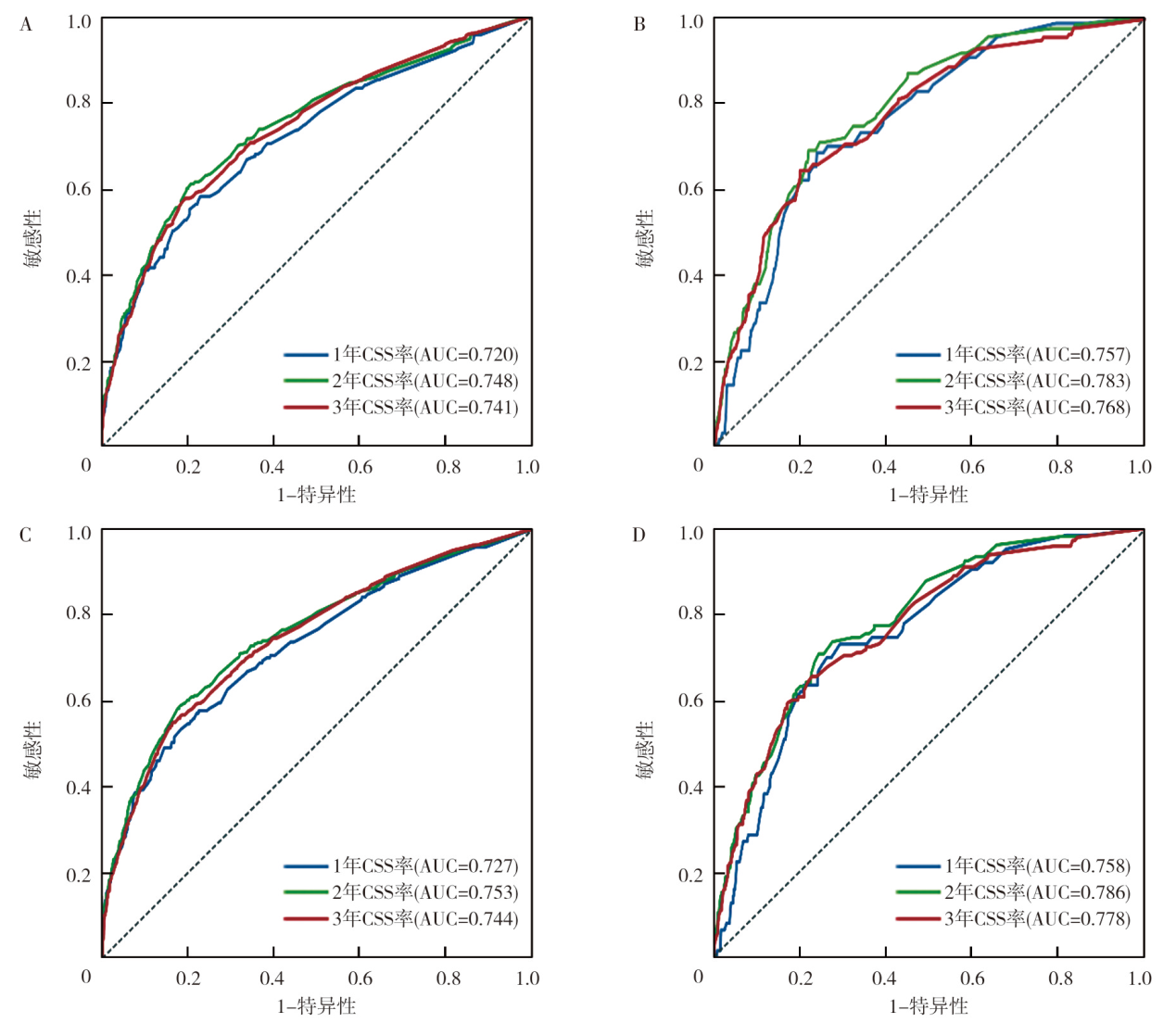
| C-index(95%CI) | 0.715(0.688~0.741) | 0.741(0.703~0.773) | 0.718(0.692~0.746) | 0.750(0.714~0.786) | |
| 1年CSS率AUC(95%CI) | 0.720(0.675~0.764) | 0.757(0.701~0.812) | 0.727(0.681~0.769) | 0.758(0.699~0.818) | |
| 2年CSS率AUC(95%CI) | 0.748(0.714~0.782) | 0.783(0.736~0.829) | 0.753(0.720~0.791) | 0.786(0.743~0.830) | |
| 3年CSS率AUC(95%CI) | 0.741(0.712~0.771) | 0.768(0.724~0.810) | 0.744(0.717~0.773) | 0.778(0.737~0.819) | |
| 1年Brier评分(95%CI) | 0.064(0.056~0.073) | 0.058(0.045~0.070) | 0.060(0.052~0.068) | 0.056(0.044~0.068) | |
| 2年Brier评分(95%CI) | 0.105(0.094~0.115) | 0.097(0.082~0.112) | 0.093(0.082~0.103) | 0.087(0.073~0.102) | |
| 3年Brier评分(95%CI) | 0.143(0.131~0.154) | 0.135(0.118~0.152) | 0.127(0.115~0.138) | 0.120(0.104~0.139) | |
"
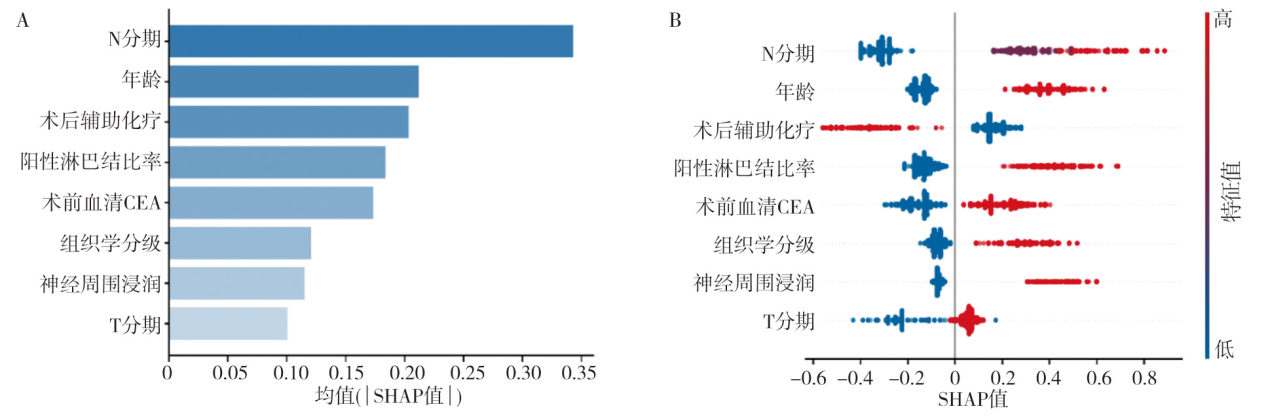
"
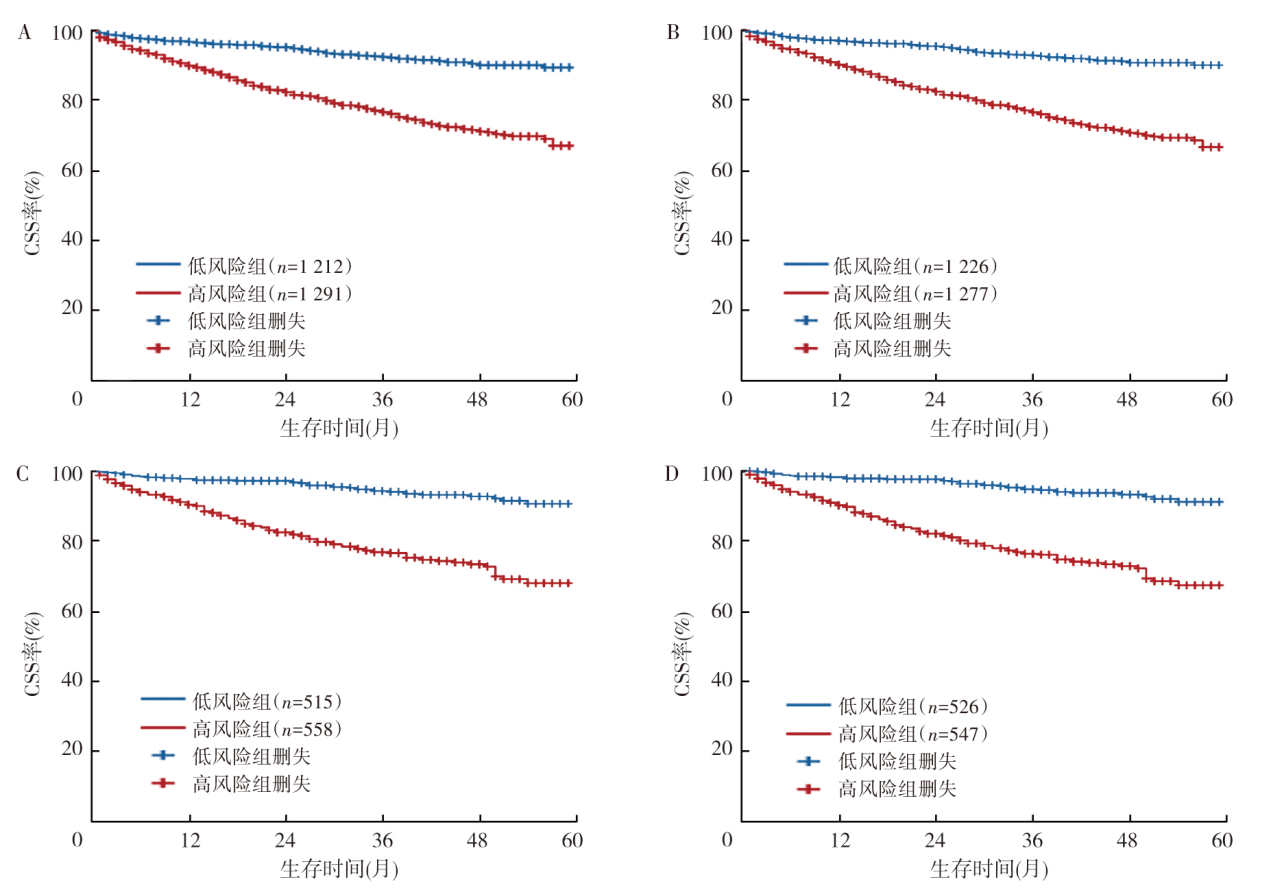
"
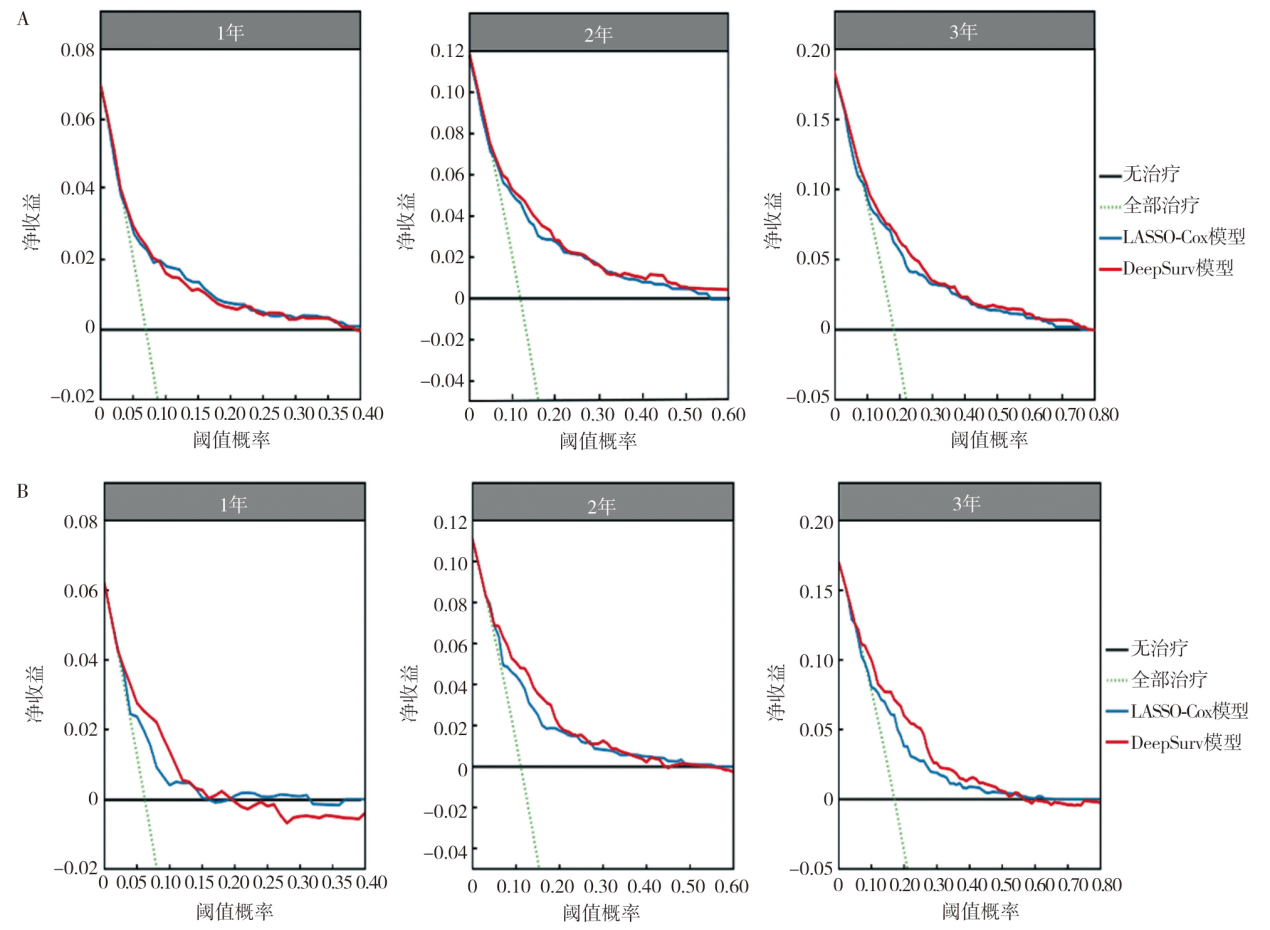
"
| [1] | Sung H, Ferlay J, Siegel RL, et al. Global cancer statistics 2020: GLOBOCAN estimates of incidence and mortality worldwide for 36 cancers in 185 countries[J]. CA Cancer J Clin, 2021, 71(3): 209-249. DOI: 10.3322/Caac.21660. |
| [2] |
Sun S, Yi Y, Xiao ZJ, et al. ER stress activates TAp73α to promote colon cancer cell apoptosis via the PERK-ATF4 pathway[J]. J Cancer, 2023, 14(11): 1946-1955. DOI: 10.7150/Jca.84170.
pmid: 37497416 |
| [3] |
Eng C, Yoshino T, Ruíz-García E, et al. Colorectal cancer[J]. Lancet, 2024, 404(10449): 294-310. DOI: 10.1016/S0140-6736(24)00360-X.
pmid: 38909621 |
| [4] | Kiousi DE, Kouroutzidou AZ, Neanidis K, et al. Evaluating the role of probiotics in the prevention and management of age-related diseases[J]. Int J Mol Sci, 2022, 23(7): 3628. DOI: 10.3390/Ijms23073628. |
| [5] | 李翔, 王爱国, 雷哲, 等. 65-74岁年轻老年人移位型股骨颈骨折不同术式短期随访的疗效观察[J]. 中华老年医学杂志, 2025, 44(6): 795-800. DOI: 10.3760/Cma.J.Issn.0254-9026.2025.06.021. |
| [6] | 陈坤燕, 杜娟, 季雨伟, 等. 伊立替康联合XELOX方案对老年结直肠癌患者机体免疫状态,肠道微生态的影响及预后风险分析[J]. 国际肿瘤学杂志, 2024, 51(11): 690-695. DOI: 10.3760/cma.J.cn371439-20240618-00117. |
| [7] | Razon AH, Haque MI, Ahmed MF, et al. Assessment of dietary habits, nutritional status and common health complications of older people living in rural areas of Bangladesh[J]. Heliyon, 2022, 8(2): e08947. DOI: 10.1016/J.Heliyon.2022.E08947. |
| [8] | Wang S, Zhang T, Wang P, et al. The impact of perioperative multimodal pain management on postoperative outcomes in patients (aged 75 and older) undergoing short-segment lumbar fusion surgery[J]. Pain Res Manag, 2022, 2022: 9052246. DOI: 10.1155/2022/9052246. |
| [9] | Lu CF, Liao CY, Chao HS, et al. A radiomics-based deep learning approach to predict progression free-survival after tyrosine kinase inhibitor therapy in non-small cell lung cancer[J]. Cancer Imaging, 2023, 23(1): 9. DOI: 10.1186/S40644-023-00522-5. |
| [10] | O'Donnell A, Wolsztynski E, Cronin M, et al. Improving the post-operative prediction of BCR-free survival time with mRNA variables and machine learning[J]. Cancers (Basel), 2023, 15(4): 1276. DOI: 10.3390/Cancers15041276. |
| [11] | Zou P, Chen C, Wu X. Identification of fatty acid oxidation-related subtypes by integrated analysis of bulk-and single-cell transcriptome profiling in colorectal cancer[J]. J Gastrointest Oncol, 2024, 15(1): 147-163. DOI: 10.21037/Jgo-23-833. |
| [12] | 桑晓辉, 赵晋明, 白磊, 等. 基于LASSO回归构建肝移植术后急性肾损伤的预测模型[J]. 肝胆胰外科杂志, 2025, 37(4): 227-235. DOI: 10.11952/J.Issn.1007-1954.2025.04.003. |
| [13] |
Takeyama H, Noura S, Suzuki Y, et al. Higher body mass index is a simple favorable non-cancer prognostic marker for Japanese elderly colorectal cancer patients after curative resection[J]. J Anus Rectum Colon, 2022, 6(2): 134-142. DOI: 10.23922/Jarc.2021-056.
pmid: 35572483 |
| [14] |
Weiser MR. AJCC 8th edition: colorectal cancer[J]. Ann Surg Oncol, 2018, 25(6): 1454-1455. DOI: 10.1245/S10434-018-6462-1.
pmid: 29616422 |
| [15] | Soler-González G, Sastre-Valera J, Viana-Alonso A, et al. Update on the management of elderly patients with colorectal cancer[J]. Clin Transl Oncol, 2024, 26(1): 69-84. DOI: 10.1007/S12094-023-03243-0. |
| [16] | Lim BL, Park IJ, Ro JS, et al. Oncologic outcomes and associated factors of colon cancer patients aged 70 years and older[J]. Ann Coloproctol, 2025, 41(3): 198-206. DOI: 10.3393/Ac.2023.00367.0052. |
| [17] | Kuo YH, You JF, Hung HY, et al. Number of negative lymph nodes with a positive impact on survival of stage Ⅲ colon cancer; a retrospective observation study for right side and left side colon[J]. BMC Cancer, 2022, 22(1): 126. DOI: 10.1186/S12885-021-09154-Z. |
| [18] |
Liang Z, Xiang D, Feng J, et al. Log odds of positive lymph nodes show better predictive performance on the prognosis of early-onset colorectal cancer[J]. Int J Colorectal Dis, 2023, 38(1): 192. DOI: 10.1007/S00384-023-04490-X.
pmid: 37432563 |
| [19] | Luo D, Zhang R, Yang Y, et al. Pretreatment carcinoembryonic antigen level serves as a potential biomarker to guide adjuvant radiotherapy in pT4N+ colon cancer patients[J]. J Oncol, 2023, 2023: 4815996. DOI: 10.1155/2023/4815996. |
| [20] |
Yu C, Zhang Y. Establishment of prognostic nomogram for elderly colorectal cancer patients: a SEER database analysis[J]. BMC Gastroenterol, 2020, 20(1): 347. DOI: 10.1186/S12876-020-01464-Z.
pmid: 33081695 |
| [21] | Chen X, Tu J, Xu X, et al. Adjuvant chemotherapy benefit in elderly stage Ⅱ/Ⅲ colon cancer patients[J]. Front Oncol, 2022, 12: 874749. DOI: 10.3389/Fonc.2022.874749. |
| [22] | Hu J, Lv H, Zhao S, et al. Prediction of clinicopathological features, multi-omics events and prognosis based on digital pathology and deep learning in HR+/HER2- breast cancer[J]. J Thorac Dis, 2023, 15(5): 2528-2543. DOI: 10.21037/Jtd-23-445. |
| [23] | Zhu LH, Yang J, Zhang YF, et al. Identification and validation of a pyroptosis-related prognostic model for colorectal cancer based on bulk and single-cell RNA sequencing data[J]. World J Clin Oncol, 2024, 15(2): 329-355. DOI: 10.5306/Wjco.V15.I2.329. |
| [24] | She Y, Jin Z, Wu J, et al. Development and validation of a deep learning model for non-small cell lung cancer survival[J]. JAMA Netw Open, 2020, 3(6): e205842. DOI: 10.1001/Jamanetworkopen.2020.5842. |
| [1] | Liu Yonghong, Zhang Bo, Xue Lingbo, Hu Pengfei, Zhang Zhenyu, Li Jie. Predictive value of XGBoost model for pathological complete response after neoadjuvant chemotherapy in breast cancer patients [J]. Journal of International Oncology, 2026, 53(7): 412-419. |
| [2] | Yan Kun, Xu Chenyang, Song Wenhua, Xia Tongliang, Wei Dongmin, Li Wenming, Qian Ye, Lei Dapeng. Analysis of prognosis and influencing factors of stage T3-4 laryngeal cancer patients based on propensity score matching [J]. Journal of International Oncology, 2026, 53(6): 331-338. |
| [3] | Li Yansong, Jia Junmei. Predictive value of the geriatric nutritional risk index for prognosis in advanced NSCLC treated with immunotherapy and immune-related adverse events [J]. Journal of International Oncology, 2026, 53(6): 355-360. |
| [4] | Wang Yong, Zhao Haiyan, Zhang Mingming, Wu Xinlin. Relationship between intestinal microecology and the occurrence and progression of colorectal cancer [J]. Journal of International Oncology, 2026, 53(6): 370-375. |
| [5] | Yang Song, Zheng Xiangyun, Pan Yingxue, Wang Jiaming, Zhang Huanhu. Impact of imatinib adjuvant therapy on the postoperative prognosis of patients with non-gastric primary high-risk GIST [J]. Journal of International Oncology, 2026, 53(5): 283-289. |
| [6] | Li Yiping, Tang Zhuang, Ouyang Surui, Li Jin, He Jingdong. Research progress of neurokinin-1 receptor antagonists in the treatment of lung cancer [J]. Journal of International Oncology, 2026, 53(5): 306-310. |
| [7] | Wang Minjie, Lai Minghong, Cai Zhuoxin, Tang Yu, Zhang Caijin. Relationship between pan-immune inflammation value and clinicopathological features of non-small cell lung cancer and predictive analysis for bone metastasis [J]. Journal of International Oncology, 2026, 53(4): 207-212. |
| [8] | Han Yufei, Li Fengmei, Zhang Weina, Zhang Ping, Hou Ping. Short-term efficacy and clinical outcomes of concurrent chemoradiotherapy followed by anlotinib maintenance treatment in patients with locally advanced cervical cancer [J]. Journal of International Oncology, 2026, 53(4): 219-223. |
| [9] | Tong Xinyu, Yang Jing, Wang Minglei, Huang Chengsuo, Luo Yingshu, Peng Jieqiong, Han Shumei, Liu Bo. Current status and advances in the medical treatment of esophageal cancer [J]. Journal of International Oncology, 2026, 53(4): 240-247. |
| [10] | Zhang Baihong, Yue Hongyun. Advances in cancer chemotherapy in the era of precision medicine [J]. Journal of International Oncology, 2026, 53(3): 178-181. |
| [11] | Yang Rui, Guo Xinwei, Liu Yangchen. Research progress on the impact of fibrinogen/prealbumin ratio for the prediction of prognosis of digestive system tumors [J]. Journal of International Oncology, 2026, 53(2): 111-114. |
| [12] | Cui Xiaohui, Miao Yanan, Cao Ranhua. Predictive value of F-PLR score and LMR for the prognosis of patients with esophageal cancer receiving neoadjuvant immunotherapy combined with chemotherapy [J]. Journal of International Oncology, 2026, 53(10): 591-599. |
| [13] | Jiang Ye, Ji Shuang, Lao Jiahui, Yan Li, Liu Yamin, Tang Fang. Impact of different chemotherapy regimens on the occurrence of grade ≥ 3 neutropenia in middle-aged and elderly patients with ovarian cancer [J]. Journal of International Oncology, 2026, 53(10): 608-614. |
| [14] | Qiu Kexin, Li Mengzhen, Guo Haoran, Fan Mengsi, Yan Li. Prognostic analysis of different surgical approaches in elderly patients with advanced ovarian cancer [J]. Journal of International Oncology, 2025, 52(9): 576-582. |
| [15] | Liu Mei, Hu Yuchong, Li Fengtong, Chao Lemen, Liu Meng, Kang Linlin. Mechanism of action of SHCBP1 in malignant tumors and progress in clinical research [J]. Journal of International Oncology, 2025, 52(9): 583-586. |
| Viewed | ||||||
|
Full text |
|
|||||
|
Abstract |
|
|||||