Journal of International Oncology ›› 2026, Vol. 53 ›› Issue (6): 339-345.doi: 10.3760/cma.j.cn371439-20251229-00055
• Original Article • Previous Articles Next Articles
Factors influencing the occurrence of high-grade acute radiodermatitis in patients undergoing image guided radiation therapy after breast cancer surgery and the construction of a prediction model
Su Jialin, Zheng Jin, Zhao Canjun, Han Lijun, Zhang Jie, Wang Liping( )
)
Department of Traditional Chinese Medicine ,Tangdu Hospital,Air Force Medical University Xi'an 710038, China
-
Received:2025-12-29Online:2026-06-08Published:2026-06-05 -
Contact:Wang Liping E-mail:chenchenmama2022@163.com -
Supported by:Key Research and Development Program of Shaanxi Province of China(2024SF-YBXM-459)

Cite this article
Su Jialin, Zheng Jin, Zhao Canjun, Han Lijun, Zhang Jie, Wang Liping. Factors influencing the occurrence of high-grade acute radiodermatitis in patients undergoing image guided radiation therapy after breast cancer surgery and the construction of a prediction model[J]. Journal of International Oncology, 2026, 53(6): 339-345.
share this article

"
| 一般临床资料 | 高级别(n=81) | 低级别(n=374) | t/χ2值 | P值 | 一般临床资料 | 高级别(n=81) | 低级别(n=374) | t/χ2值 | P值 |
|---|---|---|---|---|---|---|---|---|---|
| 年龄(岁)a | 49.98±9.70 | 50.43±9.79 | -0.38 | 0.707 | 铁蛋白水平(μg/L)a | 197.34±21.88 | 135.37±14.47 | 31.55 | <0.001 |
| BMIa | 30.33±4.39 | 25.94±3.28 | 10.23 | <0.001 | hs-CRP水平(mg/L)a | 6.48±2.03 | 2.05±0.77 | 32.78 | <0.001 |
| 吸烟史b | CD3+ T细胞水平(%)a | 86.34±3.25 | 68.52±3.10 | 46.50 | <0.001 | ||||
| 否 | 68(83.95) | 352(94.12) | 9.69 | 0.002 | 肿瘤部位b | ||||
| 是 | 13(16.05) | 22(5.88) | 左胸 | 39(48.15) | 194(51.87) | 0.37 | 0.543 | ||
| 饮酒史b | 右胸 | 42(51.85) | 180(48.13) | ||||||
| 否 | 74(91.36) | 330(88.24) | 0.65 | 0.419 | 肿瘤最大径(cm)a | 3.24±0.98 | 3.20±0.95 | 0.34 | 0.733 |
| 是 | 7(8.64) | 44(11.76) | 肿瘤分期b | ||||||
| 高血压b | Ⅰ期 | 25(30.86) | 110(29.41) | 0.12 | 0.942 | ||||
| 否 | 54(66.67) | 254(67.91) | 0.05 | 0.828 | Ⅱ期 | 36(44.44) | 174(46.52) | ||
| 是 | 27(33.33) | 120(32.09) | Ⅲ期 | 20(24.70) | 90(24.07) | ||||
| 糖尿病b | 肿瘤分型b | ||||||||
| 否 | 55(67.90) | 295(78.88) | 4.52 | 0.034 | 激素受体阳性型 | 63(77.78) | 280(74.87) | 0.60 | 0.742 |
| 是 | 26(32.10) | 79(21.12) | HER2阳性型 | 12(14.81) | 56(14.97) | ||||
| 化疗史b | 三阴性型 | 6(7.41) | 38(10.16) | ||||||
| 否 | 50(61.73) | 225(60.16) | 0.07 | 0.794 | Ki-67核抗原a | 17.19±3.28 | 17.04±3.19 | 0.38 | 0.703 |
| 是 | 31(38.27) | 149(39.84) | 手术类型b | ||||||
| 内分泌治疗史b | 保乳术 | 23(28.40) | 110(29.41) | 0.03 | 0.855 | ||||
| 否 | 39(48.15) | 188(50.27) | 0.12 | 0.730 | 改良根治术 | 58(71.60) | 264(70.59) | ||
| 是 | 42(51.85) | 186(49.73) | 切口长度(cm)a | 10.04±2.88 | 10.11±2.92 | -0.20 | 0.845 | ||
| 靶向治疗史b | 最大照射野面积(cm2)a | 22.34±4.38 | 22.26±4.29 | 0.15 | 0.880 | ||||
| 否 | 71(87.65) | 336(89.84) | 0.34 | 0.562 | 子野数量(个)a | 37.34±5.44 | 37.14±4.89 | 0.33 | 0.744 |
| 是 | 10(12.35) | 38(10.16) | 分次照射时间(min)a | 4.33±1.35 | 4.20±1.30 | 0.81 | 0.418 |
"
| 因素 | β值 | SE值 | Wald χ2值 | OR值 | 95%CI | P值 |
|---|---|---|---|---|---|---|
| BMI | 0.42 | 0.62 | 0.46 | 1.52 | 1.15~2.53 | 0.019 |
| 吸烟史 | 0.36 | 0.44 | 0.68 | 1.44 | 1.09~1.98 | 0.024 |
| 糖尿病 | 0.48 | 0.41 | 1.39 | 1.62 | 1.26~3.05 | 0.013 |
| 铁蛋白水平 | 0.58 | 0.64 | 0.20 | 1.78 | 1.49~3.55 | 0.009 |
| hs-CRP水平 | 0.74 | 0.59 | 1.57 | 2.09 | 1.63~4.46 | <0.001 |
| CD3+ T细胞水平 | 0.67 | 0.58 | 0.11 | 1.96 | 1.50~3.83 | 0.004 |
"
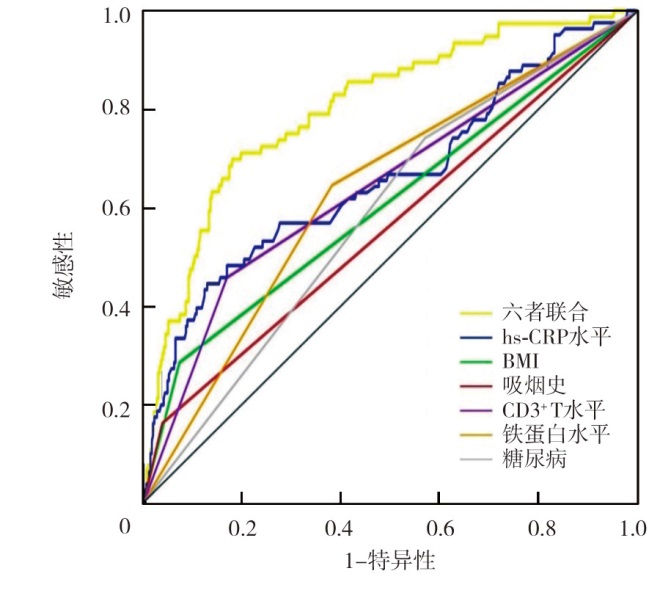
| 指标 | 截断值 | 敏感性(%) | 特异性(%) | AUC | 95%CI |
|---|---|---|---|---|---|
| BMI | 27.22 | 32.86 | 93.41 | 0.69 | 0.67~0.72 |
| 吸烟史 | - | 16.47 | 96.93 | 0.67 | 0.64~0.70 |
| 糖尿病 | - | 72.67 | 43.15 | 0.71 | 0.68~0.75 |
| 铁蛋白水平 | 163.34 μg/L | 65.33 | 64.78 | 0.73 | 0.69~0.77 |
| hs-CRP水平 | 3.70 mg/L | 55.34 | 80.26 | 0.77 | 0.73~0.81 |
| CD3+ T细胞 水平 | 72.48% | 53.16 | 77.25 | 0.74 | 0.71~0.79 |
| 六者联合 | - | 71.28 | 81.35 | 0.88 | 0.85~0.90 |
"
"
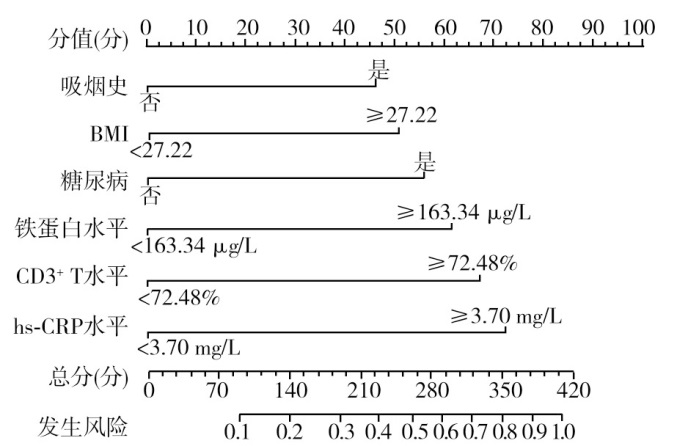
"
"
| [1] |
Rajeswaran T, Gojsevic M, Zhang LY, et al. Correlation of CTCAE and patient-reported breast radiation dermatitis symptom scores[J]. Support Care Cancer, 2024, 32(12): 801. DOI: 10.1007/s00520-024-09018-9.
pmid: 39556198 |
| [2] |
Chakraborty MA, Lee SF, Wong HCY, et al. Chronic radiation dermatitis in breast cancer patients: pathophysiology, prevention and management strategies, and clinical impact[J]. Ann Palliat Med, 2025, 14(3): 269-282. DOI: 10.21037/apm-24-158.
pmid: 40511570 |
| [3] |
Gojsevic M, Rajeswaran T, Zhang LY, et al. Concordance of patient- and clinician-reported outcomes of acute radiation dermatitis in breast cancer[J]. Support Care Cancer, 2024, 32(11): 767. DOI: 10.1007/s00520-024-08966-6.
pmid: 39495339 |
| [4] |
Lee JY, Hyun MH, Yang G, et al. Efficacy and safety of hyperbaric oxygen therapy for radiation-induced dermatitis in patients with breast cancer: a randomized pilot study[J]. Support Care Cancer, 2025, 33(5): 399. DOI: 10.1007/s00520-025-09463-0.
pmid: 40259026 |
| [5] | Que SY, Ma XL, Yang T, et al. Evaluation of the effect of herbal agents as management of radiodermatitis in breast cancer patients: a systematic review and meta-analysis[J]. Jpn J Nurs Sci, 2024, 21(1): e12559. DOI: 10.1111/jjns.12559. |
| [6] | Purswani JM, Nwankwo C, Adotama P, et al. Radiation-induced skin changes after breast or chest wall irradiation in patients with breast cancer and skin of color: a systematic review[J]. Clin Breast Cancer, 2023, 23(1): 1-14. DOI: 10.1016/j.clbc.2022.10.002. |
| [7] |
Chen J, Zhou X, Weng KG, et al. Optimizing intraoperative radiotherapy as a tumor bed boost with whole-breast irradiation in breast cancer[J]. World J Surg Oncol, 2025, 23(1): 298. DOI: 10.1186/s12957-025-03958-0.
pmid: 40708010 |
| [8] |
Jafari F, Izadi-Avanji FS, Maghami M, et al. Topical use of chicory root extract gel on the incidence and severity of radiodermatitis in breast cancer patients: a randomized controled trial[J]. Support Care Cancer, 2024, 32(12): 805. DOI: 10.1007/s00520-024-09017-w.
pmid: 39560759 |
| [9] | Kraemer J, Momm F. Decrease of radiation-induced skin reactions in breast cancer patients by preventive application of film dressings—a systematic review[J]. Strahlenther Onkol, 2024, 200(2): 109-122. DOI: 10.1007/s00066-023-02151-0. |
| [10] | 中华人民共和国国家卫生健康委员会. 乳腺癌诊疗指南 (2022年版)[J]. 中国合理用药探索, 2022, 19(10): 1-26. DOI: 10.3969/j.issn.2096-3327.2022.10.001. |
| [11] |
Loganadane G, Loap P, Allali S, et al. Hypofractionated whole-breast radiation therapy with simultaneous integrated boost after breast-conserving surgery: preliminary real-life experience of the Radiation Therapy Oncology Group 1005 trial[J]. Br J Radiol, 2025, 98(1173): 1403-1408. DOI: 10.1093/bjr/tqaf157.
pmid: 40650925 |
| [12] | 国家癌症中心/国家肿瘤质控中心. 乳腺癌术后放疗靶区勾画和计划设计指南[J]. 中华放射肿瘤学杂志, 2022, 31(10): 863-878. DOI: 10.3760/cma.j.cn113030-20220627-00226. |
| [13] | Xie YX, Wang Q, Hu T, et al. Risk factors related to acute radiation dermatitis in breast cancer patients after radiotherapy: a systematic review and meta-analysis[J]. Front Oncol, 2021, 11: 738851. DOI: 10.3389/fonc.2021.738851. |
| [14] | Kyei KA, Anim-Sampong S, Akoe EA, et al. Radiation-induced dermatitis among breast cancer patients undergoing adjuvant radiotherapy in Ghana[J]. Transl Oncol, 2024, 46: 102028. DOI: 10.1016/j.tranon.2024.102028. |
| [15] | Nanthong R, Tungfung S, Soonklang K, et al. Predictive factors associated with acute radiation dermatitis in patients with breast cancer: a retrospective cohort study[J]. PeerJ, 2025, 13: e19202. DOI: 10.7717/peerj.19202. |
| [16] | Dzul S, Ninia J, Jang H, et al. Predictors of acute radiation dermatitis and esophagitis in african american patients receiving whole-breast radiation therapy[J]. Pract Radiat Oncol, 2022, 12(1): 52-59. DOI: 10.1016/j.prro.2021.08.004. |
| [17] | Lee TF, Chang CH, Chi CH, et al. Utilizing radiomics and dosiomics with AI for precision prediction of radiation dermatitis in breast cancer patients[J]. BMC Cancer, 2024, 24(1): 965. DOI: 10.1186/s12885-024-12753-1. |
| [18] | Huang CJ, Huang MY, Fang PT, et al. Randomized double-blind, placebo-controlled trial evaluating oral glutamine on radiation-induced oral mucositis and dermatitis in head and neck cancer patients[J]. Am J Clin Nutr, 2019, 109(3): 606-614. DOI: 10.1093/ajcn/nqy329. |
| [19] |
Xie YX, Hu T, Chen RW, et al. Predicting acute radiation dermatitis in breast cancer: a prospective cohort study[J]. BMC Cancer, 2023, 23(1): 537. DOI: 10.1186/s12885-023-10821-6.
pmid: 37308936 |
| [20] |
Fu ZQ, Wang CH, Chen JH, et al. The incidence and risk factors of acute radiation-induced dermatitis in gynecologic malignancies treated with intensity-modulated radiation therapy[J]. Transl Cancer Res, 2020, 9(10): 6062-6069. DOI: 10.21037/tcr-20-796.
pmid: 35117217 |
| [21] |
Jafari F, Izadi-Avanji FS, Maghami M, et al. Topical use of chicory root extract gel on the incidence and severity of radiodermatitis in breast cancer patients: a randomized controled trial[J]. Support Care Cancer, 2024, 32(12): 805. DOI: 10.1007/s00520-024-09017-w.
pmid: 39560759 |
| [22] | 郑林晶, 杨东, 胡兵, 等. 早期乳腺癌保乳术后大分割放疗的临床观察[J]. 国际肿瘤学杂志, 2019, 46(6): 331-336. DOI: 10.3760/cma.j.issn.1673-422X.2019.06.003. |
| [23] | 杨文博, 孙云川, 杨洪娟, 等. 清热生肌膏对乳腺癌大鼠放射治疗后急性放射性皮炎发生率、ICM-1及新生血管生成的影响[J]. 广西医科大学学报, 2023, 40(8): 1299-1305. DOI: 10.16190/j.cnki.45-1211/r.2023.08.006. |
| [24] | 王亚欣, 邹美英, 李龄, 等. 冷敷联合自粘性软聚硅酮薄膜敷料预防乳腺癌放射性皮炎效果[J]. 现代中西医结合杂志, 2024, 33(16): 2310-2314. DOI: 10.3969/j.issn.1008-8849.2024.16.023. |
| [25] | 朱乐莎, 张遵浩, 田龙. 乳腺癌患者急性放射性皮炎关联规则预测模型创建[J]. 辐射研究与辐射工艺学报, 2025, 43(1): 65-72. DOI: 10.11889/j.1000-3436.2024-0061. |
| [26] | 李子扬, 王蕊, 姚得顺, 等. 乳腺癌患者晚期放射性皮肤炎Nomogram预测模型的建立及评价[J]. 北京医学, 2025, 47(4): 290-295. DOI: 10.15932/j.0253-9713.2025.04.005. |
| [1] | Liu Yonghong, Zhang Bo, Xue Lingbo, Hu Pengfei, Zhang Zhenyu, Li Jie. Predictive value of XGBoost model for pathological complete response after neoadjuvant chemotherapy in breast cancer patients [J]. Journal of International Oncology, 2026, 53(7): 412-419. |
| [2] | Ma Chiluan, Jia Dianjun, Wei Dongdong, Wang Jingrun, Li Xinping, Zhao Boyan, Zhao Yue. Efficacy and safety of concurrent radiotherapy combined with tegafur suppositories and immune checkpoint inhibitors in the treatment of elderly patients with esophageal cancer [J]. Journal of International Oncology, 2026, 53(7): 426-433. |
| [3] | Li Lina, Liu Shuai, Zhang Nan. Research progress on preoperative radiotherapy for breast cancer [J]. Journal of International Oncology, 2026, 53(5): 301-305. |
| [4] | Han Yufei, Li Fengmei, Zhang Weina, Zhang Ping, Hou Ping. Short-term efficacy and clinical outcomes of concurrent chemoradiotherapy followed by anlotinib maintenance treatment in patients with locally advanced cervical cancer [J]. Journal of International Oncology, 2026, 53(4): 219-223. |
| [5] | Li Yao, Tian Lin, Liu Haolin, Xiao Jing. Effects of lncRNA CASC19 on proliferation,migration and invasion of breast cancer cells by regulating miR-410-3p/LAMC1 signaling pathway [J]. Journal of International Oncology, 2026, 53(3): 129-136. |
| [6] | Guo Xuetao, Qiao Julong, Shao Hongjiang, Wang Xin, Su Riguge, Liu Lu, Liang Lu. Analysis of influencing factors and predictive efficacy of biochemical persistence/recurrence after radical resection for high-risk localized prostate cancer [J]. Journal of International Oncology, 2026, 53(3): 157-162. |
| [7] | Liu Xinlei, Li Yaru, Chen Shuning, Tang Shenghao, Qin Yan, Liu Yankui, Qi Xiaowei. Research progress of HER2 ultra-low expression breast cancer [J]. Journal of International Oncology, 2026, 53(1): 53-56. |
| [8] | Chen Qiaoliang, Qin Xinyan, Lai Ruihe, Tan Shuangxiu. Diagnostic value of multimodal Nomogram model combining 18F-FDG PET/CT and ultrasound for triple negative breast cancer [J]. Journal of International Oncology, 2025, 52(9): 560-565. |
| [9] | Wu Songyou, Wang Gang, Wang Wenling, Dong Hongmin, Chen Weiwei, Li Xiaokai, Chen Wanghua, Zuo Kai. Prospective cohort study on the effect of abdominal circumference on the intestinal radiation dose volume and the acute intestinal toxicity in pelvic intensity modulated radiation therapy for rectal cancer patients [J]. Journal of International Oncology, 2025, 52(9): 566-575. |
| [10] | Guo Junlong, Zou Ruiqi, Chen Shaoqiang, Liang Yuxin, Li Jing, Yong Sunan, He Yuting, Xie Xiaobing, Li Ping. Research progress of RNA m6A modification in breast cancer [J]. Journal of International Oncology, 2025, 52(8): 532-537. |
| [11] | Liu Qi, Qu Guobin, Zhu Jian, Wu Fan. Feasibility study of using dual-energy CT virtual non-contrast images to replace true non-contrast images in photon and proton radiotherapy dose calculations [J]. Journal of International Oncology, 2025, 52(7): 401-408. |
| [12] | Zhu Jian. Preface to the dosimetric characteristic of proton radiotherapy for tumors [J]. Journal of International Oncology, 2025, 52(7): 432-433. |
| [13] | Wu Shizhang, Hu Man, Dai Tianyuan, Li Chengqiang, Tao Cheng, Duan Jinghao, Chen Jinhu, Bai Tong, Kong Tian, Zhu Jian. Analysis of dosimetric characteristics of proton radiotherapy in 1 case of whole central nervous system tumor [J]. Journal of International Oncology, 2025, 52(7): 434-440. |
| [14] | Li Chengqiang, Wang Yungang, Yu Yishan, Wu Shizhang, Tao Cheng, Ma Xingmin, Dai Tianyuan, Duan Jinghao, Chen Jinhu, Bai Tong, Zhu Jian. Analysis of dosimetric characteristics of proton radiotherapy in 4 cases of breast cancer [J]. Journal of International Oncology, 2025, 52(7): 448-454. |
| [15] | Duan Jinghao, Yue Jinbo, Tao Cheng, Wu Shizhang, Li Chengqiang, Dai Tianyuan, Chen Jinhu, Bai Tong, Zhu Jian. Analysis of dosimetric characteristics of proton radiotherapy in 3 cases of abdominal and pelvic tumors [J]. Journal of International Oncology, 2025, 52(7): 455-461. |
| Viewed | ||||||
|
Full text |
|
|||||
|
Abstract |
|
|||||