Journal of International Oncology ›› 2026, Vol. 53 ›› Issue (10): 615-622.doi: 10.3760/cma.j.cn371439-20260228-00097
• Original Article • Previous Articles Next Articles
Feasibility analysis of cone beam CT-based adaptive radiation therapy for prostate cancer
Li Bao1, Chen Yongzhong1, Chen Jingsheng1, Xu Liming2, Jin Jun1( )
)
- 1
Department of Radiation Oncology ,Ezhou Central Hospital of Hubei Province Ezhou 436000, China
2Department of Radiotherapy ,Renmin Hospital of Wuhan University Wuhan 430060, China
-
Received:2026-02-28Online:2026-10-08Published:2026-10-10 -
Contact:Jin Jun E-mail:jinjunjinjun@126.com -
Supported by:Ezhou Basic Research and Talent Innovation Special Project(EZ01-007-20240141);Science and Technology Innovation Think Tank Project of Ezhou Association for Science and Technology(EZZK-2025116)

Cite this article
Li Bao, Chen Yongzhong, Chen Jingsheng, Xu Liming, Jin Jun. Feasibility analysis of cone beam CT-based adaptive radiation therapy for prostate cancer[J]. Journal of International Oncology, 2026, 53(10): 615-622.
share this article
"

"
| 结构 | 剂量限值 |
|---|---|
| PTV | ①≤5%的PTV体积接受≥110%处方剂量;②PTV内最高剂量<115%处方剂量;③高剂量区应避开小肠、结肠、直肠;④PTV内最低剂量≥93%处方剂量 |
| 小肠 | V50<5%,Dmax<52 Gy |
| 直肠 | V50<60%,V60<50%,V70<25% |
| 膀胱 | V50<60%,V60<50%,V70<30% |
| 骨盆 | V30<30%,Dmean<20 Gy |
| 左股骨头 | V30<20%,Dmean<30 Gy |
| 右股骨头 | V30<20%,Dmean<30 Gy |
"
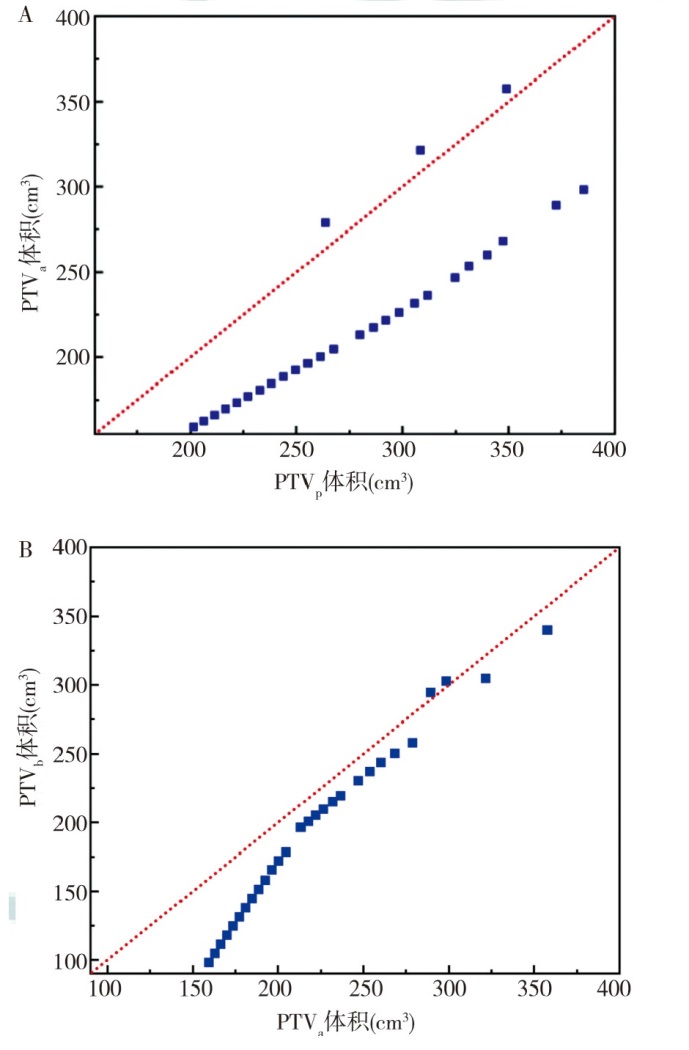
| 靶区 | 靶区体积(cm3) | 处方剂量覆盖率(%) |
|---|---|---|
| PTVp | 281.6±52.8 | 97.4±2.1 |
| PTVa | 224.6±46.2a | 97.8±2.4 |
| PTVb | 194.2±58.2ab | 98.3±2.0 |
| F值 | 4.78 | 0.55 |
| P值 | 0.013 | 0.582 |
"
"
"
| 参数 | Planp | Plana | Planb | F值 | P值 |
|---|---|---|---|---|---|
| D2%(Gy) | 74.1±1.2 | 73.9±1.2a | 73.6±1.3ab | 3.88 | 0.027 |
| D50%(Gy) | 71.9±1.0 | 71.8±1.0 | 71.7±1.1 | 0.05 | 0.951 |
| D98%(Gy) | 70.2±0.7 | 70.3±0.6 | 70.3±0.7 | 0.31 | 0.735 |
| Dmean(Gy) | 71.9±0.9 | 71.9±1.0 | 71.8±1.0 | 0.03 | 0.971 |
| HI | 0.051±0.019 | 0.046±0.021a | 0.042±0.018ab | 4.28 | 0.019 |
| CI | 0.847±0.032 | 0.845±0.037 | 0.864±0.032b | 3.58 | 0.035 |
"
"
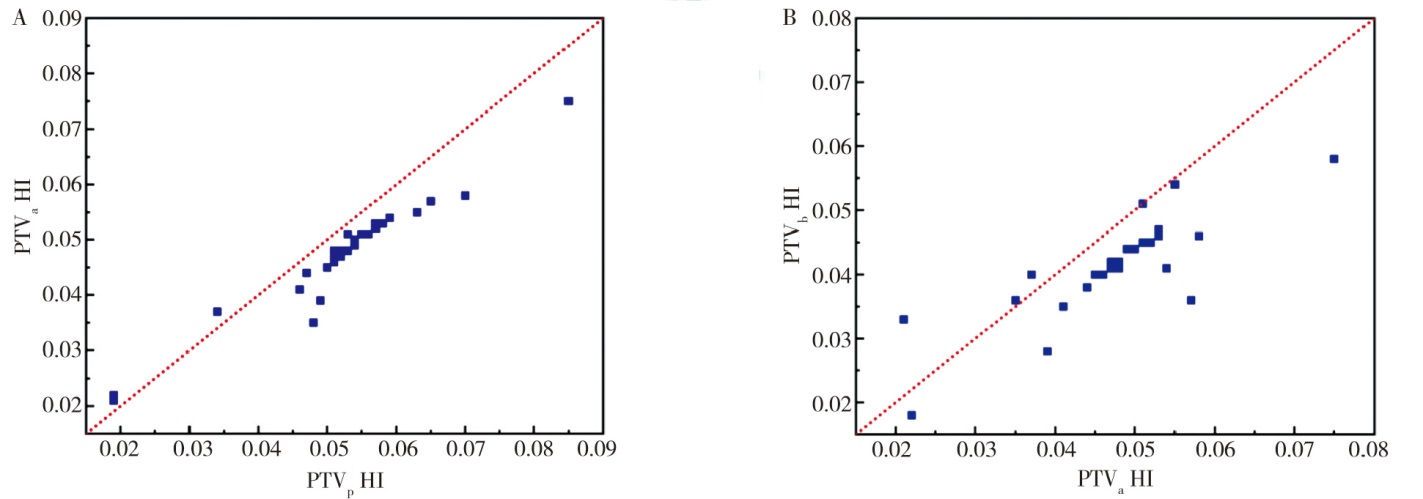
"
| 参数 | Planp | Plana | Planb | F值 | P值 |
|---|---|---|---|---|---|
| 直肠 | |||||
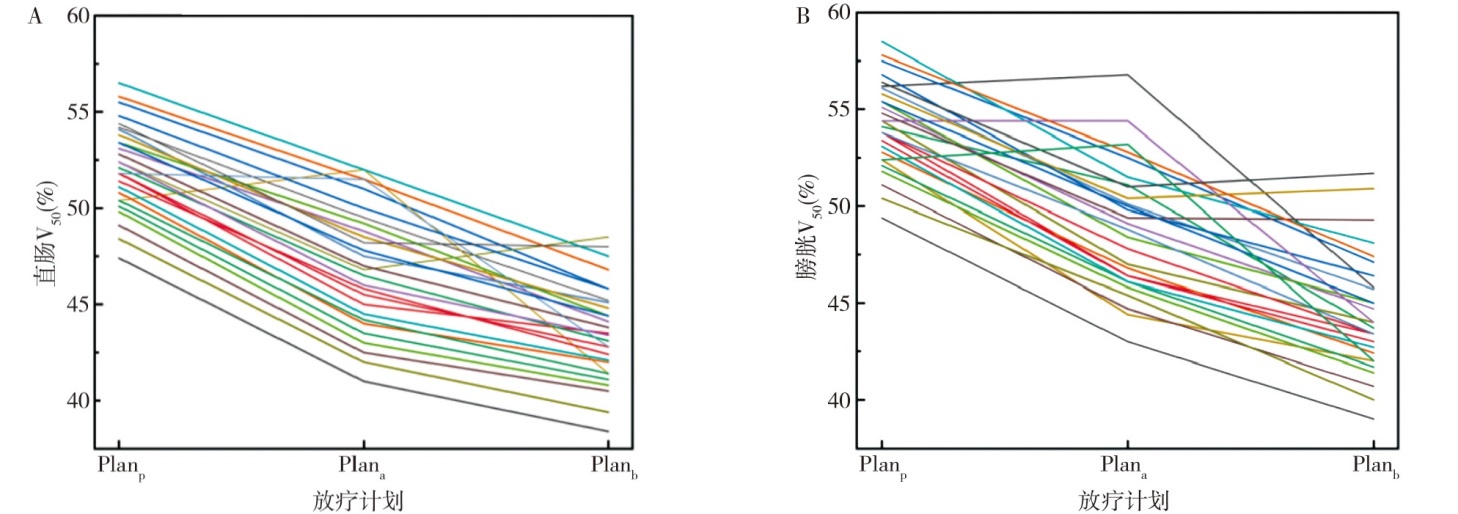
| V50(%) | 52.4±2.3 | 47.2±2.9a | 44.3±3.0ab | 4.65 | 0.013 |
| V60(%) | 38.4±3.3 | 33.4±3.5a | 30.4±3.1ab | 4.42 | 0.017 |
| V70(%) | 18.4±3.5 | 12.4±3.7a | 10.4±3.3ab | 4.28 | 0.019 |
| 膀胱 | |||||
| V50(%) | 54.6±2.1 | 50.1±3.0a | 45.2±3.2ab | 4.35 | 0.018 |
| V60(%) | 43.8±3.4 | 36.4±3.7a | 32.4±3.1ab | 4.33 | 0.018 |
| V70(%) | 21.8±3.6 | 15.4±3.9a | 11.4±3.3ab | 4.42 | 0.017 |
| 骨盆 | |||||
| Dmean(Gy) | 12.3±1.0 | 11.2±0.9 | 10.7±1.1 | 2.85 | 0.066 |
| V30(%) | 27.8±3.2 | 25.1±3.4a | 22.7±3.1a | 3.85 | 0.027 |
| 左股骨头 | |||||
| Dmean(Gy) | 15.6±1.0 | 15.1±0.9 | 14.6±1.0 | 1.52 | 0.228 |
| V30(%) | 16.0±1.8 | 15.1±1.7 | 14.5±1.6 | 1.48 | 0.237 |
| 右股骨头 | |||||
| Dmean(Gy) | 15.1±1.0 | 15.6±1.0 | 14.6±0.9 | 1.55 | 0.222 |
| V30(%) | 12.2±2.4 | 12.5±2.5 | 11.9±2.3 | 0.52 | 0.598 |
| 注:OAR为危及器官;Planp为基于CT的初始放疗计划;Plana为第1周ART计划;Planb为第4周ART计划;a为与Planp比较,P<0.05;b为与Plana比较,P<0.05;ART为自适应放疗 | |||||
"
| [1] | Sung H, Filho AM, Laversanne M, et al. Global cancer statistics 2024: GLOBOCAN estimates of incidence and mortality worldwide for 34 cancers in 186 countries[J]. CA Cancer J Clin, 2026, 76(4): e70090. DOI: 10.3322/caac.70090. |
| [2] | Abu-Hijlih R, Alzibdeh A, Abaza H, et al. Prostatectomy versus definitive radiation for localized prostate cancer: revisiting the debate at a tertiary cancer center[J]. Front Oncol, 2026, 16: 1756635. DOI: 10.3389/fonc.2026.1756635. |
| [3] | van As N, Griffin C, Tree A, et al. Phase 3 trial of stereotactic body radiotherapy in localized prostate cancer[J]. N Engl J Med, 2024, 391(15): 1413-1425. DOI: 10.1056/NEJMoa2403365. |
| [4] | 赵鑫, 范学武, 田龙, 等. 三维超声在前列腺癌图像引导放疗中的应用与评价研究[J]. 国际肿瘤学杂志, 2024, 51(1): 43-49. DOI: 10.3760/cma.j.cn371439-20230418-00005. |
| [5] | 赫捷, 陈万青, 李霓. 中国前列腺癌筛查与早诊早治指南(2022,北京)[J]. 中国肿瘤, 2022, 31(1): 1-30. DOI: 10.11735/j.issn.1004-0242.2022.01.A001. |
| [6] | Schaeffer EM, Srinivas S, Adra N, et al. Prostate cancer, version 4.2023, NCCN clinical practice guidelines in oncology[J]. J Natl Compr Canc Netw, 2023, 21(10): 1067-1096. DOI: 10.6004/jnccn.2023.0050. |
| [7] | Amin MB, Edge SB, Greene FL, et al. AJCC cancer staging manual[M]. 8th ed. New York: Springer, 2016: 589-628. DOI: 10.1007/978-3-319-40618-3. |
| [8] | Landberg T, Chavaudra J, Dobbs J, et al. Prescribing, recording and reporting photon beam therapy (supplement to ICRU Report 50): ICRU Report 62[M]. Bethesda: ICRU, 1999. DOI: 10.1093/jicru/os32.1.1. |
| [9] | Knopf AC, Boye D, Lomax A, et al. Adequate margin definition for scanned particle therapy in the incidence of intrafractional motion[J]. Phys Med Biol, 2013, 58(17): 6079-6094. DOI: 10.1088/0031-9155/58/17/6079. |
| [10] |
Wang W, Wu Q, Yan D. Quantitative evaluation of cone-beam computed tomography in target volume definition for offline image-guided radiation therapy of prostate cancer[J]. Radiother Oncol, 2010, 94(1): 71-75. DOI: 10.1016/j.radonc.2009.10.005.
pmid: 19897268 |
| [11] | Eckl M, Alfakhori N, Willam M, et al. A cone-beam computed tomography based workflow for online adaptive ultra-hypofractionated radiotherapy of prostate cancer[J]. Phys Imaging Radiat Oncol, 2025, 36: 100869. DOI: 10.1016/j.phro.2025.100869. |
| [12] | Zhu LL, Bredfeldt JS, Hancox C, et al. CT online adaptive radiotherapy is associated with dosimetric and acute toxicity improvements in prostate cancer treatment[J]. Radiother Oncol, 2025, 213: 111207. DOI: 10.1016/j.radonc.2025.111207. |
| [13] | Christiansen RL, Dysager L, Hansen CR, et al. Online adaptive radiotherapy potentially reduces toxicity for high-risk prostate cancer treatment[J]. Radiother Oncol, 2022, 167: 165-171. DOI: 10.1016/j.radonc.2021.12.013. |
| [14] | Amjad A, Chen X, Hall WA, et al. Patient-specific deep learning auto-segmentation for MR-guided adaptive radiotherapy of prostate cancer[J]. Int J Radiat Oncol Biol Phys, 2023, 117(2): e638-e639. DOI: 10.1016/j.ijrobp.2023.06.2044. |
| [15] | Kim JY, Tawk B, Knoll M, et al. Clinical workflow of cone beam computer tomography-based daily online adaptive radiotherapy with offline magnetic resonance guidance: the modular adaptive radiotherapy system (MARS)[J]. Cancers (Basel), 2024, 16(6): 1210. DOI: 10.3390/cancers16061210. |
| [16] | Groot Koerkamp ML, Bol GH, Kroon PS, et al. Bringing online adaptive radiotherapy to a standard C-arm linac[J]. Phys Imaging Radiat Oncol, 2024, 31: 100597. DOI: 10.1016/j.phro.2024.100597. |
| [17] |
Ferrara E, Beldì D, Yin J, et al. Adaptive strategy for external beam radiation therapy in prostate cancer: management of the geometrical uncertainties with robust optimization[J]. Pract Radiat Oncol, 2020, 10(6): e521-e528. DOI: 10.1016/j.prro.2020.05.006.
pmid: 32464369 |
| [18] |
Posiewnik M, Piotrowski T. A review of cone-beam CT applications for adaptive radiotherapy of prostate cancer[J]. Phys Med, 2019, 59: 13-21. DOI: 10.1016/j.ejmp.2019.02.014.
pmid: 30928061 |
| [19] | Capone L, Cavallo F, Di Minico D, et al. Offline adaptive radiation therapy for prostate cancer: using daily CBCT and deformable image fusion for correct replanning[J]. J Biomed Pract, 2021, 5(1): 5937. DOI: 10.13135/2532-7925/5937. |
| [20] | Mansour IR, Johnstone CD, Malkov V, et al. Comparison of online adaptation strategies for magnetic resonance guided prostate radiation therapy[J]. Phys Imaging Radiat Oncol, 2025, 35: 100816. DOI: 10.1016/j.phro.2025.100816. |
| [21] |
Malygina H, Auerbach H, Ries M, et al. Intra-adaptational changes in online adaptive radiotherapy: from the ideal to the real dose[J]. Strahlenther Onkol, 2025, 201(11): 1170-1184. DOI: 10.1007/s00066-025-02425-9.
pmid: 40663147 |
| [22] | 赵永瑞, 高莹, 陈怡东, 等. 基于直线加速器的分次立体定向放疗对小体积脑转移瘤的有效性及安全性[J]. 国际肿瘤学杂志, 2023, 50(3): 138-143. DOI: 10.3760/cma.j.cn371439-20221214-00028. |
| [23] |
Saito N, Schmitt D, Bangert M. Correlation between intrafractional motion and dosimetric changes for prostate IMRT: comparison of different adaptive strategies[J]. J Appl Clin Med Phys, 2018, 19(4): 87-97. DOI: 10.1002/acm2.12359.
pmid: 29862644 |
| [24] |
Shan G, Hu W, Chen L, et al. Dosimetric evaluation of image-guided radiation therapy for prostate cancer[J]. Med Dosim, 2021, 46(2): 117-126. DOI: 10.1016/j.meddos.2020.09.007.
pmid: 33020024 |
| [1] | Lan Liu, Guo Min, Wei Tingting, Zhao Yingxi, Long Yaxiu. Efficacy and safety analysis of full-course toripalimab combined with induction chemotherapy and concurrent chemoradiotherapy in the treatment of locally advanced nasopharyngeal carcinoma [J]. Journal of International Oncology, 2026, 53(9): 513-520. |
| [2] | Wang Zhenli, Zhang Yaowen, Guo Yixiao, Lu Yukun, Huang Xiao, Sun Xiaodong, Wang Yinliang, Zheng Anping, Li Yazhou. Dosimetric comparison of carbon ion and photon radiotherapy for thoracic esophageal cancer [J]. Journal of International Oncology, 2026, 53(9): 521-526. |
| [3] | Niu Ping, Tian Long, Cui Ling. Construction of a nomogram prediction model for evaluating the therapeutic efficacy of hyperbaric oxygen chamber therapy in managing acute radiation dermatitis among breast cancer patients [J]. Journal of International Oncology, 2026, 53(8): 464-469. |
| [4] | Che Yunan, Chen Xiang, Chu Xu, Lu Daofeng, Jiang Kun. Research progress of tumor microenvironment in the pathogenesis of prostate cancer [J]. Journal of International Oncology, 2026, 53(8): 502-507. |
| [5] | Ma Chiluan, Jia Dianjun, Wei Dongdong, Wang Jingrun, Li Xinping, Zhao Boyan, Zhao Yue. Efficacy and safety of concurrent radiotherapy combined with tegafur suppositories and immune checkpoint inhibitors in the treatment of elderly patients with esophageal cancer [J]. Journal of International Oncology, 2026, 53(7): 426-433. |
| [6] | Su Jialin, Zheng Jin, Zhao Canjun, Han Lijun, Zhang Jie, Wang Liping. Factors influencing the occurrence of high-grade acute radiodermatitis in patients undergoing image guided radiation therapy after breast cancer surgery and the construction of a prediction model [J]. Journal of International Oncology, 2026, 53(6): 339-345. |
| [7] | Li Lina, Liu Shuai, Zhang Nan. Research progress on preoperative radiotherapy for breast cancer [J]. Journal of International Oncology, 2026, 53(5): 301-305. |
| [8] | Han Yufei, Li Fengmei, Zhang Weina, Zhang Ping, Hou Ping. Short-term efficacy and clinical outcomes of concurrent chemoradiotherapy followed by anlotinib maintenance treatment in patients with locally advanced cervical cancer [J]. Journal of International Oncology, 2026, 53(4): 219-223. |
| [9] | Guo Xuetao, Qiao Julong, Shao Hongjiang, Wang Xin, Su Riguge, Liu Lu, Liang Lu. Analysis of influencing factors and predictive efficacy of biochemical persistence/recurrence after radical resection for high-risk localized prostate cancer [J]. Journal of International Oncology, 2026, 53(3): 157-162. |
| [10] | Wu Songyou, Wang Gang, Wang Wenling, Dong Hongmin, Chen Weiwei, Li Xiaokai, Chen Wanghua, Zuo Kai. Prospective cohort study on the effect of abdominal circumference on the intestinal radiation dose volume and the acute intestinal toxicity in pelvic intensity modulated radiation therapy for rectal cancer patients [J]. Journal of International Oncology, 2025, 52(9): 566-575. |
| [11] | Liu Qi, Qu Guobin, Zhu Jian, Wu Fan. Feasibility study of using dual-energy CT virtual non-contrast images to replace true non-contrast images in photon and proton radiotherapy dose calculations [J]. Journal of International Oncology, 2025, 52(7): 401-408. |
| [12] | Zhu Jian. Preface to the dosimetric characteristic of proton radiotherapy for tumors [J]. Journal of International Oncology, 2025, 52(7): 432-433. |
| [13] | Wu Shizhang, Hu Man, Dai Tianyuan, Li Chengqiang, Tao Cheng, Duan Jinghao, Chen Jinhu, Bai Tong, Kong Tian, Zhu Jian. Analysis of dosimetric characteristics of proton radiotherapy in 1 case of whole central nervous system tumor [J]. Journal of International Oncology, 2025, 52(7): 434-440. |
| [14] | Li Chengqiang, Wang Yungang, Yu Yishan, Wu Shizhang, Tao Cheng, Ma Xingmin, Dai Tianyuan, Duan Jinghao, Chen Jinhu, Bai Tong, Zhu Jian. Analysis of dosimetric characteristics of proton radiotherapy in 4 cases of breast cancer [J]. Journal of International Oncology, 2025, 52(7): 448-454. |
| [15] | Duan Jinghao, Yue Jinbo, Tao Cheng, Wu Shizhang, Li Chengqiang, Dai Tianyuan, Chen Jinhu, Bai Tong, Zhu Jian. Analysis of dosimetric characteristics of proton radiotherapy in 3 cases of abdominal and pelvic tumors [J]. Journal of International Oncology, 2025, 52(7): 455-461. |
| Viewed | ||||||
|
Full text |
|
|||||
|
Abstract |
|
|||||