Journal of International Oncology ›› 2025, Vol. 52 ›› Issue (11): 695-699.doi: 10.3760/cma.j.cn371439-20250123-00119
• Original article • Previous Articles Next Articles
Diagnostic value of MRI combined with serum LRG1 and LOXL2 for prostate cancer
Ye Rui, Chen Zhen( ), Hao Ningning, Li Rongrong
- Department of Radiology Diagnosis, 900th Hospital of PLA Joint Logistic Support Force, Fuzhou 350003, China
-
Received:2025-01-23Revised:2025-09-19Online:2025-11-08Published:2025-12-21 -
Contact:Chen Zhen E-mail:ipy17e@163.com

Cite this article
Ye Rui, Chen Zhen, Hao Ningning, Li Rongrong. Diagnostic value of MRI combined with serum LRG1 and LOXL2 for prostate cancer[J]. Journal of International Oncology, 2025, 52(11): 695-699.
share this article

"
| 序列 | 重复时间 (ms) | 回波时间 (ms) | 层厚 (mm) | 层间距 (mm) | 扫描野(cm×cm) |
|---|---|---|---|---|---|
| T1WI | 700 | 7 | 4 | 1 | 20×20 |
| T2WI | 4 100 | 80 | 4 | 1 | 25×25 |
| DWI | 6 000 | 80 | 4 | 1 | 20×20 |
| DCE | 5 | 1.7 | 3.5 | 0.35 | 26×26 |
"
| 项目 | 对照组(n=59) | 前列腺癌组(n=84) | t/χ2值 | P值 |
|---|---|---|---|---|
| 年龄(岁) | 65.85±4.26 | 66.37±4.29 | 0.72 | 0.475 |
| BMI(kg/m2) | 23.19±2.10 | 23.56±2.05 | 1.05 | 0.295 |
| 糖尿病 | 12(20.34) | 28(33.33) | 2.91 | 0.088 |
| 高血压 | 15(25.42) | 34(40.48) | 3.49 | 0.062 |
| 高脂血症 | 3(5.08) | 10(11.90) | 1.95 | 0.163 |
| 慢性肾脏病 | 5(8.47) | 15(17.86) | 2.54 | 0.111 |
| 前列腺癌家族史 | 3(5.08) | 11(13.10) | 2.52 | 0.113 |
| Ktrans(/min) | 0.09±0.03 | 0.13±0.04 | 6.50 | <0.001 |
| Kep(/min) | 0.48±0.11 | 0.53±0.12 | 2.54 | 0.012 |
| ADC(×10-3 mm2/s) | 1.16±0.15 | 0.92±0.13 | 10.20 | <0.001 |
"
| 组别 | LRG1 | LOXL2 | PSA |
|---|---|---|---|
| 对照组(n=59) | 92.51±14.34 | 5.21±0.93 | 6.04(2.62,12.04) |
| 前列腺癌组(n=84) | 115.48±15.61 | 6.79±1.15 | 16.05(12.23,22.89) |
| t/Z值 | 8.96 | 8.73 | 7.02 |
| P值 | <0.001 | <0.001 | <0.001 |
"
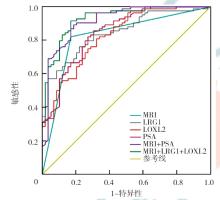
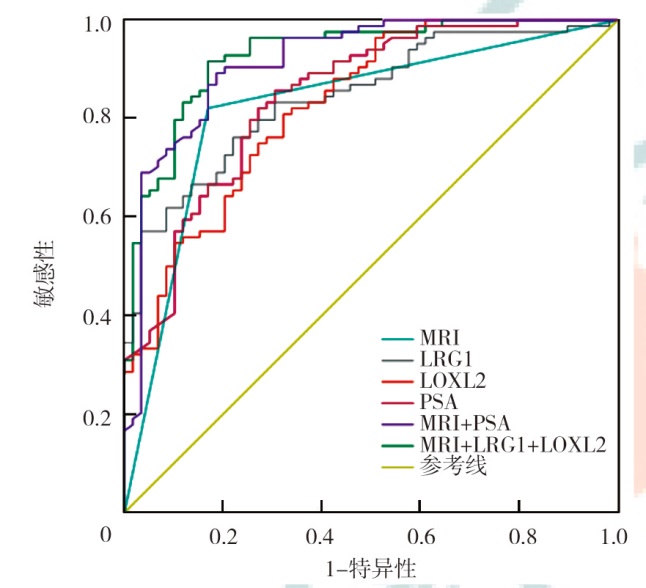
| 指标 | 截断值(ng/ml) | AUC | 95%CI | 敏感性 | 特异性 | 约登指数 |
|---|---|---|---|---|---|---|
| MRI | 0.826 | 0.753~0.899 | 0.821 | 0.831 | 0.652 | |
| LRG1 | 103.20 | 0.844 | 0.782~0.907 | 0.762 | 0.780 | 0.542 |
| LOXL2 | 5.78 | 0.829 | 0.762~0.895 | 0.810 | 0.678 | 0.487 |
| PSA | 7.65 | 0.845 | 0.815~0.934 | 0.857 | 0.695 | 0.552 |
| MRI+PSA | 0.916 | 0.868~0.965 | 0.893 | 0.814 | 0.706 | |
| MRI+LRG1+LOXL2 | 0.929 | 0.888~0.971 | 0.917 | 0.831 | 0.747 |
"
| [1] | Bray F, Laversanne M, Sung H, et al. Global cancer statistics 2022: GLOBOCAN estimates of incidence and mortality worldwide for 36 cancers in 185 countries[J]. CA Cancer J Clin, 2024, 74(3): 229-263. DOI: 10.3322/caac.21834. |
| [2] | Okubo Y, Sato S, Terao H, et al. Review of the developing landscape of prostate biopsy and its roles in prostate cancer diagnosis and treatment[J]. Arch Esp Urol, 2023, 76(9): 633-642. DOI: 10.56434/j.arch.esp.urol.20237609.78. |
| [3] | Sekhoacha M, Riet K, Motloung P, et al. Prostate cancer review: genetics, diagnosis, treatment options, and alternative approaches[J]. Molecules, 2022, 27(17): 5730. DOI: 10.3390/molecules27175730. |
| [4] |
Camilli C, Hoeh AE, De Rossi G, et al. LRG1: an emerging player in disease pathogenesis[J]. J Biomed Sci, 2022, 29(1): 6. DOI: 10.1186/s12929-022-00790-6.
pmid: 35062948 |
| [5] |
Liu P, Wang W, Wang F, et al. Alterations of plasma exosomal proteins and motabolies are associated with the progression of castration-resistant prostate cancer[J]. J Transl Med, 2023, 21(1): 40. DOI: 10.1186/s12967-022-03860-3.
pmid: 36681849 |
| [6] | Alonso-Nocelo M, Ruiz-Cañas L, Sancho P, et al. Macrophages direct cancer cells through a LOXL2-mediated metastatic cascade in pancreatic ductal adenocarcinoma[J]. Gut, 2023, 72(2): 345-359. DOI: 10.1136/gutjnl-2021-325564. |
| [7] | Ma S, Xu M, Zhang J, et al. Analysis and functional validations of multiple cell death patterns for prognosis in prostate cancer[J]. Int Immunopharmacol, 2024, 143(Part 1): 113216. DOI: 10.1016/j.intimp.2024.113216. |
| [8] | 赫捷, 陈万青, 李霓, 等. 中国前列腺癌筛查与早诊早治指南(2022, 北京)[J]. 中国肿瘤, 2022, 31(1): 1-30. DOI: 10.11735/j.issn.1004-0242.2022.01.A001. |
| [9] |
Turkbey B, Rosenkrantz AB, Haider MA, et al. Prostate imaging reporting and data system version 2.1: 2019 update of prostate imaging reporting and data system version 2[J]. Eur Urol, 2019, 76(3): 340-351. DOI: 10.1016/j.eururo.2019.02.033.
pmid: 30898406 |
| [10] |
Fernandes MC, Yildirim O, Woo S, et al. The role of MRI in prostate cancer: current and future directions[J]. MAGMA, 2022, 35(4): 503-521. DOI: 10.1007/s10334-022-01006-6.
pmid: 35294642 |
| [11] | 赵鑫, 范学武, 田龙, 等. 三维超声在前列腺癌图像引导放疗中的应用与评价研究[J]. 国际肿瘤学杂志, 2024, 51(1): 43-49. DOI: 10.3760/cma.j.cn371439-20230418-00005. |
| [12] | Wu H, Zeng C, Wu G, et al. Exosomal LRG1 promotes non-small cell lung cancer proliferation and metastasis by binding FN1 protein[J]. Exp Cell Res, 2024, 439(2): 114097-114105. DOI: 10.1016/j.yexcr.2024.114097. |
| [13] | Zhao X, Chen J, Zhang C, et al. LncRNA AGAP2-AS1 interacts with IGF2BP2 to promote bladder cancer progression via regulating LRG1 mRNA stability[J]. Cell Signal, 2023, 111: 110839. DOI: 10.1016/j.cellsig.2023.110839. |
| [14] |
He L, Feng A, Guo H, et al. LRG1 mediated by ATF3 promotes growth and angiogenesis of gastric cancer by regulating the SRC/STAT3/VEGFA pathway[J]. Gastric Cancer, 2022, 25(3): 527-541. DOI: 10.1007/s10120-022-01279-9.
pmid: 35094168 |
| [15] | Dritsoula A, Camilli C, Moss SE, et al. The disruptive role of LRG1 on the vasculature and perivascular microenvironment[J]. Front Cardiovasc Med, 2024, 11: 1386177. DOI: 10.3389/fcvm.2024.1386177. |
| [16] |
Wu D, Xie W, Chen X, et al. LRG1 is involved in the progression of ovarian cancer via modulating FAK/AKT signaling pathway[J]. Front Biosci (Landmark Ed), 2023, 28(5): 101. DOI: 10.31083/j.fbl2805101.
pmid: 37258465 |
| [17] | Peng T, Lin S, Meng Y, et al. LOXL2 small molecule inhibitor restrains malignant transformation of cervical cancer cells by repres-sing LOXL2-induced epithelial-mesenchymal transition (EMT)[J]. Cell Cycle, 2022, 21(17): 1827-1841. DOI: 10.1080/15384101.2022.2073047. |
| [18] | Shen Y, Yan J, Li L, et al. LOXL2-induced PEAR1 Ser891 phosphorylation suppresses CD44 degradation and promotes triple-negative breast cancer metastasis[J]. J Clin Invest, 2024, 134(16): e177357-e177373. DOI: 10.1172/JCI177357. |
| [19] | Pascual-Reguant L, Serra-Camprubí Q, Datta D, et al. Interactions between BRD4S, LOXL2, and MED1 drive cell cycle transcription in triple-negative breast cancer[J]. EMBO Mol Med, 2023, 15(12): e18459. DOI: 10.15252/emmm.202318459. |
| [20] | Xia Q, Du Z, Chen M, et al. A protein complex of LCN2, LOXL2 and MMP9 facilitates tumour metastasis in oesophageal cancer[J]. Mol Oncol, 2023, 17(11): 2451-2471. DOI: 10.1002/1878-0261.13529. |
| [21] | 罗瑛译, 韦利娥, 玉开温. 多模态MRI参数联合血清miR-301a水平评估前列腺癌危险程度及预测早期复发的价值[J]. 放射学实践, 2022, 37(5): 560-565. DOI: 10.13609/j.cnki.1000-0313.2022.05.005. |
| [22] | 许品, 李锋, 张双, 等. 磁共振成像联合血清microRNA-221对前列腺癌的诊断价值[J]. 中国现代医学杂志, 2023, 33(18): 26-30. DOI: 10.3969/j.issn.1005-8982.2023.18.005. |
| [1] | Chen Qiaoliang, Qin Xinyan, Lai Ruihe, Tan Shuangxiu. Diagnostic value of multimodal Nomogram model combining 18F-FDG PET/CT and ultrasound for triple negative breast cancer [J]. Journal of International Oncology, 2025, 52(9): 560-565. |
| [2] | Radiation Oncology Professional Committee of the Chinese Research Hospital Association, Hebei Society of Mathematical and Physical Medicine, Tianjin Precision Medicine Society. Expert consensus on the clinical diagnosis and treatment of post-obstructive pneumonia in newly diagnosed lung cancer patients [J]. Journal of International Oncology, 2025, 52(8): 484-494. |
| [3] | Li Xiaoxuan, Xia Zhipeng, Luan Rumei, Wan Yunyan, Yao Zhouhong, Lin Xinshan, Lin Dianjie. Clinical value of metabolomics in assessing the malignant risk of pulmonary nodules [J]. Journal of International Oncology, 2025, 52(7): 409-413. |
| [4] | Chen Danlei, Deng Junjun, Li Miao. Progress of clinical application of circulating tumor cells in lung cancer [J]. Journal of International Oncology, 2025, 52(2): 119-123. |
| [5] | Chinese Society of Clinical Oncology-Supportive Care and Rehabilitation Committee, Chinese Expert Consensus Working Group on Cancer-related Anorexia . Chinese expert consensus on the diagnosis and treatment of cancer-related anorexia [J]. Journal of International Oncology, 2025, 52(2): 67-78. |
| [6] | Ji Haitao, Wang Yanfeng, Liu Yongcheng, Hao Nan. Expression and clinical significance of DHCR7 in gastric cancer based on bioinformatics analysis [J]. Journal of International Oncology, 2025, 52(2): 94-100. |
| [7] | Liu Wenhui, Yin Ping, Qi Jie. Diagnostic value of detection of serum G-17,sB7-H3,and DKK1 for early gastric cancer [J]. Journal of International Oncology, 2024, 51(8): 498-503. |
| [8] | Liu Na, Kou Jieli, Yang Feng, Liu Taotao, Li Danping, Han Junrui, Yang Lizhou. Clinical value of serum miR-106b-5p and miR-760 combined with low-dose spiral CT in the diagnosis of early lung cancer [J]. Journal of International Oncology, 2024, 51(6): 321-325. |
| [9] | Yuan Jian, Huang Yanhua. Diagnostic value of Hp-IgG antibody combined with serum DKK1 and sB7-H3 in early gastric cancer [J]. Journal of International Oncology, 2024, 51(6): 338-343. |
| [10] | Zhang Ningning, Yang Zhe, Tan Limei, Li Zhenning, Wang Di, Wei Yongzhi. Diagnostic value of cervical cell DNA ploidy analysis combined with B7-H4 and PKCδ for cervical cancer [J]. Journal of International Oncology, 2024, 51(5): 286-291. |
| [11] | Chen Qi, Xu Chenyang, Wang Yin, Lei Dapeng. Current application status of hyperspectral imaging in the diagnosis and treatment of head and neck tumor [J]. Journal of International Oncology, 2024, 51(5): 298-302. |
| [12] | Zhang Lili, Tan Ru, Fang Xueli, Yang Yu, Sang Zheng, Li Baosheng. Imaging diagnosis, pathological upgrade, and imaging technology progress of ductal carcinoma in situ of the breast [J]. Journal of International Oncology, 2024, 51(3): 166-169. |
| [13] | Peng Qin, Cai Yuting, Wang Wei. Advances on KPNA2 in liver cancer [J]. Journal of International Oncology, 2024, 51(3): 181-185. |
| [14] | Jin Xudong, Chen Zhongjian, Mao Weimin. Research progress on the role of MTAP in malignant mesothelioma [J]. Journal of International Oncology, 2024, 51(2): 99-104. |
| [15] | Sun Haomiao, Sun Haibo, Sun Jianling. Application value of serum MAGEA3 and HE4 in the auxiliary diagnosis of lung cancer patients [J]. Journal of International Oncology, 2024, 51(12): 749-754. |
| Viewed | ||||||
|
Full text |
|
|||||
|
Abstract |
|
|||||