Journal of International Oncology ›› 2026, Vol. 53 ›› Issue (6): 346-354.doi: 10.3760/cma.j.cn371439-20251123-00056
• Original Article • Previous Articles Next Articles
Predictive efficacy of a combined model of radiomics features and clinical signatures for bone metastasis in NSCLC
Li Jianing1, Yao Xuemin1, Wang Jinyun2, Jia Jinghao1( ), Sun Guogui1()
- 1
Department of Oncology Radiotherapy and Chemotherapy ,North China University of Science and Technology Affiliated Hospital Tangshan 063000, China
2Department of Thoracic Surgery ,Fourth Medical Center of Chinese PLA General Hospital Beijing 100036, China
-
Received:2025-11-23Online:2026-06-08Published:2026-06-05 -
Contact:Jia Jinghao, Sun Guogui E-mail:jjh0322@163.com;guogui_sun2021@sina.com -
Supported by:National Natural Science Foundation of China(82172658);Medical Science Research Project of Hebei Province of China(20191595)

Cite this article
Li Jianing, Yao Xuemin, Wang Jinyun, Jia Jinghao, Sun Guogui. Predictive efficacy of a combined model of radiomics features and clinical signatures for bone metastasis in NSCLC[J]. Journal of International Oncology, 2026, 53(6): 346-354.
share this article
"

"
| 项目 | 无骨转移(n=123) | 骨转移(n=414) | χ2值 | P值 | 项目 | 无骨转移(n=123) | 骨转移(n=414) | χ2值 | P值 |
|---|---|---|---|---|---|---|---|---|---|
| 年龄(岁) | D-二聚体(ng/ml) | ||||||||
| ≤60 | 47 | 155 | 0.02 | 0.877 | ≤230 | 62 | 340 | 50.70 | <0.001 |
| >60 | 76 | 259 | >230 | 61 | 74 | ||||
| 性别 | CEA(ng/ml) | ||||||||
| 男 | 66 | 247 | 1.41 | 0.236 | ≤5 | 31 | 316 | 108.41 | <0.001 |
| 女 | 57 | 167 | >5 | 92 | 98 | ||||
| 吸烟史 | CYFRA21-1(ng/ml) | ||||||||
| 无 | 97 | 283 | 5.06 | 0.025 | ≤3.3 | 47 | 248 | 18.02 | <0.001 |
| 有 | 26 | 131 | >3.3 | 76 | 166 | ||||
| 家族史 | SCC-Ag(ng/ml) | ||||||||
| 无 | 115 | 388 | 0.01 | 0.929 | ≤1.5 | 104 | 309 | 5.25 | 0.022 |
| 有 | 8 | 26 | >1.5 | 19 | 105 | ||||
| 肿瘤位置 | 毛刺征 | ||||||||
| 左肺上叶 | 37 | 94 | 0.100 | 无 | 4 | 149 | 49.89 | <0.001 | |
| 左肺下叶 | 24 | 88 | 有 | 119 | 265 | ||||
| 右肺上叶 | 44 | 127 | 分叶征 | ||||||
| 右肺中叶 | 3 | 18 | 无 | 30 | 269 | 63.30 | <0.001 | ||
| 右肺下叶 | 15 | 87 | 有 | 93 | 145 | ||||
| T分期 | 胸膜凹陷征 | ||||||||
| T1-2 | 103 | 374 | 4.16 | 0.041 | 无 | 41 | 306 | 68.30 | <0.001 |
| T3-4 | 20 | 40 | 有 | 82 | 108 | ||||
| N分期 | 血管集束征 | ||||||||
| N0-1 | 27 | 289 | 89.67 | <0.001 | 无 | 83 | 342 | 13.15 | <0.001 |
| N2-3 | 96 | 125 | 有 | 40 | 72 | ||||
| 病理类型 | |||||||||
| 鳞状细胞癌 | 16 | 170 | 32.97 | <0.001 | |||||
| 腺癌 | 107 | 244 |
"
| 项目 | 训练集(n=376) | 验证集(n=161) | χ2值 | P值 | 项目 | 训练集(n=376) | 验证集(n=161) | χ2值 | P值 |
|---|---|---|---|---|---|---|---|---|---|
| 年龄(岁) | D-二聚体(ng/ml) | ||||||||
| ≤60 | 144 | 58 | 0.25 | 0.618 | ≤230 | 282 | 120 | 0.01 | 0.909 |
| >60 | 232 | 103 | >230 | 94 | 41 | ||||
| 性别 | CEA(ng/ml) | ||||||||
| 男 | 209 | 104 | 3.77 | 0.052 | ≤5 | 235 | 112 | 2.46 | 0.117 |
| 女 | 167 | 57 | >5 | 141 | 49 | ||||
| 吸烟史 | CYFRA21-1(ng/ml) | ||||||||
| 无 | 269 | 111 | 0.37 | 0.544 | ≤3.3 | 215 | 80 | 2.56 | 0.110 |
| 有 | 107 | 50 | >3.3 | 161 | 81 | ||||
| 家族史 | SCC-Ag(ng/ml) | ||||||||
| 无 | 353 | 150 | 0.10 | 0.755 | ≤1.5 | 301 | 112 | 6.98 | 0.008 |
| 有 | 23 | 11 | >1.5 | 75 | 49 | ||||
| 肿瘤位置 | 毛刺征 | ||||||||
| 左肺上叶 | 95 | 36 | 无 | 108 | 45 | 0.03 | 0.856 | ||
| 左肺下叶 | 75 | 37 | 有 | 268 | 116 | ||||
| 右肺上叶 | 129 | 42 | 6.86 | 0.143 | 分叶征 | ||||
| 右肺中叶 | 12 | 9 | 无 | 193 | 106 | 9.62 | 0.002 | ||
| 右肺下叶 | 65 | 37 | 有 | 183 | 55 | ||||
| T分期 | 胸膜凹陷征 | ||||||||
| T1-2 | 342 | 135 | 5.74 | 0.017 | 无 | 237 | 110 | 1.38 | 0.240 |
| T3-4 | 34 | 26 | 有 | 139 | 51 | ||||
| N分期 | 血管集束征 | ||||||||
| N0-1 | 219 | 97 | 0.19 | 0.666 | 无 | 282 | 143 | 13.04 | <0.001 |
| N2-3 | 157 | 64 | 有 | 94 | 18 | ||||
| 病理类型 | |||||||||
| 鳞状细胞癌 | 108 | 78 | 19.37 | <0.001 | |||||
| 腺癌 | 268 | 83 |
"
"
"
| 因素 | 单因素分析 | 多因素分析 | |||||
|---|---|---|---|---|---|---|---|
| OR值 | 95%CI | P值 | OR值 | 95%CI | P值 | ||
| 年龄 | 1.00 | 0.66~1.51 | 0.993 | ||||
| 性别 | 0.78 | 0.52~1.17 | 0.236 | ||||
| 吸烟史 | 1.73 | 1.07~2.79 | 0.026 | 1.31 | 0.69~2.49 | 0.414 | |
| 家族史 | 0.96 | 0.42~2.19 | 0.929 | ||||
| 肿瘤位置 | |||||||
| 左肺上叶 | Ref | ||||||
| 左肺下叶 | 1.44 | 0.80~2.60 | 0.223 | ||||
| 右肺上叶 | 1.14 | 0.68~1.90 | 0.625 | ||||
| 右肺中叶 | 2.36 | 0.66~8.49 | 0.188 | ||||
| 右肺下叶 | 2.28 | 1.17~4.45 | 0.015 | - | - | - | |
| T分期 | 0.57 | 0.32~1.01 | 0.043 | 0.69 | 0.52~0.87 | <0.001 | |
| N分期 | 0.12 | 0.08~0.20 | <0.001 | 0.24 | 0.13~0.43 | <0.001 | |
| 病理类型 | 4.66 | 2.66~8.16 | <0.001 | 6.01 | 2.83~12.77 | <0.001 | |
| D-二聚体(ng/ml) | 0.22 | 0.14~0.34 | <0.001 | 0.32 | 0.17~0.59 | <0.001 | |
| CEA(ng/ml) | 0.10 | 0.07~0.17 | <0.001 | 0.25 | 0.14~0.44 | <0.001 | |
| CYFRA21-1(ng/ml) | 0.41 | 0.27~0.63 | <0.001 | 0.65 | 0.35~1.18 | 0.156 | |
| SCC-Ag(ng/ml) | 1.86 | 1.09~3.18 | 0.023 | 1.91 | 0.87~4.19 | 0.106 | |
| 毛刺征 | 0.06 | 0.02~0.17 | <0.001 | 0.21 | 0.07~0.65 | 0.007 | |
| 分叶征 | 0.17 | 0.11~0.26 | <0.001 | - | - | - | |
| 胸膜凹陷征 | 0.18 | 0.11~0.27 | <0.001 | 0.32 | 0.18~0.56 | <0.001 | |
| 血管集束征 | 0.44 | 0.28~0.69 | <0.001 | - | - | - | |
"
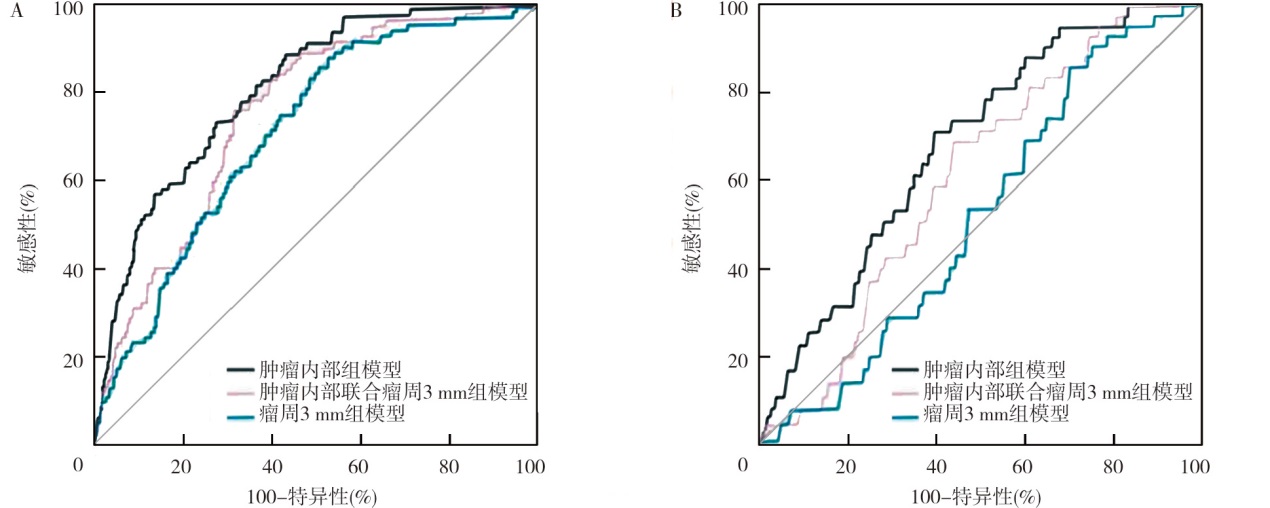
| 模型 | AUC | 95%CI | 敏感性(%) | 特异性(%) | 准确性(%) |
|---|---|---|---|---|---|
| 训练集(n=376) | |||||
| 肿瘤内部组模型 | 0.81 | 0.76~0.86 | 75.61 | 71.42 | 63.32 |
| 肿瘤内部联合瘤周3 mm组模型 | 0.79 | 0.74~0.84 | 77.93 | 71.70 | 76.69 |
| 瘤周3 mm组模型 | 0.74 | 0.69~0.80 | 87.24 | 52.18 | 71.58 |
| 联合模型 | 0.94 | 0.89~0.95 | 94.65 | 83.14 | 83.64 |
| 验证集(n=161) | |||||
| 肿瘤内部组模型 | 0.66 | 0.57~0.75 | 67.68 | 62.96 | 65.48 |
| 肿瘤内部联合瘤周3 mm组模型 | 0.63 | 0.54~0.72 | 64.92 | 62.90 | 76.25 |
| 瘤周3 mm组模型 | 0.53 | 0.43~0.62 | 83.81 | 34.75 | 86.53 |
| 联合模型 | 0.92 | 0.89~0.98 | 86.54 | 91.12 | 82.28 |
"
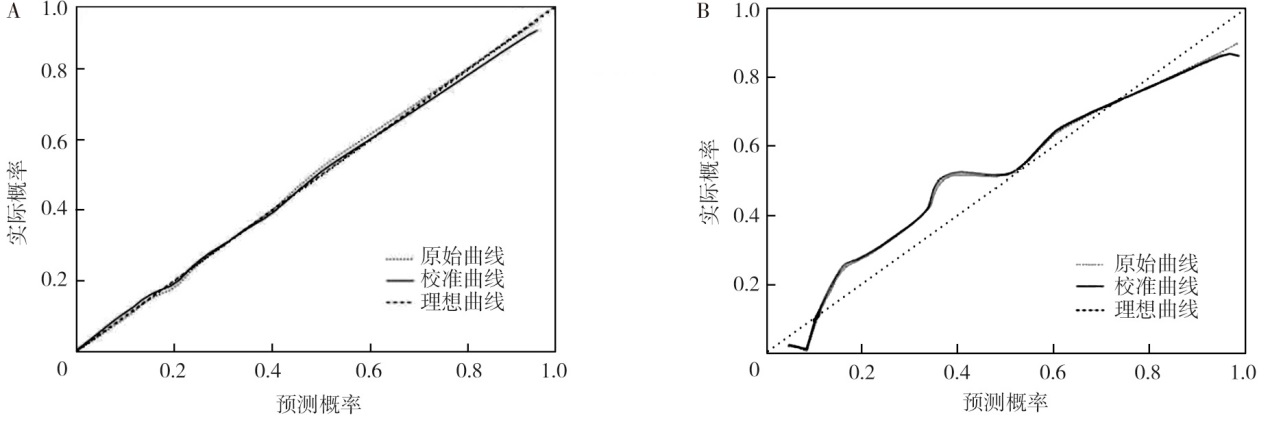
"
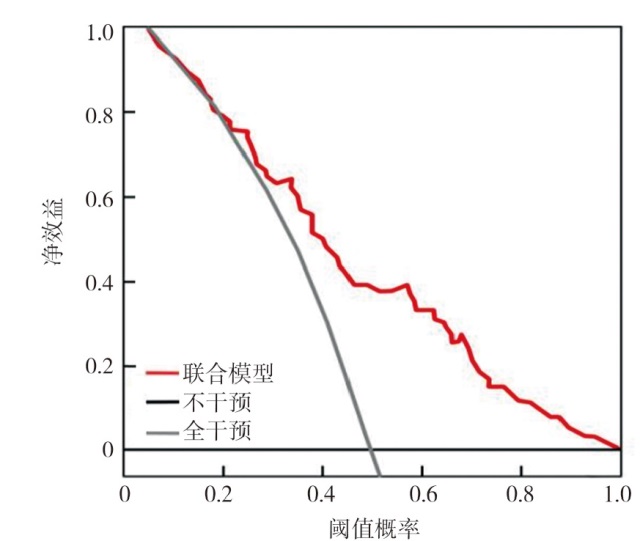
"
| [1] | Bray F, Laversanne M, Sung H, et al. Global cancer statistics 2022: GLOBOCAN estimates of incidence and mortality worldwide for 36 cancers in 185 countries[J]. CA Cancer J Clin, 2024, 74(3): 229-263. DOI: 10.3322/caac.21834. |
| [2] | Li Y, Yan B, He S. Advances and challenges in the treatment of lung cancer[J]. Biomed Pharmacother, 2023, 169: 115891. DOI: 10.1016/j.biopha.2023.115891. |
| [3] | 朱志朋, 虞淦军, 许炜. 地舒单抗联合免疫检查点抑制剂在非小细胞肺癌骨转移中的临床研究进展[J]. 中国肿瘤生物治疗杂志, 2024, 31(5): 528-534. DOI: 10.3872/j.issn.1007-385x.2024.05.014. |
| [4] |
Broder MS, Gutierrez B, Cherepanov D, et al. Burden of skeletal-related events in prostate cancer: unmet need in pain improvement[J]. Support Care Cancer, 2015, 23(1): 237-247. DOI: 10.1007/s00520-014-2437-3.
pmid: 25270847 |
| [5] | She K, Yang W, Li M, et al. FAIM2 promotes non-small cell lung cancer cell growth and bone metastasis by activating the Wnt/β-catenin pathway[J]. Front Oncol, 2021, 11: 690142. DOI: 10.3389/fonc.2021.690142. |
| [6] |
Lubner MG, Smith AD, Sandrasegaran K, et al. CT texture analysis: definitions, applications, biologic correlates, and challenges[J]. Radiographics, 2017, 37(5): 1483-1503. DOI: 10.1148/rg.2017170056.
pmid: 28898189 |
| [7] | Koo HJ, Xu H, Choi CM, et al. Preoperative CT predicting recurrence of surgically resected adenocarcinoma of the lung[J]. Medicine (Baltimore), 2016, 95(2): e2513. DOI: 10.1097/MD.0000000000002513. |
| [8] | Vansteenkiste J, De Ruysscher D, Eberhardt WE, et al. Early and locally advanced non-small-cell lung cancer (NSCLC): ESMO clinical practice guidelines for diagnosis, treatment and follow-up[J]. Ann Oncol, 2013, 24 Suppl 6: vi89-vi98. DOI: 10.1093/annonc/mdx222. |
| [9] | 钟建, 胡必富, 童随阳. 人附睾蛋白4等肿瘤标志物联合全身骨显像对非小细胞肺癌骨转移的诊断价值[J]. 国际呼吸杂志, 2023, 43(7): 789-795. DOI: 10.3760/cma.j.cn131368-20221112-01018. |
| [10] | Li W, Guo Z, Zou Z, et al. Development and validation of a prognostic nomogram for bone metastasis from lung cancer: a large population-based study[J]. Front Oncol, 2022, 12: 1005668. DOI: 10.3389/fonc.2022.1005668. |
| [11] | 邱小雯, 宋轶鹏. 非小细胞肺癌脑转移危险因素及治疗进展研究[J]. 中国医刊, 2022, 57(10): 1059-1063. DOI: 10.3969/j.issn.1008-1070.2022.10.005. |
| [12] |
Knapp BJ, Devarakonda S, Govindan R. Bone metastases in non-small cell lung cancer: a narrative review[J]. J Thorac Dis, 2022, 14(5): 1696-1712. DOI: 10.21037/jtd-21-1502.
pmid: 35693589 |
| [13] | 许尧, 张超, 郭旭, 等. 肺癌不同病理类型与骨转移临床特征相关性研究[J]. 中华骨科杂志, 2019, 39(6): 329-335. DOI: 10.3760/cma.j.issn.0253-2352.2019.06.002. |
| [14] | Hu H, Chen WJ, Sun C, et al. D-D and PLR, NLR combined forecasting first-line treatment: the short-term curative effect and prognosis of patients with SCLC[J]. Medicine (Baltimore), 2023, 102(45): e34877. DOI: 10.1097/MD.0000000000034877. |
| [15] | 秦晓娟, 袁媛. 血清CA125、CEA、NSE和SII联合检测对原发性肺癌患者骨转移的预测价值[J]. 国际呼吸杂志, 2024, 44(5): 563-567. DOI: 10.3760/cma.j.cn131368-20240329-00166. |
| [16] | 马海洋, 吴琼, 张勇. 临床特征联合血清标志物检测预警模型在肺癌骨转移诊断中的临床价值[J]. 中国骨与关节杂志, 2023, 12(5): 351-356. DOI: 10.3969/j.issn.2095-252X.2023.05.006. |
| [17] |
Numata T, Endo T, Yanai H, et al. Serum CEA and CYFRA levels in ALK-rearranged NSCLC patients: correlation with distant metastasis[J]. In Vivo, 2020, 34(4): 2095-2100. DOI: 10.21873/invivo.12013.
pmid: 32606188 |
| [18] | 陈亮亮, 陈基明, 丁俊, 等. CT影像组学特征预测非小细胞肺癌同步脑转移的价值[J]. 放射学实践, 2022, 37(4): 419-425. DOI: 10.13609/j.cnki.1000-0313.2022.04.002. |
| [19] |
Yilmaz A, Duyar SS, Cakir E, et al. Clinical impact of visceral pleural, lymphovascular and perineural invasion in completely resected non-small cell lung cancer[J]. Eur J Cardiothorac Surg, 2011, 40(3): 664-670. DOI: 10.1016/j.ejcts.2010.12.059.
pmid: 21334917 |
| Viewed | ||||||
|
Full text |
|
|||||
|
Abstract |
|
|||||