


国际肿瘤学杂志 ›› 2026, Vol. 53 ›› Issue (10): 628-634.doi: 10.3760/cma.j.cn371439-20251128-00099
高密1, 干葵2, 朱军3, 黄美金3( )
)
收稿日期:2025-11-28
出版日期:2026-10-08
发布日期:2026-10-10
通讯作者:
黄美金,Email:hmj986@163.com作者简介:高密和干葵对本文有同等贡献
基金资助:
Gao Mi1, Gan Kui2, Zhu Jun3, Huang Meijin3()
Received:2025-11-28
Online:2026-10-08
Published:2026-10-10
Contact:
Huang Meijin,Email:hmj986@163.comAbout author:Gao Mi and Gan Kui are contributed equally to the article
Supported by:摘要:
KRAS与STK11(又称LKB1)的共突变为肺癌中一个独特的分子亚型(KL亚型),其特征表现为高肿瘤突变负荷与免疫检查点抑制剂耐药并存的“免疫学悖论”。该亚型的耐药性主要源于多重机制共同塑造的免疫抑制微环境,包括髓系细胞异常募集、代谢重编程及KEAP1/NRF2通路的协同作用。目前,KL亚型的治疗策略已转向多途径联合干预,例如直接靶向KRASG12C、调控免疫微环境以及新兴疗法等。尽管临床转化仍面临模型局限、肿瘤异质性和联合毒性等挑战,但通过整合多组学分析、创新试验设计与新兴治疗模式,KL亚型有望实现从难治类型向可干预靶点的转变,这些进展共同为KL亚型的未来治疗开发提供了理论依据与明确方向。
高密, 干葵, 朱军, 黄美金. 肺癌中KRAS/STK11共突变亚型的两面性:免疫学悖论与治疗机遇[J]. 国际肿瘤学杂志, 2026, 53(10): 628-634.
Gao Mi, Gan Kui, Zhu Jun, Huang Meijin. Duality of KRAS/STK11 co-mutation subtype in lung cancer:immunological paradox and therapeutic opportunities[J]. Journal of International Oncology, 2026, 53(10): 628-634.
图1
肺癌STK11/KRAS共突变亚型免疫豁免微环境的多层次机制 注:MDSC为髓源性抑制细胞;AMPK为AMP活化蛋白激酶;FAO为脂肪酸氧化;NRF2为核转录因子红系2相关因子2;System X为Xc-系统(胱氨酸/谷氨酸逆向转运体);Glu为谷氨酸;Cys为半胱氨酸;PPP为磷酸戊糖途径;ATF4为激活转录因子4;Asn为天冬酰胺;GSH为谷胱甘肽;Gln为谷氨酰胺"
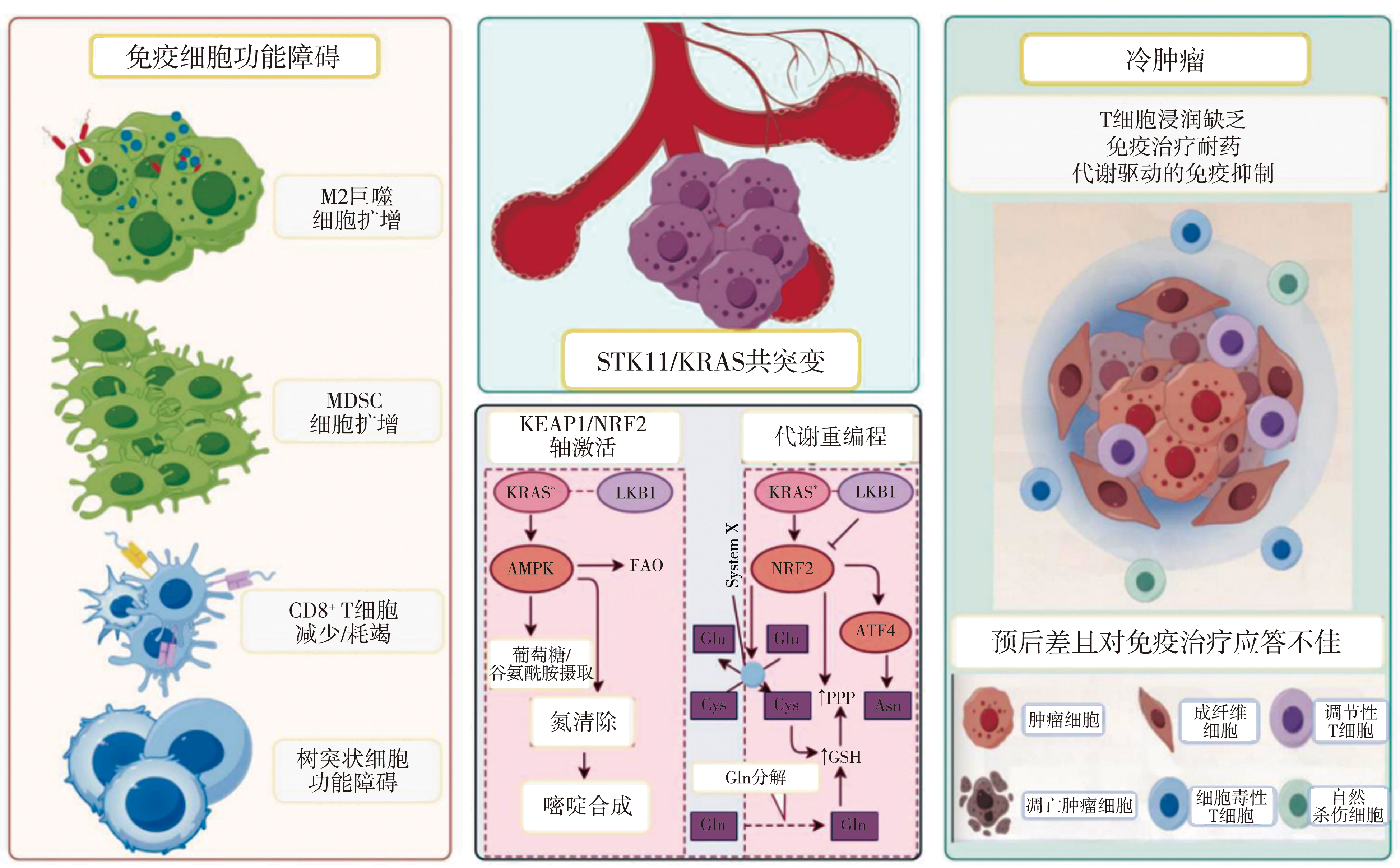
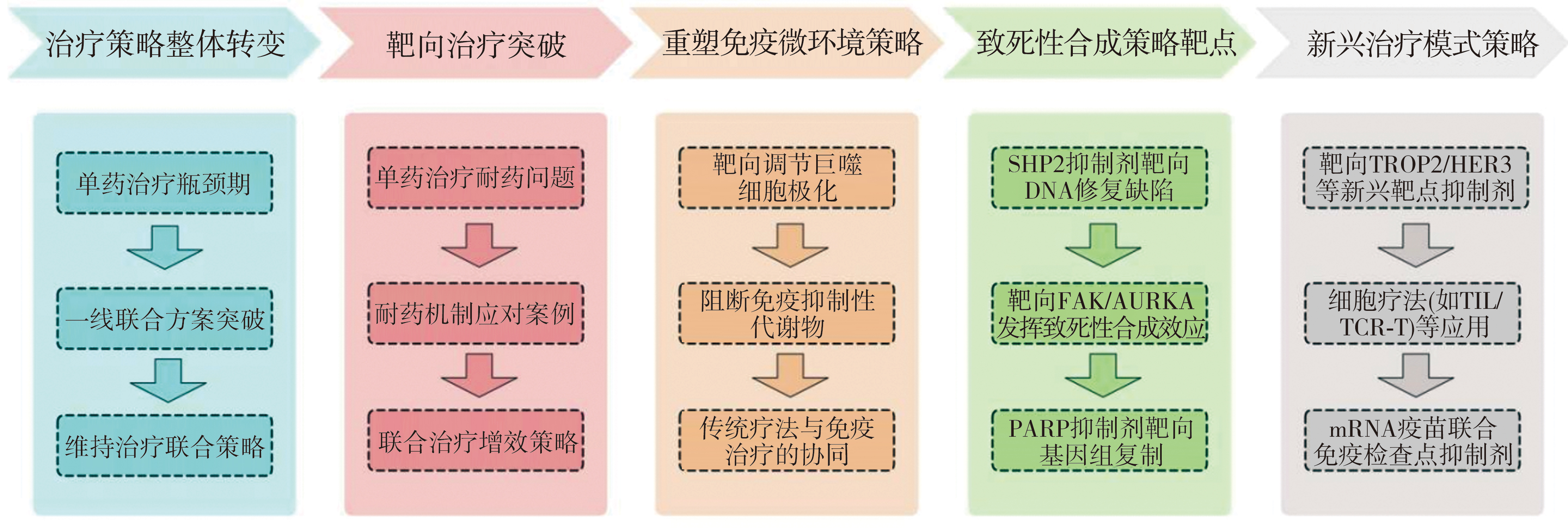
图2
肺癌中STK11/KRAS共突变亚型的治疗策略发展历程 注:FAK为黏着斑激酶;AURKA为极光激酶A;PARP为多腺苷二磷酸核糖聚合酶;TROP2为人滋养层细胞表面抗原2;HER3为人表皮生长因子受体3;TIL为肿瘤浸润淋巴细胞;TCR-T为T细胞受体基因修饰T细胞"
| [1] | Deng J, Thennavan A, Dolgalev I, et al. ULK1 inhibition overcomes compromised antigen presentation and restores antitumor immunity in LKB1 mutant lung cancer[J]. Nat Cancer, 2021, 2(5): 503-514. DOI: 10.1038/s43018-021-00208-6. |
| [2] | Skoulidis F, Goldberg ME, Greenawalt DM, et al. STK11/LKB1 mutations and PD-1 inhibitor resistance in KRAS-mutant lung adenocarcinoma[J]. Cancer Discov, 2018, 8(7): 822-835. DOI:10.1158/2159-8290.CD-18-0099. |
| [3] |
Rosner S, Connor S, Sanber K, et al. Divergent clinical and immunologic outcomes based on STK11 co-mutation status in resectable KRAS-mutant lung cancers following neoadjuvant immune checkpoint blockade[J]. Clin Cancer Res, 2025, 31(2): 339-351. DOI: 10.1158/1078-0432.CCR-24-2983.
pmid: 39545922 |
| [4] |
Kitajima S, Ivanova E, Guo S, et al. Suppression of STING associated with LKB1 loss in KRAS-driven lung cancer[J]. Cancer Discov, 2019, 9(1): 34-45. DOI: 10.1158/2159-8290.CD-18-0689.
pmid: 30297358 |
| [5] | Ricciuti B, Arbour KC, Lin JJ, et al. Diminished efficacy of programmed death-(ligand)1 inhibition in STK11- and KEAP1-mutant lung adenocarcinoma is affected by KRAS mutation status[J]. J Thorac Oncol, 2022, 17(3): 399-410. DOI: 10.1016/j.jtho.2021.10.013. |
| [6] |
Li R, Salehi-Rad R, Crosson W, et al. Inhibition of granulocytic myeloid-derived suppressor cells overcomes resistance to immune checkpoint inhibition in LKB1-deficient non-small cell lung cancer[J]. Cancer Res, 2021, 81(12): 3295-3308. DOI: 10.1158/0008-5472.CAN-20-3564.
pmid: 33853830 |
| [7] |
Qian Y, Galan-Cobo A, Guijarro I, et al. MCT4-dependent lactate secretion suppresses antitumor immunity in LKB1-deficient lung adenocarcinoma[J]. Cancer Cell, 2023, 41(7): 1363-1380.e7. DOI: 10.1016/j.ccell.2023.05.015.
pmid: 37327788 |
| [8] |
Koyama S, Akbay EA, Li YY, et al. STK11/LKB1 deficiency promotes neutrophil recruitment and proinflammatory cytokine production to suppress T-cell activity in the lung tumor microenvironment[J]. Cancer Res, 2016, 76(5): 999-1008. DOI: 10.1158/0008-5472.CAN-15-1439.
pmid: 26833127 |
| [9] | Yang J, Singh N, Xu C, et al. STK11 coordinates IL-4 signaling with metabolic reprogramming to control M2 macrophage polarization and antitumor immunity[J]. Sci Adv, 2025, 11(39): eadx5495. DOI: 10.1126/sciadv.adx5495. |
| [10] |
Galan-Cobo A, Sitthideatphaiboon P, Qu X, et al. LKB1 and KEAP1/NRF2 pathways cooperatively promote metabolic reprogramming with enhanced glutamine dependence in KRAS-mutant lung adenocarcinoma[J]. Cancer Res, 2019, 79(13): 3251-3267. DOI: 10.1158/0008-5472.CAN-18-3527.
pmid: 31040157 |
| [11] | Middleton G, Robbins HL, Fletcher P, et al. A phase Ⅱ trial of mTORC1/2 inhibition in STK11 deficient non small cell lung cancer[J]. NPJ Precis Oncol, 2025, 9(1): 67. DOI: 10.1038/s41698-025-00838-4. |
| [12] | 马正红, 姜超. 非小细胞肺癌KRASG12C突变的研究进展[J]. 国际肿瘤学杂志, 2024, 51(2): 95-98. DOI: 10.3760/cma.j.cn371439-20231008-00013. |
| [13] | Best SA, Gubser PM, Sethumadhavan S, et al. Glutaminase inhibition impairs CD8 T cell activation in STK11-/Lkb1-deficient lung cancer[J]. Cell Metab, 2022, 34(6): 874-887.e6. DOI: 10.1016/j.cmet.2022.04.003. |
| [14] |
Best SA, Ding S, Kersbergen A, et al. Distinct initiating events underpin the immune and metabolic heterogeneity of KRAS-mutant lung adenocarcinoma[J]. Nat Commun, 2019, 10(1): 4190. DOI: 10.1038/s41467-019-12164-y.
pmid: 31519898 |
| [15] | Boeschen M, Kuhn CK, Wirtz H, et al. Comparative bioinformatic analysis of KRAS, STK11 and KEAP1 (co-)mutations in non-small cell lung cancer with a special focus on KRAS G12C[J]. Lung Cancer, 2023, 184: 107361. DOI: 10.1016/j.lungcan.2023.107361. |
| [16] |
Negrao MV, Paula AG, Molkentine D, et al. Impact of co-mutations and transcriptional signatures in non-small cell lung cancer patients treated with adagrasib in the KRYSTAL-1 trial[J]. Clin Cancer Res, 2025, 31(6): 1069-1081. DOI: 10.1158/1078-0432.CCR-24-2310.
pmid: 39804166 |
| [17] |
Ohta T, Iijima K, Miyamoto M, et al. Loss of Keap1 function activates Nrf2 and provides advantages for lung cancer cell growth[J]. Cancer Res, 2008, 68(5): 1303-1309. DOI: 10.1158/0008-5472.CAN-07-5003.
pmid: 18316592 |
| [18] |
Zhang P, Singh A, Yegnasubramanian S, et al. Loss of Keap1 function in prostate cancer cells causes chemo- and radio-resistance and promotes tumor growth[J]. Mol Cancer Ther, 2010, 9(2): 336-346. DOI: 10.1158/1535-7163.MCT-09-0589.
pmid: 20124447 |
| [19] | Wen H, Suzuki T, Zhang A, et al. NRF2 activation in cancer cells suppresses immune infiltration into the tumor microenvironment[J]. iScience, 2025, 28(10): 113519. DOI: 10.1016/j.isci.2025.113519. |
| [20] | Baird L, Yamamoto M. Immunoediting of KEAP1-NRF2 mutant tumours is required to circumvent NRF2-mediated immune surveillance[J]. Redox Biol, 2023, 67: 102904. DOI: 10.1016/j.redox.2023.102904. |
| [21] |
Mitsuishi Y, Taguchi K, Kawatani Y, et al. Nrf2 redirects glucose and glutamine into anabolic pathways in metabolic reprogramming[J]. Cancer Cell, 2012, 22(1): 66-79. DOI: 10.1016/j.ccr.2012.05.016.
pmid: 22789539 |
| [22] | Galan-Cobo A, Vokes NI, Qian Y, et al. KEAP1 and STK11/LKB1 alterations enhance vulnerability to ATR inhibition in KRAS mutant non-small cell lung cancer[J]. Cancer Cell, 2025, 43(8): 1530-1548.e9. DOI: 10.1016/j.ccell.2025.06.011. |
| [23] | Nokin MJ, Mira A, Patrucco E, et al. RAS-ON inhibition overcomes clinical resistance to KRAS G12C-OFF covalent blockade[J]. Nat Commun, 2024, 15(1): 7554. DOI: 10.1038/s41467-024-51828-2. |
| [24] | Skoulidis F, Li BT, Dy GK, et al. Sotorasib for lung cancers with KRAS p.G12C mutation[J]. N Engl J Med, 2021, 384(25): 2371-2381. DOI: 10.1056/NEJMoa2103695. |
| [25] | Jänne PA, Riely GJ, Gadgeel SM, et al. Adagrasib in non-small-cell lung cancer harboring a KRASG12C mutation[J]. N Engl J Med, 2022, 387(2): 120-131. DOI: 10.1056/NEJMoa2204619. |
| [26] | Awad MM, Liu S, Rybkin II, et al. Acquired resistance to KRASG12C inhibition in cancer[J]. N Engl J Med, 2021, 384(25): 2382-2393. DOI: 10.1056/NEJMoa2105281. |
| [27] | Tanaka N, Lin JJ, Li C, et al. Clinical acquired resistance to KRASG12C inhibition through a novel KRAS switch-Ⅱ pocket mutation and polyclonal alterations converging on RAS-MAPK reactivation[J]. Cancer Discov, 2021, 11(8): 1913-1922. DOI: 10.1158/2159-8290.CD-21-0365. |
| [28] |
Arbour KC, Rizvi H, Plodkowski AJ, et al. Treatment outcomes and clinical characteristics of patients with KRAS-G12C-mutant non-small cell lung cancer[J]. Clin Cancer Res, 2021, 27(8): 2209-2215. DOI: 10.1158/1078-0432.CCR-20-4023.
pmid: 33558425 |
| [29] | Zhang F, Wang B, Wu M, et al. Current status of KRAS G12C inhibitors in NSCLC and the potential for combination with anti-PD-(L)1 therapy: a systematic review[J]. Front Immunol, 2025, 16: 1509173. DOI: 10.3389/fimmu.2025.1509173. |
| [30] | Johnson ML, Langdon R, Ellison D, et al. EP08.02-111 RMC-4630, a SHP2 inhibitor, in combination with sotorasib for advanced KRASG12C NSCLC after failure of prior standard therapies: a phase 2 trial[J]. J Thorac Oncol, 2022, 17(9 Suppl): S454-S455. DOI: 10.1016/j.jtho.2022.07.794. |
| [31] | Gulhati P, Schalck A, Jiang S, et al. Targeting T cell checkpoints 41BB and LAG3 and myeloid cell CXCR1/CXCR2 results in antitumor immunity and durable response in pancreatic cancer[J]. Nat Cancer, 2023, 4(1): 62-80. DOI: 10.1038/s43018-022-00500-z. |
| [32] | Hirayama A, Tanaka K, Tsutsumi H, et al. Regulation of PD-L1 expression in non-small cell lung cancer by interleukin-1β[J]. Front Immunol, 2023, 14: 1192861. DOI: 10.3389/fimmu.2023.1192861. |
| [33] |
Ndembe G, Intini I, Moro M, et al. Caloric restriction and metformin selectively improved LKB1-mutated NSCLC tumor response to chemo- and chemo-immunotherapy[J]. J Exp Clin Cancer Res, 2024, 43(1): 6. DOI: 10.1186/s13046-023-02933-5.
pmid: 38163906 |
| [34] | Qiao T, Xiong Y, Feng Y, et al. Inhibition of LDH-A by oxamate enhances the efficacy of anti-PD-1 treatment in an NSCLC humanized mouse model[J]. Front Oncol, 2021, 11: 632364. DOI: 10.3389/fonc.2021.632364. |
| [35] |
Hong L, Aminu M, Li S, et al. Efficacy and clinicogenomic correlates of response to immune checkpoint inhibitors alone or with chemotherapy in non-small cell lung cancer[J]. Nat Commun, 2023, 14(1): 695. DOI: 10.1038/s41467-023-36328-z.
pmid: 36755027 |
| [36] |
Mukhopadhyay S, Huang HY, Lin Z, et al. Genome-wide CRISPR screens identify multiple synthetic lethal targets that enhance KRASG12C inhibitor efficacy[J]. Cancer Res, 2023, 83(24): 4095-4111. DOI: 10.1158/0008-5472.CAN-23-2729.
pmid: 37729426 |
| [37] | Fu NJ, Sheng YW, Fan Z, et al. Synthetic lethality of SHP2 and XIAP suppresses proliferation and metastasis in KRAS-mutant nonsmall cell lung cancer[J]. Adv Sci (Weinh), 2025, 12(15): e2411642. DOI: 10.1002/advs.202411642. |
| [38] | Gilbert-Ross M, Konen J, Koo J, et al. Targeting adhesion signaling in KRAS, LKB1 mutant lung adenocarcinoma[J]. JCI Insight, 2017, 2(5): e90487. DOI: 10.1172/jci.insight.90487. |
| [39] |
Deng B, Liu F, Chen N, et al. AURKA emerges as a vulnerable target for KEAP1-deficient non-small cell lung cancer by activation of asparagine synthesis[J]. Cell Death Dis, 2024, 15(3): 233. DOI: 10.1038/s41419-024-06577-x.
pmid: 38521813 |
| [40] | Guo H, Xu Z, Li K, et al. Clinical applications of antibody-drug conjugates in advanced non-small cell lung cancer[J]. Front Immunol, 2026, 17: 1787148. DOI: 10.3389/fimmu.2026.1787148. |
| [41] | Albarrán V, San Román M, Pozas J, et al. Adoptive T cell therapy for solid tumors: current landscape and future challenges[J]. Front Immunol, 2024, 15: 1352805. DOI: 10.3389/fimmu.2024.1352805. |
| [42] |
Ricciuti B, Garassino MC. Precision immunotherapy for STK11/KEAP1-mutant NSCLC[J]. J Thorac Oncol, 2024, 19(6): 877-882. DOI: 10.1016/j.jtho.2024.03.002.
pmid: 38849167 |
| [43] | Albarrán-Fernández V, Angelats L, Delgado J, et al. Unlocking the potential of engineered immune cell therapy for solid tumors[J]. Nat Commun, 2025, 16(1): 1144. DOI: 10.1038/s41467-025-56527-0. |
| [44] | He M, Lv W, Rao Y. Opportunities and challenges of small molecule induced targeted protein degradation[J]. Front Cell Dev Biol, 2021, 9: 685106. DOI: 10.3389/fcell.2021.685106. |
| [1] | 蓝柳, 郭敏, 韦婷婷, 赵迎喜, 龙亚秀. 全程特瑞普利单抗联合诱导化疗及同步放化疗治疗局部晚期鼻咽癌的疗效及安全性分析[J]. 国际肿瘤学杂志, 2026, 53(9): 513-520. |
| [2] | 方海平, 黄毅, 王根和. 晚期三阴性乳腺癌免疫治疗研究进展[J]. 国际肿瘤学杂志, 2026, 53(9): 547-553. |
| [3] | 毕士祥, 尹贻波, 刘文健. 胸段食管鳞状细胞癌术后复发转移模式研究进展[J]. 国际肿瘤学杂志, 2026, 53(9): 554-558. |
| [4] | 张婕, 陈锦澍, 李园, 娄彦妮, 刘青. 肿瘤源性外泌体在肿瘤骨转移中的作用机制与转化前景[J]. 国际肿瘤学杂志, 2026, 53(9): 572-576. |
| [5] | 高鉴, 祝伟. 胶质母细胞瘤放疗后衰老微环境的形成机制及靶向治疗研究进展[J]. 国际肿瘤学杂志, 2026, 53(8): 485-490. |
| [6] | 曾娇, 丁江华. 高剂量伏美替尼在耐药性EGFR突变型NSCLC中的应用进展[J]. 国际肿瘤学杂志, 2026, 53(8): 491-495. |
| [7] | 车禹男, 陈翔, 储旭, 卢道峰, 蒋堃. 肿瘤微环境在前列腺癌发病机制中的研究进展[J]. 国际肿瘤学杂志, 2026, 53(8): 502-507. |
| [8] | 温馨格, 马飞飞, 孙诚诚, 徐则宇, 崔言刚, 丛蕾. 低位直肠癌全程新辅助治疗联合免疫治疗后实现临床完全缓解1例并文献复习[J]. 国际肿瘤学杂志, 2026, 53(8): 508-512. |
| [9] | 马池銮, 贾殿军, 魏冬冬, 王井润, 李欣萍, 赵博艳, 赵悦. 放疗同步替加氟栓联合免疫检查点抑制剂治疗老年食管癌的疗效与安全性[J]. 国际肿瘤学杂志, 2026, 53(7): 426-433. |
| [10] | 高玉琼, 刁杰, 殷红. 溶瘤病毒在逆转肿瘤免疫治疗耐药中的研究进展[J]. 国际肿瘤学杂志, 2026, 53(7): 434-438. |
| [11] | 张天焘, 徐世红, 王培鑫, 王小强, 李楷, 赵军. 基于上皮间质转化探讨骨肉瘤恶性生物学行为相关研究进展[J]. 国际肿瘤学杂志, 2026, 53(7): 439-444. |
| [12] | 李岩松, 贾军梅. 老年营养风险指数在晚期NSCLC免疫治疗预后及免疫相关不良反应中的预测价值[J]. 国际肿瘤学杂志, 2026, 53(6): 355-360. |
| [13] | 周黛妍, 曾欣欣, 郝梦迪, 刘维璐, 谢沛, 张绪慧. 类器官技术在肺癌精准治疗中的创新应用与挑战[J]. 国际肿瘤学杂志, 2026, 53(6): 366-369. |
| [14] | 孙晓宁, 何盼, 王宪, 姚淑娟. 卵巢癌中癌相关成纤维细胞的免疫调节机制与临床意义[J]. 国际肿瘤学杂志, 2026, 53(6): 376-380. |
| [15] | 于欣静, 杨阳, 李殊瑶, 乔晓娟. CD300家族及其调控免疫细胞抗肿瘤作用机制的研究进展[J]. 国际肿瘤学杂志, 2026, 53(5): 296-300. |
| 阅读次数 | ||||||
|
全文 |
|
|||||
|
摘要 |
|
|||||
